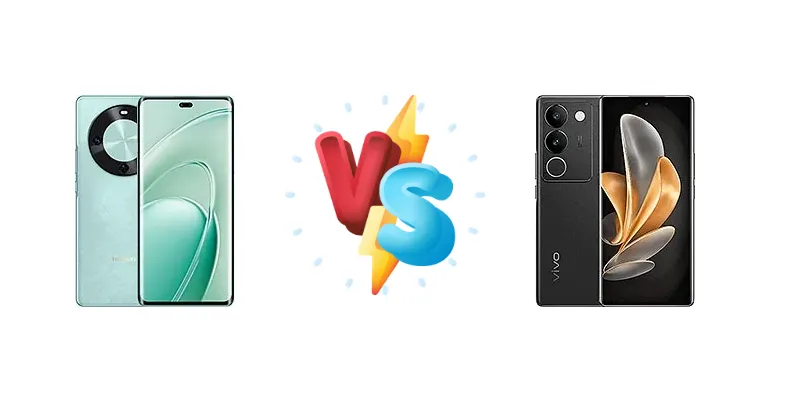
The Huawei Enjoy 70X and vivo S17t represent compelling options in the increasingly competitive mid-range smartphone market. The Enjoy 70X leverages Huawei’s in-house Kirin 8000A chipset, while the S17t opts for the MediaTek Dimensity 8050. This comparison dissects their key differences, focusing on performance, charging, and overall user experience to determine which device offers the best value.
🏆 Quick Verdict
For the average user prioritizing fast charging and a more modern chipset architecture, the vivo S17t emerges as the stronger contender. Its 80W charging significantly outperforms the Enjoy 70X’s 40W, and the Dimensity 8050 offers a performance edge, despite the Kirin 8000A’s respectable capabilities.
| Network |
|---|
| 2G bands | GSM 850 / 900 / 1800 / 1900 | GSM 850 / 900 / 1800 / 1900 |
| 3G bands | HSDPA 850 / 900 / 2100 | HSDPA 850 / 900 / 1700(AWS) / 1900 / 2100 |
| 4G bands | LTE | 1, 3, 4, 5, 8, 28, 34, 38, 39, 40, 41 |
| 5G bands | SA/NSA | 1, 3, 5, 8, 28, 38, 40, 41, 77, 78 SA/NSA |
| Speed | HSPA, LTE, 5G | HSPA, LTE, 5G |
| Technology | GSM / HSPA / LTE / 5G | GSM / CDMA / HSPA / CDMA2000 / LTE / 5G |
| Launch |
|---|
| Announced | 2025, January 03 | 2023, May 31 |
| Status | Available. Released 2025, January 13 | Available. Released 2023, June 08 |
| Body |
|---|
| Build | Glass front, plastic frame, plastic back or silicone polymer back (eco leather) | - |
| Dimensions | 164 x 74.9 x 8 mm (6.46 x 2.95 x 0.31 in) | 164.2 x 74.4 x 7.5 mm (6.46 x 2.93 x 0.30 in) |
| SIM | Nano-SIM + Nano-SIM | Nano-SIM + Nano-SIM |
| Weight | 189 g or 193 g (6.67 oz) | 186 g (6.56 oz) |
| Display |
|---|
| Resolution | 1224 x 2700 pixels (~437 ppi density) | 1260 x 2800 pixels, 20:9 ratio (~453 ppi density) |
| Size | 6.78 inches, 111.5 cm2 (~90.8% screen-to-body ratio) | 6.78 inches, 111.0 cm2 (~90.8% screen-to-body ratio) |
| Type | AMOLED, 120Hz, HDR Vivid | AMOLED, 1B colors, 120Hz, HDR10+, 1300 nits (peak) |
| Platform |
|---|
| CPU | Hexa-core (3x2.19 GHz Cortex-A77 & 3x1.84 GHz Cortex-A55) | Octa-core (1x3.0 GHz Cortex-A78 & 3x2.6 GHz Cortex-A78 & 4x2.0 GHz Cortex-A55) |
| Chipset | Kirin 8000A - Enjoy 70XKirin 8000 - Enjoy 70X Premium | Mediatek Dimensity 8050 (6 nm) |
| GPU | Mali-G610 | Mali-G77 MC9 |
| OS | HarmonyOS 4.2 | Android 13, OriginOS 3 |
| Memory |
|---|
| Card slot | No | No |
| Internal | 128GB 8GB RAM, 256GB 8GB RAM, 512GB 8GB RAM | 512GB 12GB RAM |
| Main Camera |
|---|
| Dual | 50 MP, f/1.9, 23mm (wide), 1/1.56", 1.0µm, dual pixel PDAF
Auxiliary lens | 50 MP, f/1.9, (wide), 1/1.56", 1.0µm, PDAF, OIS
8 MP, f/2.2, (ultrawide) |
| Features | Color spectrum sensor, LED flash, HDR, panorama | Color spectrum sensor, Ring-LED flash, panorama, HDR |
| Video | 4K, 1080p | 4K@30fps, 1080p@30fps |
| Selfie camera |
|---|
| Features | - | Dual-LED flash, HDR |
| Single | 8 MP, f/2.0, (wide) | 50 MP, f/2.0, 22mm (wide), AF |
| Video | 4K, 1080p | 1080p@30fps |
| Sound |
|---|
| 35mm jack | No | No |
| Loudspeaker | Yes, with stereo speakers | Yes |
| Comms |
|---|
| Bluetooth | 5.1, A2DP, LE | 5.2, A2DP, LE, aptX HD |
| NFC | Yes | Yes |
| Positioning | GPS, GLONASS, GALILEO, BDS, QZSS | GPS (L1), GLONASS (G1), BDS (B1I), GALILEO (E1), QZSS (L1) |
| Radio | No | No |
| USB | USB Type-C 2.0 | USB Type-C 2.0, OTG |
| WLAN | Wi-Fi 802.11 a/b/g/n/ac, dual-band | Wi-Fi 802.11 a/b/g/n/ac/6, dual-band, Wi-Fi Direct |
| Features |
|---|
| Sensors | Fingerprint (under display, optical), accelerometer, gyro, compass | Fingerprint (under display, optical), accelerometer, gyro, proximity, compass |
| Battery |
|---|
| Charging | 40W wired | 80W wired, 70% in 30 min |
| Type | Si/C Li-Ion 6100 mAh | 4600 mAh |
| Misc |
|---|
| Colors | Black, White, Blue, Green, Gold | Black, Blue, Pink |
| Models | BRE-AL80, BRE-AL80a | - |
| Price | - | About 400 EUR |
Huawei Enjoy 70X
- Potential Huawei ecosystem integration
- Respectable performance for everyday tasks
- May be more affordable
- Older chipset architecture
- Slower 40W charging
- Potential limitations with Google Mobile Services
vivo S17t
- Faster 80W charging
- More modern Dimensity 8050 chipset
- Improved multi-core performance
- May be slightly more expensive
- Potential for software bloatware (typical of vivo)
- Camera performance may not be exceptional
Display Comparison
Neither device’s display specifications are provided, so a direct comparison is limited. However, given the market positioning, both likely feature LCD panels. The vivo S17t, being a newer release, may benefit from improved color calibration and potentially higher peak brightness. The absence of LTPO technology on either device suggests standard refresh rates, impacting smoothness during scrolling and animations.
Camera Comparison
Without detailed camera specifications, a precise comparison is difficult. However, the market segment suggests both phones will prioritize software processing over cutting-edge hardware. The absence of information regarding sensor sizes and optical image stabilization (OIS) suggests neither phone will excel in low-light photography. The S17t may benefit from MediaTek’s image signal processor (ISP) advancements, potentially offering slightly better image quality and video recording capabilities. The inclusion of a 2MP macro camera on either device is likely a marketing tactic, offering limited practical benefit due to its low resolution and fixed focus.
Performance
The vivo S17t’s MediaTek Dimensity 8050, fabricated on a 6nm process, holds a clear architectural advantage over the Huawei Enjoy 70X’s Kirin 8000A. The Dimensity 8050’s octa-core configuration, featuring a Cortex-A78 prime core clocked at 3.0 GHz and additional Cortex-A78 performance cores, provides superior multi-core performance compared to the Enjoy 70X’s hexa-core setup with older Cortex-A77 cores. This translates to faster app loading times, smoother multitasking, and improved gaming performance on the S17t. While the Kirin 8000A is still capable, the Dimensity 8050’s newer architecture and higher clock speeds offer a noticeable performance uplift.
Battery Life
The battery capacity for both devices is unknown. However, the charging speed is a significant differentiator. The vivo S17t’s 80W wired charging is a substantial advantage, capable of reaching 70% charge in just 30 minutes. This is double the speed of the Huawei Enjoy 70X’s 40W charging. Even if the Enjoy 70X has a slightly larger battery capacity, the S17t’s faster charging will minimize downtime and provide a more convenient user experience. The faster charging also implies better power delivery circuitry within the S17t.
Buying Guide
Buy the Huawei Enjoy 70X if you prioritize brand loyalty within the Huawei ecosystem and are comfortable with potentially limited access to Google Mobile Services. It’s a solid choice for everyday tasks and light gaming. Buy the vivo S17t if you value faster charging speeds, a more contemporary chipset with broader compatibility, and a smoother overall user experience, particularly for demanding applications and gaming.
Frequently Asked Questions
❓ Does the Kirin 8000A chipset struggle with graphically intensive games like Genshin Impact?
While the Kirin 8000A is capable, it will likely require reduced graphics settings and frame rate caps to maintain a stable experience in demanding games like Genshin Impact. The Dimensity 8050 in the vivo S17t offers a more comfortable gaming experience with higher sustained frame rates and less thermal throttling.
❓ Is the 80W charging on the vivo S17t likely to degrade the battery health faster?
Modern smartphones employ sophisticated charging algorithms to mitigate battery degradation from fast charging. While 80W is faster than 40W, the S17t’s charging circuitry is designed to protect the battery. The convenience of faster charging often outweighs the minimal potential impact on long-term battery health.
❓ Will I be able to use all of my favorite apps on the Huawei Enjoy 70X without issues related to Google Mobile Services?
The Huawei Enjoy 70X may not have full access to Google Mobile Services (GMS). This means you may need to rely on Huawei’s AppGallery and sideloading apps, which can be less convenient and may not support all applications. Compatibility should be verified before purchase.