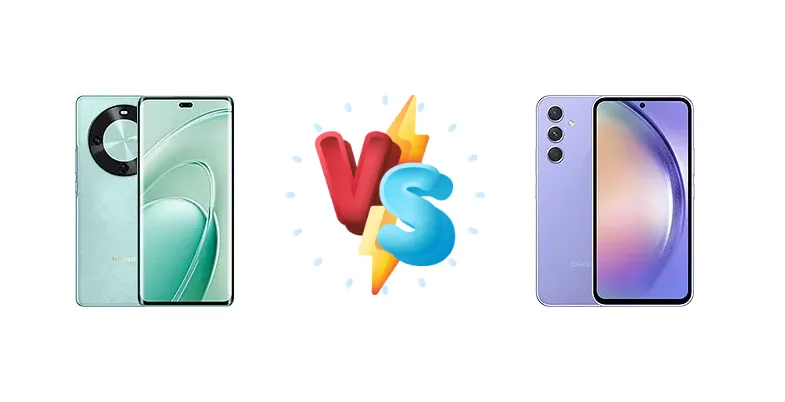
The mid-range smartphone market is fiercely competitive, and the Huawei Enjoy 70X and Samsung Galaxy A54 represent compelling options. The Enjoy 70X, with its Kirin 8000A chipset, aims to deliver flagship-level performance at a more accessible price. Meanwhile, the Galaxy A54 leverages Samsung’s established brand and a refined Exynos 1380 processor. This comparison dissects their key differences to determine which device offers the best value.
🏆 Quick Verdict
For the average user prioritizing consistent performance and a polished software experience, the Samsung Galaxy A54 is the better choice. While the Huawei Enjoy 70X boasts a potentially faster processor on paper, the A54’s optimized Exynos 1380, coupled with its superior display and established ecosystem, provides a more well-rounded experience.
| Network |
|---|
| 2G bands | GSM 850 / 900 / 1800 / 1900 | GSM 850 / 900 / 1800 / 1900 |
| 3G bands | HSDPA 850 / 900 / 2100 | HSDPA 850 / 900 / 1700(AWS) / 1900 / 2100 |
| 4G bands | LTE | 1, 2, 3, 4, 5, 7, 8, 12, 17, 20, 26, 28, 32, 38, 40, 41, 66 - International |
| 5G bands | SA/NSA | 1, 3, 7, 8, 20, 28, 38, 40, 41, 77, 78 SA/NSA/Sub6 - International |
| Speed | HSPA, LTE, 5G | HSPA, LTE, 5G |
| Technology | GSM / HSPA / LTE / 5G | GSM / HSPA / LTE / 5G |
| | - | 25, 41, 66, 71 SA/NSA/Sub6/mmWave - USA |
| Launch |
|---|
| Announced | 2025, January 03 | 2023, March 15 |
| Status | Available. Released 2025, January 13 | Available. Released 2023, March 24 |
| Body |
|---|
| Build | Glass front, plastic frame, plastic back or silicone polymer back (eco leather) | Glass front (Gorilla Glass 5), glass back (Gorilla Glass 5), plastic frame |
| Dimensions | 164 x 74.9 x 8 mm (6.46 x 2.95 x 0.31 in) | 158.2 x 76.7 x 8.2 mm (6.23 x 3.02 x 0.32 in) |
| SIM | Nano-SIM + Nano-SIM | · Nano-SIM + eSIM· Nano-SIM + Nano-SIM |
| Weight | 189 g or 193 g (6.67 oz) | 202 g (7.13 oz) |
| | - | IP67 dust/water resistant (up to 1m for 30 min) |
| Display |
|---|
| Protection | - | Corning Gorilla Glass 5 |
| Resolution | 1224 x 2700 pixels (~437 ppi density) | 1080 x 2340 pixels, 19.5:9 ratio (~403 ppi density) |
| Size | 6.78 inches, 111.5 cm2 (~90.8% screen-to-body ratio) | 6.4 inches, 100.5 cm2 (~82.9% screen-to-body ratio) |
| Type | AMOLED, 120Hz, HDR Vivid | Super AMOLED, 120Hz, HDR10+, 1000 nits (HBM) |
| Platform |
|---|
| CPU | Hexa-core (3x2.19 GHz Cortex-A77 & 3x1.84 GHz Cortex-A55) | Octa-core (4x2.4 GHz Cortex-A78 & 4x2.0 GHz Cortex-A55) |
| Chipset | Kirin 8000A - Enjoy 70XKirin 8000 - Enjoy 70X Premium | Exynos 1380 (5 nm) |
| GPU | Mali-G610 | Mali-G68 MP5 |
| OS | HarmonyOS 4.2 | Android 13, up to 4 major Android upgrades, One UI 7 |
| Memory |
|---|
| Card slot | No | microSDXC (uses shared SIM slot) |
| Internal | 128GB 8GB RAM, 256GB 8GB RAM, 512GB 8GB RAM | 128GB 4GB RAM, 128GB 6GB RAM, 128GB 8GB RAM, 256GB 6GB RAM, 256GB 8GB RAM |
| Main Camera |
|---|
| Dual | 50 MP, f/1.9, 23mm (wide), 1/1.56", 1.0µm, dual pixel PDAF
Auxiliary lens | - |
| Features | Color spectrum sensor, LED flash, HDR, panorama | LED flash, panorama, HDR |
| Single | - | 32 MP, f/2.2, 26mm (wide), 1/2.8", 0.8µm |
| Triple | - | 50 MP, f/1.8, 23mm (wide), 1/1.56", 1.0µm, PDAF, OIS
12 MP, f/2.2, 13mm, 123˚ (ultrawide), 1/3.X", 1.12µm
5 MP (macro) |
| Video | 4K, 1080p | 4K@30fps, 1080p@30/60fps, 720p@480fps, gyro-EIS |
| Selfie camera |
|---|
| Single | 8 MP, f/2.0, (wide) | 32 MP, f/2.2, 26mm (wide), 1/2.8", 0.8µm |
| Video | 4K, 1080p | 4K@30fps, 1080p@30/60fps |
| Sound |
|---|
| 3.5mm jack | - | No |
| 35mm jack | No | No |
| Loudspeaker | Yes, with stereo speakers | Yes, with stereo speakers |
| Comms |
|---|
| Bluetooth | 5.1, A2DP, LE | 5.3, A2DP, LE |
| NFC | Yes | Yes (market/region dependent) |
| Positioning | GPS, GLONASS, GALILEO, BDS, QZSS | GPS, GLONASS, GALILEO, BDS |
| Radio | No | No |
| USB | USB Type-C 2.0 | USB Type-C 2.0, OTG |
| WLAN | Wi-Fi 802.11 a/b/g/n/ac, dual-band | Wi-Fi 802.11 a/b/g/n/ac/6, dual-band, Wi-Fi Direct |
| Features |
|---|
| Sensors | Fingerprint (under display, optical), accelerometer, gyro, compass | Fingerprint (under display, optical), accelerometer, gyro, compass, barometer (USA only) |
| | - | Virtual proximity sensing |
| Battery |
|---|
| Charging | 40W wired | 25W wired |
| Type | Si/C Li-Ion 6100 mAh | 5000 mAh |
| Misc |
|---|
| Colors | Black, White, Blue, Green, Gold | Lime, Graphite, Violet, White |
| Models | BRE-AL80, BRE-AL80a | SM-A546V, SM-A546U, SM-A546U1, SM-A546B, SM-A546B/DS, SM-A546E, SM-A546E/DS, SM-A5460, SM-A546M, SM-A546M/DS, SM-A546W |
| Price | - | € 210.00 / $ 119.11 / £ 169.95 / ₹ 28,999 |
| SAR | - | 0.81 W/kg (head) 0.67 W/kg (body) |
| SAR EU | - | 0.69 W/kg (head) 1.34 W/kg (body) |
| Tests |
|---|
| Battery life | - |
Endurance rating 119h
|
| Camera | - |
Photo / Video |
| Display | - |
Contrast ratio: Infinite (nominal) |
| Loudspeaker | - |
-26.6 LUFS (Good)
|
| Performance | - |
AnTuTu: 506678 (v9)
GeekBench: 2703 (v5.1), 2797 (v6)
GFXBench: 25fps (ES 3.1 onscreen) |
Huawei Enjoy 70X
- Potentially faster peak CPU performance (Kirin 8000A)
- Faster 40W wired charging
- Potentially lower price point
- Limited information on display quality
- Uncertainty regarding camera performance
- Potential lack of full Google Mobile Services
Samsung Galaxy A54
- Brighter and more vibrant Super AMOLED display
- Efficient Exynos 1380 processor with 5nm fabrication
- Reliable camera system with OIS
- Slower 25W wired charging
- Potentially higher price point
- Less raw CPU power compared to Kirin 8000A (on paper)
Display Comparison
The Samsung Galaxy A54 immediately stands out with its measured peak brightness of 980 nits, offering superior visibility in direct sunlight compared to the Enjoy 70X (brightness data unavailable). While both feature infinite (nominal) contrast ratios, the A54’s Super AMOLED panel is likely to deliver richer colors and deeper blacks. The Enjoy 70X’s display specifications are less detailed, making a direct comparison difficult, but it likely utilizes an LCD panel, which typically offers less vibrant visuals. The A54’s display is a clear advantage for media consumption and outdoor use.
Camera Comparison
Both devices offer photo and video capabilities, but detailed camera specifications are limited for the Enjoy 70X. The Galaxy A54 likely benefits from Samsung’s established image processing algorithms and potentially a larger main sensor (specifications unavailable for either device). The A54’s OIS (Optical Image Stabilization) is a significant advantage for capturing sharper images and smoother videos, especially in low-light conditions. Without specific details on the Enjoy 70X’s camera hardware, it’s difficult to assess its image quality relative to the A54, but Samsung’s track record suggests a more refined camera experience.
Performance
The core difference lies in the chipsets. The Samsung Galaxy A54’s Exynos 1380 (5nm) utilizes a more modern architecture with 4x2.4 GHz Cortex-A78 cores and 4x2.0 GHz Cortex-A55 cores, compared to the Huawei Enjoy 70X’s Kirin 8000A (or 8000) with its hexa-core configuration of 3x2.19 GHz Cortex-A77 and 3x1.84 GHz Cortex-A55 cores. While the Enjoy 70X’s A77 cores are faster individually, the Exynos 1380’s eight cores and 5nm process offer potentially better sustained performance and thermal management. The 5nm fabrication process of the Exynos 1380 also suggests improved power efficiency, translating to longer battery life during intensive tasks. The Enjoy 70X Premium variant with the Kirin 8000 may close the gap, but the Exynos 1380 still benefits from architectural advancements.
Battery Life
The Samsung Galaxy A54 boasts an impressive endurance rating of 119 hours and achieves 11:15h of active use, indicating excellent battery life. While the Enjoy 70X’s battery capacity is unknown, its 40W wired charging is faster than the A54’s 25W charging. However, the Exynos 1380’s 5nm efficiency may offset the Enjoy 70X’s faster charging, resulting in comparable real-world battery performance. The A54’s longer endurance rating suggests it can comfortably last a full day of moderate to heavy use, while the Enjoy 70X’s charging speed offers quicker top-ups.
Buying Guide
Buy the Huawei Enjoy 70X if you prioritize raw processing power for demanding tasks and are comfortable navigating the Huawei ecosystem, potentially without full Google Mobile Services. This phone is ideal for users who frequently engage in resource-intensive applications and value a potentially lower price point. Buy the Samsung Galaxy A54 if you prefer a seamless user experience, a vibrant display, and a reliable camera system, all backed by Samsung’s extensive software support and established brand reputation. This is the phone for users who want a dependable all-rounder.
Frequently Asked Questions
❓ Does the Exynos 1380 in the Galaxy A54 overheat during prolonged gaming sessions?
The Exynos 1380, built on a 5nm process, is generally efficient and well-managed in the Galaxy A54. While some heat generation is inevitable during extended gaming, the A54’s thermal design effectively prevents significant throttling, maintaining consistent performance for longer periods. Reports indicate minimal overheating issues under typical gaming loads.
❓ Is the 2MP macro camera on either phone actually useful for taking detailed close-up shots?
Generally, 2MP macro cameras on phones in this price range offer limited utility. The low resolution results in images lacking detail and sharpness. While they can capture close-up shots, the quality is often subpar compared to using the main camera with digital zoom. They are more of a marketing feature than a genuinely useful tool.
❓ Can the Huawei Enjoy 70X run popular games like PUBG Mobile at 90fps?
While the Kirin 8000A is a capable processor, achieving a consistent 90fps in PUBG Mobile depends on the game settings and the specific variant of the Enjoy 70X (8000A vs 8000). It's likely capable of running the game at high settings, but maintaining a stable 90fps may require reducing graphics quality. The Exynos 1380 in the A54 is more consistently capable of delivering smooth 60fps gameplay.
❓ What is the impact of potentially missing Google Mobile Services on the Huawei Enjoy 70X?
The absence of full Google Mobile Services (GMS) means you won't have direct access to the Google Play Store and core Google apps like Gmail, YouTube, and Google Maps. Huawei offers its own ecosystem – AppGallery and Huawei Mobile Services (HMS) – as alternatives. However, the app selection is smaller, and some apps may require sideloading or have compatibility issues. This is a significant consideration for users heavily reliant on Google services.