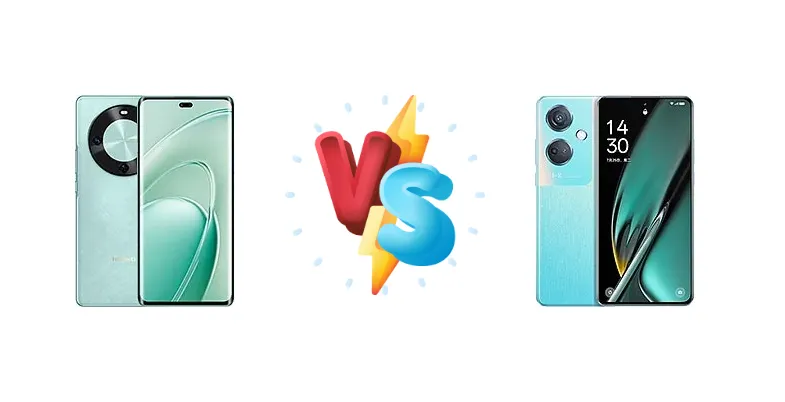
The mid-range smartphone market is fiercely competitive, and the Huawei Enjoy 70X and Oppo K11 represent compelling options for budget-conscious buyers. The Enjoy 70X leverages Huawei’s in-house Kirin 8000A chipset, while the Oppo K11 opts for Qualcomm’s Snapdragon 782G. This comparison dissects their key differences, focusing on performance, charging speed, and overall value to help you make the right choice.
🏆 Quick Verdict
For most users, the Oppo K11 emerges as the stronger contender. Its Snapdragon 782G offers a more modern architecture and generally superior performance, coupled with the game-changing 100W SuperVOOC charging. While the Enjoy 70X has its merits, the K11’s speed and convenience provide a more compelling user experience.
| Network |
|---|
| 2G bands | GSM 850 / 900 / 1800 / 1900 | GSM 850 / 900 / 1800 / 1900 |
| 3G bands | HSDPA 850 / 900 / 2100 | HSDPA 850 / 900 / 1700(AWS) / 1900 / 2100 |
| 4G bands | LTE | 1, 2, 3, 4, 5, 7, 8, 28, 34, 38, 39, 40, 41 |
| 5G bands | SA/NSA | 1, 3, 5, 8, 28, 40, 41, 77, 78 SA/NSA |
| Speed | HSPA, LTE, 5G | HSPA, LTE, 5G |
| Technology | GSM / HSPA / LTE / 5G | GSM / CDMA / HSPA / CDMA2000 / LTE / 5G |
| Launch |
|---|
| Announced | 2025, January 03 | 2023, July 25 |
| Status | Available. Released 2025, January 13 | Available. Released 2023, August 01 |
| Body |
|---|
| Build | Glass front, plastic frame, plastic back or silicone polymer back (eco leather) | Glass front, plastic frame, plastic back |
| Dimensions | 164 x 74.9 x 8 mm (6.46 x 2.95 x 0.31 in) | 162.7 x 75.5 x 8.2 mm (6.41 x 2.97 x 0.32 in) |
| SIM | Nano-SIM + Nano-SIM | Nano-SIM + Nano-SIM |
| Weight | 189 g or 193 g (6.67 oz) | 184 g (6.49 oz) |
| Display |
|---|
| Protection | - | Corning Gorilla Glass 5 |
| Resolution | 1224 x 2700 pixels (~437 ppi density) | 1080 x 2400 pixels, 20:9 ratio (~393 ppi density) |
| Size | 6.78 inches, 111.5 cm2 (~90.8% screen-to-body ratio) | 6.7 inches, 108.4 cm2 (~88.2% screen-to-body ratio) |
| Type | AMOLED, 120Hz, HDR Vivid | AMOLED, 1B colors, 120Hz, HDR10+, 500 nits (typical), 1100 nits (peak) |
| Platform |
|---|
| CPU | Hexa-core (3x2.19 GHz Cortex-A77 & 3x1.84 GHz Cortex-A55) | Octa-core (1x2.7 GHz Cortex-A78 & 3x2.4 GHz Cortex-A78 & 4x1.8 GHz Cortex-A55) |
| Chipset | Kirin 8000A - Enjoy 70XKirin 8000 - Enjoy 70X Premium | Qualcomm Snapdragon 782G (6 nm) |
| GPU | Mali-G610 | Adreno 642L |
| OS | HarmonyOS 4.2 | Android 13, ColorOS 13.1 |
| Memory |
|---|
| Card slot | No | microSDXC (dedicated slot) |
| Internal | 128GB 8GB RAM, 256GB 8GB RAM, 512GB 8GB RAM | 256GB 8GB RAM, 256GB 12GB RAM, 512GB 12GB RAM |
| Main Camera |
|---|
| Dual | 50 MP, f/1.9, 23mm (wide), 1/1.56", 1.0µm, dual pixel PDAF
Auxiliary lens | - |
| Features | Color spectrum sensor, LED flash, HDR, panorama | LED flash, HDR, panorama |
| Triple | - | 50 MP, f/1.8, 24mm (wide), 1/1.56", 1.0µm, multi-directional PDAF, OIS
8 MP, f/2.2, 112˚ (ultrawide), 1/4.0", 1.12µm
2 MP (macro) |
| Video | 4K, 1080p | 4K@30fps, 1080p@30/60/120fps, gyro-EIS |
| Selfie camera |
|---|
| Features | - | HDR |
| Single | 8 MP, f/2.0, (wide) | 16 MP, f/2.4, 24mm (wide), 1.0µm |
| Video | 4K, 1080p | 1080p@30fps, gyro-EIS |
| Sound |
|---|
| 35mm jack | No | No |
| Loudspeaker | Yes, with stereo speakers | Yes, with stereo speakers |
| Comms |
|---|
| Bluetooth | 5.1, A2DP, LE | 5.2, A2DP, LE, aptX HD |
| NFC | Yes | Yes |
| Positioning | GPS, GLONASS, GALILEO, BDS, QZSS | GPS, GLONASS, GALILEO, BDS, QZSS |
| Radio | No | No |
| USB | USB Type-C 2.0 | USB Type-C 2.0, OTG |
| WLAN | Wi-Fi 802.11 a/b/g/n/ac, dual-band | Wi-Fi 802.11 a/b/g/n/ac/6, dual-band, Wi-Fi Direct |
| Features |
|---|
| Sensors | Fingerprint (under display, optical), accelerometer, gyro, compass | Fingerprint (under display, optical), accelerometer, gyro, proximity, compass |
| Battery |
|---|
| Charging | 40W wired | 100W wired, 100% in 26 min |
| Type | Si/C Li-Ion 6100 mAh | Li-Po 5000 mAh |
| Misc |
|---|
| Colors | Black, White, Blue, Green, Gold | Moonshadow Gray; Glacier Blue |
| Models | BRE-AL80, BRE-AL80a | PJC110 |
Huawei Enjoy 70X
- Potentially refined Huawei software experience
- Huawei ecosystem integration
- Competitive pricing
- Older Kirin 8000A chipset
- Slower 40W charging
- Limited access to Google services
Oppo K11
- More powerful Snapdragon 782G chipset
- Ultra-fast 100W charging
- Open Android experience with Google services
- Oppo’s ColorOS may not appeal to all users
- Potentially less optimized software compared to Huawei’s ecosystem
- May be slightly more expensive
Display Comparison
Neither device boasts a standout display. Details on panel technology (OLED vs LCD) and resolution are missing, but both likely target a 1080p+ resolution common in this price bracket. The key difference lies in charging; display quality is likely similar. Bezels are expected to be moderate on both, prioritizing affordability over an edge-to-edge design. Color accuracy will likely be adequate for everyday use, but neither is positioned as a display-centric device.
Camera Comparison
Without detailed camera specifications beyond the main sensors, a direct comparison is challenging. However, the Oppo K11 likely benefits from Qualcomm’s image signal processor (ISP), known for its strong computational photography capabilities. Huawei’s Kirin chipsets also have capable ISPs, but the Snapdragon 782G’s ISP is generally considered more advanced. The absence of information regarding OIS (Optical Image Stabilization) on either device suggests reliance on software stabilization. Users should expect competent daylight photography from both, but low-light performance will likely favor the K11 due to its more modern ISP.
Performance
The Oppo K11’s Snapdragon 782G (6nm) holds a significant architectural advantage over the Huawei Enjoy 70X’s Kirin 8000A. The Snapdragon 782G features an octa-core configuration with a prime Cortex-A78 core clocked at 2.7 GHz, alongside three additional Cortex-A78 cores. This contrasts with the Enjoy 70X’s hexa-core setup, utilizing older Cortex-A77 cores. The 6nm process node of the Snapdragon also contributes to better power efficiency and sustained performance. While the Kirin 8000A is no slouch, the Snapdragon 782G will deliver a smoother experience in demanding tasks and gaming. The K11’s GPU will also outperform the Kirin’s, offering higher frame rates and better graphics fidelity.
Battery Life
The Oppo K11’s 100W SuperVOOC charging is a game-changer. A full charge from 0-100% takes a mere 26 minutes, drastically reducing downtime. The Huawei Enjoy 70X, with its 40W charging, is significantly slower. While battery capacity isn’t specified, the K11’s charging speed effectively mitigates any potential capacity disadvantage. Users who frequently find themselves needing a quick top-up will overwhelmingly prefer the K11.
Buying Guide
Buy the Huawei Enjoy 70X if you prioritize a potentially more refined software experience within the Huawei ecosystem and are comfortable with the limitations of the Kirin chipset. Buy the Oppo K11 if you value raw performance, incredibly fast charging, and a more open Android experience with access to a wider range of Google services. Gamers and power users will find the K11 particularly appealing.
Frequently Asked Questions
❓ Does the Kirin 8000A chipset in the Enjoy 70X struggle with graphically intensive games like Genshin Impact?
The Kirin 8000A is capable of running Genshin Impact, but you’ll likely need to lower graphics settings to achieve a consistently smooth frame rate. The Snapdragon 782G in the Oppo K11 offers a more comfortable gaming experience with higher settings and more stable performance.
❓ How does the 100W charging on the Oppo K11 affect battery health over the long term?
While fast charging was initially a concern for battery degradation, modern smartphones employ sophisticated charging management systems to mitigate this. Oppo’s SuperVOOC technology includes multiple layers of protection to ensure safe and efficient charging, minimizing long-term battery health impact. The convenience of a 26-minute full charge often outweighs the minimal potential degradation.
❓ Is the lack of Google Mobile Services (GMS) on the Huawei Enjoy 70X a significant limitation for most users?
Yes, the absence of GMS is a major drawback for many. It means you won’t have direct access to the Google Play Store and popular Google apps like Gmail, YouTube, and Google Maps. Huawei’s AppGallery offers alternatives, but the selection is limited, and compatibility can be an issue.