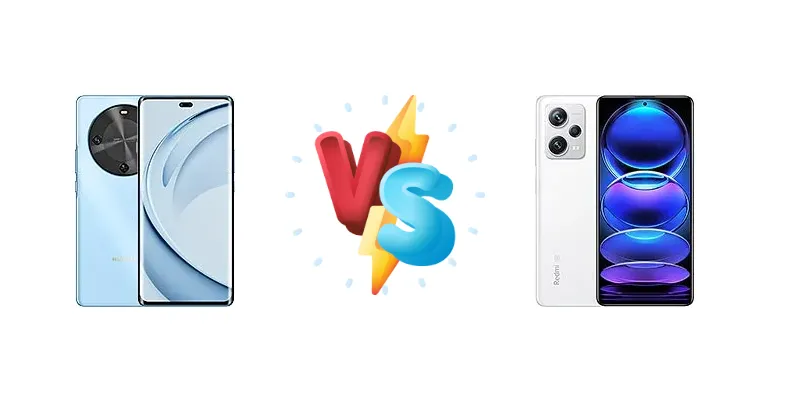
The Huawei Enjoy 70X Energy and Xiaomi Redmi Note 12 Pro+ represent distinct approaches to the mid-range smartphone market. The Enjoy 70X Energy prioritizes extended battery life and affordability, while the Redmi Note 12 Pro+ aggressively targets users demanding blazing-fast charging and a more powerful chipset. This comparison dissects their key differences to determine which device best suits your needs.
🏆 Quick Verdict
For the average user prioritizing speed and features, the Xiaomi Redmi Note 12 Pro+ is the clear winner. Its 120W charging and Dimensity 1080 chipset offer a significantly faster and more responsive experience. However, users on a tighter budget who value long battery life may find the Enjoy 70X Energy a compelling alternative.
| Network |
|---|
| 2G bands | GSM 850 / 900 / 1800 / 1900 | GSM 850 / 900 / 1800 / 1900 - SIM 1 & SIM 2 |
| 3G bands | HSDPA 850 / 900 / 2100 | HSDPA 800 / 850 / 900 / 1900 / 2100 |
| 4G bands | LTE | 1, 3, 5, 8, 19, 34, 38, 39, 40, 41 - International, China |
| 5G bands | - | 1, 3, 5, 8, 28, 38, 40, 41, 77, 78 SA/NSA - International |
| Speed | HSPA, LTE | HSPA, LTE-A (CA), 5G |
| Technology | GSM / HSPA / LTE | GSM / CDMA / HSPA / EVDO / LTE / 5G |
| | - | 1, 3, 5, 8, 28, 38, 41, 77, 78 SA/NSA - China |
| Launch |
|---|
| Announced | 2025, April 04 | 2022, October 27 |
| Status | Available. Released 2025, April | Available. Released 2022, November 01 |
| Body |
|---|
| Build | Glass front, plastic frame, plastic back or silicone polymer back (eco leather) | Glass front (Gorilla Glass 5), glass back |
| Dimensions | 164 x 74.9 x 8 mm (6.46 x 2.95 x 0.31 in) | 162.9 x 76 x 8.9 mm (6.41 x 2.99 x 0.35 in) |
| SIM | Nano-SIM + Nano-SIM | Dual SIM (Nano-SIM, dual stand-by) |
| Weight | 189 g or 194 g (6.67 oz) | 208.4 g (7.34 oz) |
| | - | IP53, dust and splash resistant |
| Display |
|---|
| Protection | Aluminosilicate glass | Corning Gorilla Glass 5 |
| Resolution | 1224 x 2700 pixels (~437 ppi density) | 1080 x 2400 pixels, 20:9 ratio (~395 ppi density) |
| Size | 6.78 inches, 111.5 cm2 (~90.8% screen-to-body ratio) | 6.67 inches, 107.4 cm2 (~86.8% screen-to-body ratio) |
| Type | AMOLED, 120Hz | OLED, 1B colors, 120Hz, Dolby Vision, HDR10+, 500 nits (typ), 900 nits (HBM) |
| Platform |
|---|
| CPU | - | Octa-core (2x2.6 GHz Cortex-A78 & 6x2.0 GHz Cortex-A55) |
| Chipset | - | Mediatek MT6877V Dimensity 1080 (6 nm) |
| GPU | - | Mali-G68 MC4 |
| OS | HarmonyOS 4.2 | Android 12, MIUI 13 |
| Memory |
|---|
| Card slot | No | No |
| Internal | 128GB 8GB RAM, 256GB 8GB RAM, 512GB 8GB RAM | 256GB 8GB RAM, 256GB 12GB RAM |
| | - | UFS 2.2 |
| Main Camera |
|---|
| Dual | 50 MP, f/1.8, 26mm (wide), PDAF
Auxiliary lens | - |
| Features | Color spectrum sensor, LED flash, HDR, panorama | Dual-LED dual-tone flash, HDR, panorama |
| Triple | - | 200 MP, f/1.7, 24mm (wide), 1/1.4", 0.56µm, PDAF, OIS
8 MP, f/2.2, 120˚ (ultrawide), 1/4", 1.12µm
2 MP, f/2.4, (macro) |
| Video | 1080p@30fps | 4K@30fps, 1080p@30/60/120fps, 720p@960fps |
| Selfie camera |
|---|
| Features | - | HDR |
| Single | 8 MP, f/2.0, (wide) | 16 MP, f/2.5, (wide), 1/3.06", 1.0µm |
| Video | 1080p@30fps | 1080p@30/60fps |
| Sound |
|---|
| 3.5mm jack | - | Yes |
| 35mm jack | No | - |
| Loudspeaker | Yes | Yes, with stereo speakers |
| | - | 24-bit/192kHz audio |
| Comms |
|---|
| Bluetooth | 5.1, A2DP, LE | 5.2, A2DP, LE |
| Infrared port | - | Yes |
| NFC | No | Yes (market/region dependent) |
| Positioning | GPS, GLONASS, GALILEO, BDS, QZSS | GPS (L1), GLONASS (G1), BDS (B1I+B1c), GALILEO (E1), QZSS (L1) |
| Radio | No | No |
| USB | USB Type-C 2.0, OTG | USB Type-C 2.0, OTG |
| WLAN | Wi-Fi 802.11 a/b/g/n/ac, dual-band | Wi-Fi 802.11 a/b/g/n/ac/6, dual-band, Wi-Fi Direct |
| Features |
|---|
| Sensors | Fingerprint (under display, optical), accelerometer, compass | Fingerprint (side-mounted), accelerometer, proximity, gyro, compass |
| Battery |
|---|
| Charging | 40W wired
5W reverse wired | 120W wired, PD3.0, 100% in 19 min (advertised) |
| Type | Si/C Li-Ion 6100 mAh | Li-Po 5000 mAh, non-removable |
| Misc |
|---|
| Colors | Black, White, Blue | Arctic White, Iceberg Blue, Obsidian Black, Trend edition |
| Models | BRE-AL00a, BRE-AL00b | 22101316UCP, 22101316UG |
| Price | About 180 EUR | $ 348.00 / £ 439.00 / € 399.00 / ₹ 29,949 |
| Tests |
|---|
| Battery life | - |
Endurance rating 88h
|
| Camera | - |
Photo / Video |
| Display | - |
Contrast ratio: Infinite (nominal) |
| Loudspeaker | - |
-26.7 LUFS (Good)
|
| Performance | - |
AnTuTu: 498710 (v9)
GeekBench: 2208 (v5.1), 2372 (v6)
GFXBench: 22fps (ES 3.1 onscreen) |
Huawei Enjoy 70X Energy
- Potentially longer battery life due to less powerful chipset.
- More affordable price point.
- 5W reverse wired charging for accessories.
- Significantly slower charging speed (40W vs 120W).
- Likely less powerful chipset and inferior performance.
- Inferior display quality (likely LCD vs AMOLED).
Xiaomi Redmi Note 12 Pro+
- Blazing-fast 120W charging (0-100% in 19 minutes).
- Powerful Mediatek Dimensity 1080 chipset for smooth performance.
- Likely superior display quality (AMOLED with high contrast).
- Higher price compared to the Huawei Enjoy 70X Energy.
- Potentially shorter battery life due to more demanding chipset.
- May run warmer under heavy load.
Display Comparison
The Redmi Note 12 Pro+ boasts an unspecified display contrast ratio described as 'Infinite (nominal)', suggesting a high-quality AMOLED panel. While the Enjoy 70X Energy’s display specifications are absent, Huawei typically employs LCD panels in this price bracket. This likely translates to lower contrast and less vibrant colors compared to the Redmi. The lack of information on refresh rates for the Enjoy 70X Energy suggests it likely operates at a standard 60Hz, while the Redmi Note 12 Pro+ is expected to offer a smoother 120Hz experience, enhancing scrolling and animations.
Camera Comparison
The Redmi Note 12 Pro+’s camera system is a key differentiator, though specific details beyond 'Photo / Video' are missing. However, the 'Pro+' designation suggests a more advanced setup than the Enjoy 70X Energy. The absence of detailed camera specs for the Enjoy 70X Energy implies a more basic camera experience focused on everyday snapshots. The Redmi Note 12 Pro+ is likely to offer features like Optical Image Stabilization (OIS) and more sophisticated image processing algorithms, resulting in better low-light performance and sharper images.
Performance
The Xiaomi Redmi Note 12 Pro+ is powered by the Mediatek Dimensity 1080 (6nm), featuring an octa-core CPU with two high-performance Cortex-A78 cores clocked at 2.6 GHz and six efficiency cores at 2.0 GHz. This 6nm process node offers a balance of performance and power efficiency. The Huawei Enjoy 70X Energy’s chipset is not specified, but given its positioning, it likely utilizes a less powerful and potentially older chipset. The Dimensity 1080’s superior architecture and clock speeds will result in noticeably faster app loading times, smoother multitasking, and improved gaming performance on the Redmi Note 12 Pro+.
Battery Life
The Redmi Note 12 Pro+’s 120W wired charging is its standout feature, advertised to reach 100% charge in just 19 minutes. This is a significant advantage over the Huawei Enjoy 70X Energy’s 40W charging. While the Enjoy 70X Energy offers 5W reverse wired charging, a useful feature for topping up accessories, the Redmi Note 12 Pro+’s charging speed is in a different league. The Redmi Note 12 Pro+ also boasts an endurance rating of 88 hours, suggesting excellent battery optimization despite the powerful chipset and fast charging capabilities.
Buying Guide
Buy the Huawei Enjoy 70X Energy if you need a phone that can reliably last through a full day and beyond on a single charge, and if rapid charging isn't a priority. It's ideal for users who primarily browse, message, and make calls. Buy the Xiaomi Redmi Note 12 Pro+ if you prefer a phone that can fully recharge in under 20 minutes, and if you enjoy demanding tasks like gaming or video editing. It’s geared towards power users who want a premium experience without the flagship price tag.
Frequently Asked Questions
❓ How much faster is the 120W charging on the Redmi Note 12 Pro+ compared to the 40W charging on the Enjoy 70X Energy?
The Redmi Note 12 Pro+'s 120W charging is dramatically faster. While the Enjoy 70X Energy will take well over an hour to fully charge, the Redmi Note 12 Pro+ can reach 100% in approximately 19 minutes, offering a significant time saving for users who need a quick power boost.
❓ Will the Dimensity 1080 in the Redmi Note 12 Pro+ handle demanding games like PUBG or Genshin Impact smoothly?
Yes, the Mediatek Dimensity 1080 is a capable chipset that should handle PUBG and Genshin Impact at medium to high settings with stable frame rates. The octa-core architecture and dedicated GPU provide sufficient processing power for a smooth gaming experience.
❓ Is the lack of specific camera details for the Huawei Enjoy 70X Energy a cause for concern?
Yes, the absence of detailed camera specifications suggests a more basic camera system. While it will likely be adequate for casual photography, it won't offer the same level of detail, dynamic range, or low-light performance as the Redmi Note 12 Pro+.
❓ Does the Redmi Note 12 Pro+ support Power Delivery (PD) charging with other USB-C chargers?
Yes, the Redmi Note 12 Pro+ supports PD3.0 charging, meaning it can be charged with other USB-C PD chargers, although it will charge at the maximum speed of 120W only with the included charger.