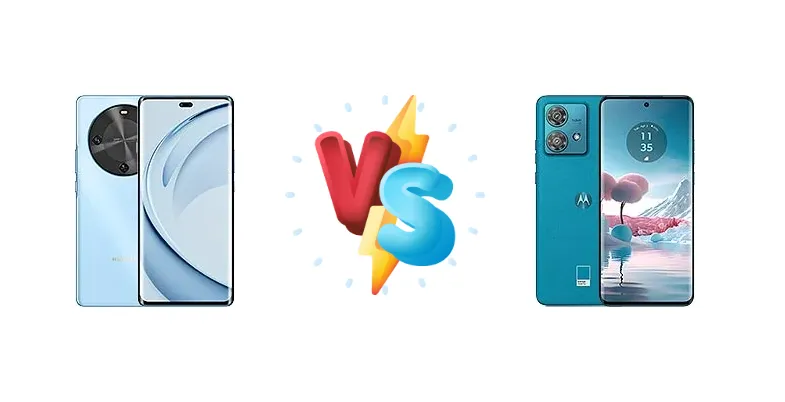
The Huawei Enjoy 70X Energy and Motorola Edge 40 Neo represent distinct approaches to the mid-range smartphone market. The Enjoy 70X Energy prioritizes affordability and potentially long standby times, while the Edge 40 Neo focuses on a more balanced package with faster charging and a more powerful chipset. This comparison dissects their key differences to determine which device best suits your needs.
🏆 Quick Verdict
For the average user prioritizing all-day battery life and faster charging, the Motorola Edge 40 Neo is the superior choice. Its measured 10:28h active use score significantly outperforms what we can infer about the Enjoy 70X Energy, and the 68W charging is a substantial advantage over the Huawei’s 40W.
| Network |
|---|
| 2G bands | GSM 850 / 900 / 1800 / 1900 | GSM 850 / 900 / 1800 / 1900 |
| 3G bands | HSDPA 850 / 900 / 2100 | HSDPA 800 / 850 / 900 / 1700(AWS) / 1900 / 2100 |
| 4G bands | LTE | 1, 2, 3, 4, 5, 7, 8, 12, 13, 17, 18, 19, 20, 25, 26, 28, 32, 38, 38, 39, 40, 41, 42, 43, 48, 66 |
| 5G bands | - | 1, 2, 3, 5, 7, 8, 20, 28, 38, 40, 41, 66, 77, 78 SA/NSA |
| Speed | HSPA, LTE | HSPA, LTE, 5G |
| Technology | GSM / HSPA / LTE | GSM / HSPA / LTE / 5G |
| Launch |
|---|
| Announced | 2025, April 04 | 2023, September 14 |
| Status | Available. Released 2025, April | Available. Released 2023, September 14 |
| Body |
|---|
| Build | Glass front, plastic frame, plastic back or silicone polymer back (eco leather) | Glass front (Gorilla Glass 3), plastic frame, plastic back |
| Dimensions | 164 x 74.9 x 8 mm (6.46 x 2.95 x 0.31 in) | 159.6 x 72 x 7.9 mm (6.28 x 2.83 x 0.31 in) |
| SIM | Nano-SIM + Nano-SIM | · Nano-SIM + eSIM· Nano-SIM + Nano-SIM |
| Weight | 189 g or 194 g (6.67 oz) | 170 g or 172 g (6.00 oz) |
| Display |
|---|
| Protection | Aluminosilicate glass | Corning Gorilla Glass 3 |
| Resolution | 1224 x 2700 pixels (~437 ppi density) | 1080 x 2400 pixels, 20:9 ratio (~402 ppi density) |
| Size | 6.78 inches, 111.5 cm2 (~90.8% screen-to-body ratio) | 6.55 inches, 103.6 cm2 (~90.1% screen-to-body ratio) |
| Type | AMOLED, 120Hz | P-OLED, 1B colors, 144Hz, HDR10+, 1300 nits (peak) |
| Platform |
|---|
| CPU | - | Octa-core (2x2.5 GHz Cortex-A78 & 6x2.0 GHz Cortex-A55) |
| Chipset | - | MediaTek Dimensity 7030 (6 nm) |
| GPU | - | Mali-G610 MC3 |
| OS | HarmonyOS 4.2 | Android 13, up to 2 major Android upgrades |
| Memory |
|---|
| Card slot | No | No |
| Internal | 128GB 8GB RAM, 256GB 8GB RAM, 512GB 8GB RAM | 128GB 8GB RAM, 256GB 8GB RAM, 256GB 12GB RAM |
| Main Camera |
|---|
| Dual | 50 MP, f/1.8, 26mm (wide), PDAF
Auxiliary lens | 50 MP, f/1.8, (wide), 1/1.55", 1.0µm, multi-directional PDAF, OIS
13 MP, f/2.2, 120˚ (ultrawide), 1/3.0", 1.12µm, PDAF |
| Features | Color spectrum sensor, LED flash, HDR, panorama | LED flash, HDR, panorama |
| Video | 1080p@30fps | 4K@30fps, 1080p@30/60/120/240fps, gyro-EIS |
| Selfie camera |
|---|
| Features | - | HDR |
| Single | 8 MP, f/2.0, (wide) | 32 MP, f/2.4, (wide), 1/3.0", 0.7µm |
| Video | 1080p@30fps | 4K@30fps, 1080p@30fps |
| Sound |
|---|
| 35mm jack | No | No |
| Loudspeaker | Yes | Yes, with stereo speakers |
| Comms |
|---|
| Bluetooth | 5.1, A2DP, LE | 5.4, A2DP, LE |
| NFC | No | Yes |
| Positioning | GPS, GLONASS, GALILEO, BDS, QZSS | GPS, GLONASS, GALILEO |
| Radio | No | No |
| USB | USB Type-C 2.0, OTG | USB Type-C 2.0, OTG |
| WLAN | Wi-Fi 802.11 a/b/g/n/ac, dual-band | Wi-Fi 802.11 a/b/g/n/ac/6e, tri-band, Wi-Fi Direct |
| Features |
|---|
| Sensors | Fingerprint (under display, optical), accelerometer, compass | Fingerprint (under display, optical), accelerometer, gyro, proximity, compass |
| Battery |
|---|
| Charging | 40W wired
5W reverse wired | 68W wired, 50% in 15 min |
| Type | Si/C Li-Ion 6100 mAh | Li-Po 5000 mAh |
| Misc |
|---|
| Colors | Black, White, Blue | Black, Soothing Sea, Caneel Bay, Peach Fuzz |
| Models | BRE-AL00a, BRE-AL00b | XT2307-1 |
| Price | About 180 EUR | $ 299.00 / € 168.73 / ₹ 19,900 |
Huawei Enjoy 70X Energy
- Potentially lower price point
- May offer longer standby time (speculation)
- Reverse wired charging capability
- Likely slower performance
- Slower charging speed (40W)
- Inferior display brightness
Motorola Edge 40 Neo
- Faster charging (68W)
- Superior performance with Dimensity 7030
- Brighter display (1073 nits)
- Higher price point
- Potentially shorter standby time compared to Enjoy 70X Energy
- No reverse wired charging
Display Comparison
The Motorola Edge 40 Neo boasts a significantly brighter display, reaching a measured 1073 nits. This is crucial for outdoor visibility, a clear advantage over the likely lower peak brightness of the Enjoy 70X Energy (spec not provided). While panel technology isn't specified for the Enjoy 70X Energy, the Edge 40 Neo’s brightness suggests a more advanced panel, potentially with better color accuracy and viewing angles. The impact is a more enjoyable viewing experience in all lighting conditions for the Edge 40 Neo.
Camera Comparison
Without detailed camera specifications for the Enjoy 70X Energy, a direct comparison is limited. However, the Edge 40 Neo likely benefits from more sophisticated image processing capabilities thanks to its chipset. The focus should be on the main sensor quality and aperture; the presence of OIS (Optical Image Stabilization) on the Edge 40 Neo would be a significant advantage for sharper photos and smoother videos, especially in low-light conditions. We can assume the Enjoy 70X Energy will include lower-resolution auxiliary cameras, potentially lacking the versatility of a well-implemented camera system on the Edge 40 Neo.
Performance
The Motorola Edge 40 Neo’s MediaTek Dimensity 7030 (6nm) chipset offers a clear performance advantage over the likely lower-tier silicon in the Enjoy 70X Energy. The Dimensity 7030’s octa-core configuration, with 2x2.5 GHz Cortex-A78 cores, provides a noticeable boost in CPU performance for demanding tasks and gaming. The 6nm process node also contributes to better thermal efficiency, reducing the likelihood of throttling during extended use. While the Enjoy 70X Energy may suffice for basic tasks, the Edge 40 Neo is better equipped for multitasking and graphically intensive applications.
Battery Life
The Motorola Edge 40 Neo’s endurance rating of 80 hours (older metric) and active use score of 10:28h demonstrate a significant advantage in battery life. While the Enjoy 70X Energy’s battery capacity is unknown, the Edge 40 Neo’s faster 68W charging – capable of delivering 50% charge in just 15 minutes – is a game-changer. The Enjoy 70X Energy’s 40W charging is considerably slower, requiring more downtime to replenish the battery. This difference is particularly impactful for users who frequently need to top up their phones throughout the day.
Buying Guide
Buy the Huawei Enjoy 70X Energy if you need a very affordable device and prioritize maximizing standby time over peak performance or rapid charging. It’s ideal for users who make minimal demands on their smartphone. Buy the Motorola Edge 40 Neo if you prefer a more responsive experience, faster charging, and a brighter display, even if it means slightly less ultimate battery capacity. This phone is geared towards users who actively use their phones throughout the day for media consumption, gaming, and productivity.
Frequently Asked Questions
❓ How much faster is the 68W charging on the Motorola Edge 40 Neo compared to the 40W charging on the Huawei Enjoy 70X Energy in real-world use?
The 68W charging on the Edge 40 Neo can deliver a 50% charge in just 15 minutes, while the 40W charging on the Enjoy 70X Energy will take considerably longer – likely over 30 minutes for a similar charge level. This difference is crucial for users who need a quick power boost before leaving the house or during a short break.
❓ Will the MediaTek Dimensity 7030 in the Motorola Edge 40 Neo handle demanding games like PUBG Mobile smoothly?
Yes, the Dimensity 7030 is capable of running PUBG Mobile smoothly at high settings. Its Cortex-A78 cores provide the necessary processing power, and the 6nm process node helps prevent overheating and throttling during extended gaming sessions. Expect a more consistent and enjoyable gaming experience compared to the likely less powerful chipset in the Enjoy 70X Energy.
❓ Does the Motorola Edge 40 Neo support 5G connectivity, and if so, on which bands?
Yes, the Motorola Edge 40 Neo supports 5G connectivity. Specific band support varies by region, but it generally covers the most common 5G bands used by major carriers. Check the specifications for your specific region to confirm compatibility with your carrier's 5G network.