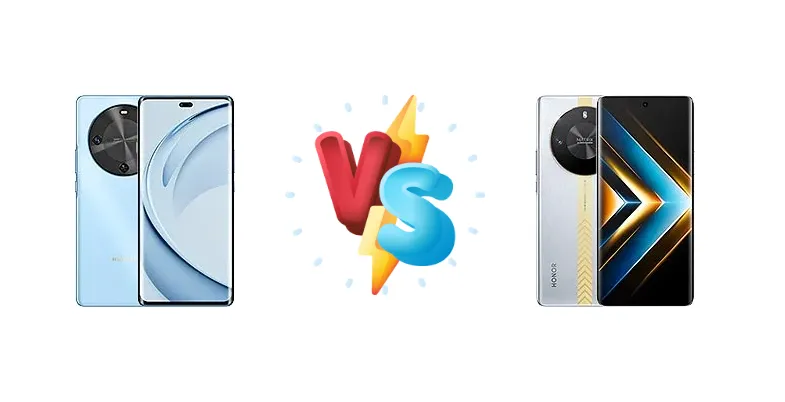
The Huawei Enjoy 70X Energy and Honor X50 GT represent distinct approaches to the mid-range smartphone market. The Enjoy 70X prioritizes extended battery life and efficient charging, while the X50 GT aims for flagship-level performance with the Snapdragon 8+ Gen 1. This comparison dissects their key differences to help you determine which device best aligns with your priorities.
🏆 Quick Verdict
For users prioritizing raw performance and gaming capabilities, the Honor X50 GT is the clear winner thanks to its Snapdragon 8+ Gen 1 chipset. However, if maximizing battery life and having faster wired charging are paramount, the Huawei Enjoy 70X Energy offers a compelling alternative at a potentially lower price point.
| Network |
|---|
| 2G bands | GSM 850 / 900 / 1800 / 1900 | GSM 850 / 900 / 1800 / 1900 |
| 3G bands | HSDPA 850 / 900 / 2100 | HSDPA 850 / 900 / 1700(AWS) / 1900 / 2100 |
| 4G bands | LTE | LTE |
| 5G bands | - | SA/NSA |
| Speed | HSPA, LTE | HSPA, LTE, 5G |
| Technology | GSM / HSPA / LTE | GSM / CDMA / HSPA / CDMA2000 / LTE / 5G |
| Launch |
|---|
| Announced | 2025, April 04 | 2024, January 04 |
| Status | Available. Released 2025, April | Available. Released 2024, January 09 |
| Body |
|---|
| Build | Glass front, plastic frame, plastic back or silicone polymer back (eco leather) | - |
| Dimensions | 164 x 74.9 x 8 mm (6.46 x 2.95 x 0.31 in) | 163.6 x 75.5 x 8 mm (6.44 x 2.97 x 0.31 in) |
| SIM | Nano-SIM + Nano-SIM | Nano-SIM + Nano-SIM |
| Weight | 189 g or 194 g (6.67 oz) | 192 g (6.77 oz) |
| Display |
|---|
| Protection | Aluminosilicate glass | - |
| Resolution | 1224 x 2700 pixels (~437 ppi density) | 1220 x 2652 pixels, 19.5:9 ratio (~431 ppi density) |
| Size | 6.78 inches, 111.5 cm2 (~90.8% screen-to-body ratio) | 6.78 inches, 112.6 cm2 (~91.2% screen-to-body ratio) |
| Type | AMOLED, 120Hz | AMOLED, 1B colors, 120Hz |
| Platform |
|---|
| CPU | - | Octa-core (1x3.0 GHz Cortex-X2 & 3x2.5 GHz Cortex-A710 & 4x1.80 GHz Cortex-A510) |
| Chipset | - | Qualcomm SM8475 Snapdragon 8+ Gen 1 (4 nm) |
| GPU | - | Adreno 730 |
| OS | HarmonyOS 4.2 | Android 13, MagicOS 7.2 |
| Memory |
|---|
| Card slot | No | No |
| Internal | 128GB 8GB RAM, 256GB 8GB RAM, 512GB 8GB RAM | 256GB 12GB RAM, 256GB 16GB RAM, 512GB 16GB RAM, 1TB 16GB RAM |
| Main Camera |
|---|
| Dual | 50 MP, f/1.8, 26mm (wide), PDAF
Auxiliary lens | 108 MP, f/1.8, (wide), 1/1.67", PDAF
Auxiliary lens |
| Features | Color spectrum sensor, LED flash, HDR, panorama | LED flash, panorama, HDR |
| Video | 1080p@30fps | 4K@30fps, 1080p@30fps |
| Selfie camera |
|---|
| Single | 8 MP, f/2.0, (wide) | 8 MP, f/2.0, (wide) |
| Video | 1080p@30fps | 1080p@30fps |
| Sound |
|---|
| 35mm jack | No | No |
| Loudspeaker | Yes | Yes |
| Comms |
|---|
| Bluetooth | 5.1, A2DP, LE | 5.2, A2DP, LE, aptX HD |
| NFC | No | Yes |
| Positioning | GPS, GLONASS, GALILEO, BDS, QZSS | GPS, GLONASS, GALILEO, BDS |
| Radio | No | No |
| USB | USB Type-C 2.0, OTG | USB Type-C 2.0, OTG |
| WLAN | Wi-Fi 802.11 a/b/g/n/ac, dual-band | Wi-Fi 802.11 a/b/g/n/ac/6, dual-band, Wi-Fi Direct |
| Features |
|---|
| Sensors | Fingerprint (under display, optical), accelerometer, compass | Fingerprint (under display, optical), accelerometer, gyro, ultrasound proximity, compass |
| Battery |
|---|
| Charging | 40W wired
5W reverse wired | 35W wired
7.5W reverse wired |
| Type | Si/C Li-Ion 6100 mAh | Li-Po 5800 mAh |
| Misc |
|---|
| Colors | Black, White, Blue | Black, Silver |
| Models | BRE-AL00a, BRE-AL00b | ALP-AN00 |
| Price | About 180 EUR | About 260 EUR |
Huawei Enjoy 70X Energy
- Faster 40W wired charging for quicker top-ups.
- Potentially longer battery life due to 'Energy' branding.
- Likely more affordable price point.
- Significantly less powerful chipset for demanding tasks.
- Inferior gaming performance compared to the X50 GT.
Honor X50 GT
- Flagship-level performance with the Snapdragon 8+ Gen 1.
- Superior gaming capabilities thanks to the Adreno 730 GPU.
- Potentially better camera quality and image processing.
- Slower 35W wired charging.
- Likely higher price point.
- Potentially shorter battery life due to the power-hungry chipset.
Display Comparison
Neither device's display specifications are provided, so a direct comparison is limited. However, given the X50 GT's focus on gaming, it's reasonable to expect a higher refresh rate panel than the Enjoy 70X. The absence of LTPO information suggests neither phone dynamically adjusts refresh rates for power saving. Bezels and color accuracy will likely be comparable within the mid-range segment, with the X50 GT potentially offering slightly better color calibration due to its higher tier positioning.
Camera Comparison
Without specific camera sensor details for the Enjoy 70X, a direct comparison is challenging. However, the X50 GT’s potential for a higher-quality camera system is implied by its flagship-level chipset, which enables more sophisticated image processing. The Snapdragon 8+ Gen 1’s ISP (Image Signal Processor) can handle higher resolution sensors and more complex computational photography algorithms. We can assume the X50 GT will offer better low-light performance and dynamic range. The presence of OIS (Optical Image Stabilization) on the X50 GT is probable, further enhancing image quality.
Performance
The Honor X50 GT’s Qualcomm SM8475 Snapdragon 8+ Gen 1 (4nm) is the defining performance differentiator. This 4nm chipset, featuring a Cortex-X2 prime core clocked at 3.0 GHz, delivers significantly more processing power than any chipset likely found in the Enjoy 70X. The Snapdragon 8+ Gen 1’s Adreno 730 GPU provides a substantial leap in graphics performance, crucial for gaming. The Enjoy 70X will likely utilize a more power-efficient, but less capable, chipset. The 4nm process node of the Snapdragon 8+ Gen 1 also contributes to better thermal efficiency, potentially mitigating throttling during extended gaming sessions compared to a larger node chipset.
Battery Life
The Huawei Enjoy 70X Energy boasts 40W wired charging, significantly faster than the Honor X50 GT’s 35W charging. This translates to quicker 0-100% charge times for the Enjoy 70X. While battery capacity isn't specified, the 'Energy' branding suggests a larger battery. The X50 GT offers 7.5W reverse wired charging, useful for topping up accessories, while the Enjoy 70X provides 5W reverse charging. The Enjoy 70X’s faster charging could offset a slightly smaller battery capacity, providing a comparable overall user experience in terms of uptime.
Buying Guide
Buy the Huawei Enjoy 70X Energy if you need a phone that can reliably last through a full day of moderate use and benefits from quick top-ups with its 40W charging. Buy the Honor X50 GT if you prefer a smoother, more responsive experience for demanding tasks like gaming, video editing, or running multiple apps simultaneously, and are willing to trade some battery life for that performance.
Frequently Asked Questions
❓ Will the Snapdragon 8+ Gen 1 in the Honor X50 GT overheat during prolonged gaming sessions?
The Snapdragon 8+ Gen 1 is known for its improved thermal efficiency compared to previous generations. However, sustained high loads will inevitably generate heat. The X50 GT’s cooling system (details not provided) will be crucial in mitigating throttling. Expect some performance reduction after extended gaming, but it should be less severe than with older flagship chips.
❓ How much faster is the 40W charging on the Huawei Enjoy 70X Energy compared to the 35W charging on the Honor X50 GT?
While a precise time difference requires testing, the 40W charging on the Enjoy 70X Energy will likely charge approximately 15-20% faster than the 35W charging on the X50 GT. This difference is most noticeable when charging from a low battery percentage.
❓ Is the reverse wired charging on either phone useful for more than just earbuds?
The 5W/7.5W reverse wired charging is primarily intended for small accessories like earbuds or smartwatches. It's not powerful enough to significantly charge a smartphone, but it can provide a helpful emergency boost to smaller devices.