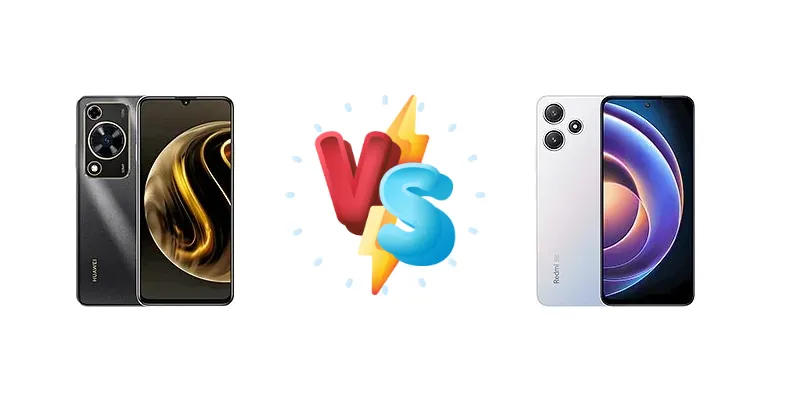
The Huawei Enjoy 70 and Xiaomi Redmi Note 12R represent compelling options in the crowded budget smartphone market. While both aim for affordability, they take distinctly different approaches under the hood. The Enjoy 70 relies on Huawei’s in-house Kirin 710A, while the Redmi Note 12R leverages the newer Qualcomm Snapdragon 4 Gen 2. This comparison dissects these core differences to determine which device delivers the best experience for your money.
🏆 Quick Verdict
For most users, the Xiaomi Redmi Note 12R emerges as the stronger choice. Its Snapdragon 4 Gen 2, built on a 4nm process, offers a significant performance and efficiency advantage over the Enjoy 70’s older 14nm Kirin 710A. While the Enjoy 70 may appeal to those deeply embedded in the Huawei ecosystem, the Redmi Note 12R provides a more future-proof and responsive experience.
| Network |
|---|
| 2G bands | GSM 850 / 900 / 1800 / 1900 | GSM 850 / 900 / 1800 / 1900 |
| 3G bands | HSDPA 850 / 900 / 2100 | HSDPA 850 / 900 / 2100 |
| 4G bands | LTE | 1, 3, 5, 8, 34, 38, 39, 40, 41 |
| 5G bands | - | 1, 5, 8, 28, 41, 78 SA/NSA |
| Speed | HSPA, LTE | HSPA, LTE, 5G |
| Technology | GSM / HSPA / LTE | GSM / CDMA / HSPA / EVDO / LTE / 5G |
| Launch |
|---|
| Announced | 2023, December 05 | 2023, June 28 |
| Status | Available. Released 2023, December 13 | Available. Released 2023, June 28 |
| Body |
|---|
| Build | - | Glass front, plastic frame, glass back |
| Dimensions | 168.3 x 77.7 x 8.9 mm (6.63 x 3.06 x 0.35 in) | 168.6 x 76.3 x 8.2 mm (6.64 x 3.00 x 0.32 in) |
| SIM | Nano-SIM + Nano-SIM | Nano-SIM + Nano-SIM |
| Weight | 207 g (7.30 oz) | 199 g (7.02 oz) |
| Display |
|---|
| Resolution | 720 x 1600 pixels, 20:9 ratio (~260 ppi density) | 1080 x 2460 pixels (~396 ppi density) |
| Size | 6.75 inches, 110.0 cm2 (~84.1% screen-to-body ratio) | 6.79 inches, 109.5 cm2 (~85.1% screen-to-body ratio) |
| Type | TFT LCD | IPS LCD, 90Hz, 550 nits |
| Platform |
|---|
| CPU | Octa-core (4x2.0 GHz Cortex-A73 & 4x1.7 GHz Cortex-A53) | Octa-core (2x2.2 GHz Cortex-A78 & 6x1.95 GHz Cortex-A55) |
| Chipset | Kirin 710A (14 nm) | Qualcomm SM4450 Snapdragon 4 Gen 2 (4 nm) |
| GPU | Mali-G51 MP4 | Adreno 613 |
| OS | HarmonyOS 4.0 | Android 13, MIUI 14 |
| Memory |
|---|
| Card slot | Nano Memory (uses shared SIM slot) | microSDXC (uses shared SIM slot) |
| Internal | 128GB 6GB RAM, 128GB 8GB RAM, 256GB 8GB RAM | 128GB 4GB RAM, 128GB 6GB RAM, 128GB 8GB RAM, 256GB 8GB RAM |
| Main Camera |
|---|
| Dual | 50 MP, f/1.8, (wide), AF
2 MP (macro) | 50 MP, f/1.8, (wide), PDAF
2 MP (macro) |
| Features | LED flash, HDR, panorama | LED flash, HDR |
| Video | 1080p@30fps | 1080p@30fps |
| Selfie camera |
|---|
| Features | - | HDR |
| Single | 8 MP, f/2.0, (wide) | 5 MP, f/2.2, (wide), 1/5.0", 1.12µm |
| Video | 1080p@30fps | 1080p@30fps |
| Sound |
|---|
| 35mm jack | No | Yes |
| Loudspeaker | Yes | Yes |
| Comms |
|---|
| Bluetooth | 5.1, A2DP, LE | 5.3, A2DP, LE |
| Infrared port | - | Yes |
| NFC | No | Yes (market/region dependent) |
| Positioning | GPS, GLONASS, GALILEO, BDS, QZSS | GPS, GLONASS, GALILEO, BDS |
| Radio | No | No |
| USB | USB Type-C 2.0, OTG | USB Type-C |
| WLAN | Wi-Fi 802.11 a/b/g/n/ac, dual-band | Wi-Fi 802.11 a/b/g/n/ac, dual-band |
| Features |
|---|
| Sensors | Fingerprint (side-mounted), accelerometer, proximity, compass | Fingerprint (side-mounted), accelerometer, compass |
| Battery |
|---|
| Charging | 22.5W wired | 18W wired, PD |
| Type | Li-Po 6000 mAh | Li-Po 5000 mAh |
| Misc |
|---|
| Colors | Black, White, Green | Black, Blue, Silver |
| Models | FGD-AL00 | 23076RA4BC |
| Price | About 160 EUR | About 150 EUR |
Huawei Enjoy 70
- Potential for deeper Huawei ecosystem integration
- Slightly higher maximum charging wattage (22.5W)
- May be more readily available in certain regions
- Older, less efficient Kirin 710A chipset
- 14nm process leads to higher heat and lower battery life
- Potentially limited app availability due to Huawei restrictions
Xiaomi Redmi Note 12R
- More modern and efficient Snapdragon 4 Gen 2 (4nm)
- PD charging support for wider compatibility
- Better performance for gaming and multitasking
- Broader app compatibility
- Lower maximum charging wattage (18W)
- Xiaomi’s MIUI software can be polarizing
- May lack certain Huawei-specific features
Display Comparison
Neither device boasts a standout display. Details on panel type and resolution are missing, but the focus here is on the underlying processors. The absence of high refresh rates on either device suggests a cost-saving measure. However, the Redmi Note 12R’s support for Power Delivery (PD) charging implies a more modern USB-C implementation, potentially supporting faster data transfer speeds compared to the Enjoy 70’s standard wired charging.
Camera Comparison
Without detailed camera specs, a direct comparison is difficult. However, the chipset plays a role in image processing. The more modern ISP within the Snapdragon 4 Gen 2 should offer improved noise reduction and dynamic range compared to the Kirin 710A. The absence of information regarding sensor size and OIS suggests both phones target basic photography needs. Expect similar results in good lighting conditions, but the Redmi Note 12R likely has an edge in low-light scenarios due to its superior processing capabilities.
Performance
The core difference lies in the chipsets. The Redmi Note 12R’s Snapdragon 4 Gen 2 (4nm) is a clear upgrade over the Huawei Enjoy 70’s Kirin 710A (14nm). The 4nm fabrication process translates to significantly improved power efficiency and thermal management. While both are octa-core CPUs, the Snapdragon 4 Gen 2 utilizes newer Cortex-A78 cores (2x2.2 GHz) alongside A55 cores, offering a noticeable performance boost over the Enjoy 70’s older Cortex-A73 (4x2.0 GHz) and A53 cores. This means faster app loading times, smoother multitasking, and better gaming performance on the Redmi Note 12R. The Redmi Note 12R is likely to exhibit less throttling under sustained load.
Battery Life
The Redmi Note 12R’s 18W charging with PD support offers a more versatile charging experience. PD allows for compatibility with a wider range of chargers and potentially faster charging speeds with compatible adapters. While the Enjoy 70’s 22.5W charging appears higher on paper, the Kirin 710A’s less efficient 14nm process will likely negate any charging speed advantage. The Snapdragon 4 Gen 2’s efficiency means the Redmi Note 12R will likely deliver longer battery life on a single charge, despite potentially having a similar capacity battery (details missing).
Buying Guide
Buy the Huawei Enjoy 70 if you prioritize Huawei’s software ecosystem and are comfortable with potentially limited app availability outside of China. Buy the Xiaomi Redmi Note 12R if you value raw performance, efficient power consumption, and broader app compatibility, especially if you’re a moderate gamer or multitasker.
Frequently Asked Questions
❓ Will the Kirin 710A struggle with demanding games like PUBG Mobile?
Yes, the Kirin 710A will likely struggle with PUBG Mobile at higher settings. While playable at lower settings, expect frame drops and potential overheating. The Snapdragon 4 Gen 2 in the Redmi Note 12R offers a significantly smoother gaming experience, even at medium settings.
❓ Does the Redmi Note 12R support Google Play Services, and will I be able to use apps like Gmail and YouTube?
Yes, the Xiaomi Redmi Note 12R fully supports Google Play Services, meaning you'll have access to the full suite of Google apps, including Gmail, YouTube, and the Google Play Store. This is a key advantage over some Huawei devices that have limited Google support.
❓ Is the 18W charging on the Redmi Note 12R slow compared to other phones?
While 18W isn't the fastest charging available, the Snapdragon 4 Gen 2's efficiency means you won't need to charge as frequently. Furthermore, the inclusion of Power Delivery (PD) allows for potentially faster charging with compatible chargers, and offers broader charger compatibility.