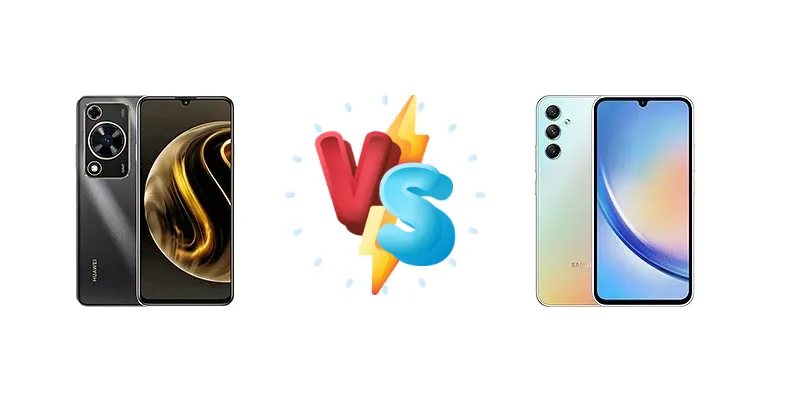
The Huawei Enjoy 70 and Samsung Galaxy A34 represent compelling options in the increasingly competitive budget smartphone market. While both aim to deliver a solid experience without breaking the bank, they take distinctly different approaches to achieving that goal. This comparison dives deep into their specifications and performance to determine which device offers the best value for your money.
🏆 Quick Verdict
For most users, the Samsung Galaxy A34 emerges as the stronger choice. Its Mediatek Dimensity 1080 chipset provides a significant performance advantage over the Huawei Enjoy 70’s Kirin 710A, translating to smoother multitasking and gaming. While both offer similar battery endurance, the A34’s brighter display and wider availability through official channels give it the edge.
| Network |
|---|
| 2G bands | GSM 850 / 900 / 1800 / 1900 | GSM 850 / 900 / 1800 / 1900 |
| 3G bands | HSDPA 850 / 900 / 2100 | HSDPA 850 / 900 / 1700(AWS) / 1900 / 2100 |
| 4G bands | LTE | 1, 2, 3, 4, 5, 7, 8, 12, 17, 20, 26, 28, 32, 38, 40, 41, 66 |
| 5G bands | - | 1, 3, 7, 8, 20, 28, 38, 40, 41, 77, 78 SA/NSA/Sub6 |
| Speed | HSPA, LTE | HSPA, LTE, 5G |
| Technology | GSM / HSPA / LTE | GSM / HSPA / LTE / 5G |
| Launch |
|---|
| Announced | 2023, December 05 | 2023, March 14 |
| Status | Available. Released 2023, December 13 | Available. Released 2023, March 24 |
| Body |
|---|
| Build | - | Glass front (Gorilla Glass 5), plastic frame, plastic back |
| Dimensions | 168.3 x 77.7 x 8.9 mm (6.63 x 3.06 x 0.35 in) | 161.3 x 78.1 x 8.2 mm (6.35 x 3.07 x 0.32 in) |
| SIM | Nano-SIM + Nano-SIM | · Nano-SIM· Nano-SIM + Nano-SIM |
| Weight | 207 g (7.30 oz) | 199 g (7.02 oz) |
| | - | IP67 dust/water resistant (up to 1m for 30 min) |
| Display |
|---|
| Protection | - | Corning Gorilla Glass 5 |
| Resolution | 720 x 1600 pixels, 20:9 ratio (~260 ppi density) | 1080 x 2340 pixels, 19.5:9 ratio (~390 ppi density) |
| Size | 6.75 inches, 110.0 cm2 (~84.1% screen-to-body ratio) | 6.6 inches, 106.9 cm2 (~84.9% screen-to-body ratio) |
| Type | TFT LCD | Super AMOLED, 120Hz, 1000 nits (HBM) |
| Platform |
|---|
| CPU | Octa-core (4x2.0 GHz Cortex-A73 & 4x1.7 GHz Cortex-A53) | Octa-core (2x2.6 GHz Cortex-A78 & 6x2.0 GHz Cortex-A55) |
| Chipset | Kirin 710A (14 nm) | Mediatek Dimensity 1080 (6 nm) |
| GPU | Mali-G51 MP4 | Mali-G68 MC4 |
| OS | HarmonyOS 4.0 | Android 13, up to 4 major Android upgrades, One UI 6.1 |
| Memory |
|---|
| Card slot | Nano Memory (uses shared SIM slot) | microSDXC (uses shared SIM slot) |
| Internal | 128GB 6GB RAM, 128GB 8GB RAM, 256GB 8GB RAM | 128GB 4GB RAM, 128GB 6GB RAM, 128GB 8GB RAM, 256GB 6GB RAM, 256GB 8GB RAM |
| Main Camera |
|---|
| Dual | 50 MP, f/1.8, (wide), AF
2 MP (macro) | - |
| Features | LED flash, HDR, panorama | LED flash, panorama, HDR |
| Triple | - | 48 MP, f/1.8, 26mm (wide), 1/2.0", 0.8µm, PDAF, OIS
8 MP, f/2.2, 123˚, (ultrawide), 1/4.0", 1.12µm
5 MP (macro) |
| Video | 1080p@30fps | 4K@30fps, 1080p@30/60fps, 720p@480fps |
| Selfie camera |
|---|
| Single | 8 MP, f/2.0, (wide) | 13 MP, f/2.2, 26mm (wide), 1/3.1", 1.12µm |
| Video | 1080p@30fps | 4K@30fps, 1080p@30fps |
| Sound |
|---|
| 3.5mm jack | - | No |
| 35mm jack | No | No |
| Loudspeaker | Yes | Yes, with stereo speakers |
| Comms |
|---|
| Bluetooth | 5.1, A2DP, LE | 5.3, A2DP, LE |
| NFC | No | Yes (market/region dependent) |
| Positioning | GPS, GLONASS, GALILEO, BDS, QZSS | GPS, GLONASS, GALILEO, BDS |
| Radio | No | No |
| USB | USB Type-C 2.0, OTG | USB Type-C 2.0, OTG |
| WLAN | Wi-Fi 802.11 a/b/g/n/ac, dual-band | Wi-Fi 802.11 a/b/g/n/ac, dual-band, Wi-Fi Direct |
| Features |
|---|
| Sensors | Fingerprint (side-mounted), accelerometer, proximity, compass | Fingerprint (under display, optical), accelerometer, gyro, compass |
| | - | Virtual proximity sensing |
| Battery |
|---|
| Charging | 22.5W wired | 25W wired |
| Type | Li-Po 6000 mAh | Li-Ion 5000 mAh |
| Misc |
|---|
| Colors | Black, White, Green | Lime, Graphite, Violet, Silver |
| Models | FGD-AL00 | SM-A346E, SM-A346B, SM-A346B/DS, SM-A346B/DSN, SM-A346E/DS, SM-A346E/DSN, SM-A346M, SM-A346M/N, SM-A346M/DSN, SM-A3460 |
| Price | About 160 EUR | € 169.99 / $ 175.00 / £ 164.99 / ₹ 23,999 |
| SAR EU | - | 0.55 W/kg (head) 1.49 W/kg (body) |
| Tests |
|---|
| Battery life | - |
Endurance rating 133h
|
| Camera | - |
Photo / Video |
| Display | - |
Contrast ratio: Infinite (nominal) |
| Loudspeaker | - |
-26.1 LUFS (Good)
|
| Performance | - |
AnTuTu: 472126 (v9)
GeekBench: 2316 (v5.5), 2518 (v6)
GFXBench: 23fps (ES 3.1 onscreen) |
Huawei Enjoy 70
- Potentially lower price point
- HarmonyOS offers a unique user experience
- Decent battery life
- Older Kirin 710A chipset offers limited performance
- Limited app availability due to HarmonyOS ecosystem
- Display specifications are unknown, likely inferior to A34
Samsung Galaxy A34
- Powerful Mediatek Dimensity 1080 chipset
- Bright and vibrant display (1009 nits)
- Wider app availability through Google Play Store
- May be slightly more expensive than the Enjoy 70
- Samsung’s One UI can be resource-intensive
- Plastic build quality
Display Comparison
The Samsung Galaxy A34 boasts a significantly brighter display, reaching a measured peak brightness of 1009 nits, compared to an unspecified brightness for the Enjoy 70. This makes the A34 far more usable outdoors under direct sunlight. While both displays are likely to be LCD panels given the price bracket, the A34’s ‘Infinite’ contrast ratio (nominal) suggests better black levels. The lack of detailed display specifications for the Enjoy 70 makes a precise comparison difficult, but the A34 clearly holds an advantage in visual clarity and outdoor visibility.
Camera Comparison
Both devices are listed as having Photo/Video capabilities, but detailed camera specifications are absent for the Enjoy 70. The A34 likely features a more sophisticated camera system, benefiting from Samsung’s image processing expertise. While both may include a standard and ultrawide lens, the A34’s sensor size and aperture are likely larger, resulting in better low-light performance. The inclusion of Optical Image Stabilization (OIS) on the A34, a common feature in this price range, would further enhance image quality and video stabilization. Without specific details on the Enjoy 70’s camera hardware, it’s difficult to make a direct comparison, but the A34 is expected to deliver superior image and video quality.
Performance
The performance gap between these two devices is substantial. The Samsung Galaxy A34’s Mediatek Dimensity 1080, built on a 6nm process, is a far more modern and efficient chipset than the Huawei Enjoy 70’s Kirin 710A (14nm). The Dimensity 1080 features a more powerful CPU configuration – 2x2.6 GHz Cortex-A78 cores versus the Enjoy 70’s 4x2.0 GHz Cortex-A73 cores – resulting in noticeably faster application loading times and smoother multitasking. The 6nm process also contributes to better thermal management, reducing the likelihood of performance throttling during extended gaming sessions. The Enjoy 70 will handle basic tasks adequately, but the A34 is the clear winner for demanding users.
Battery Life
Both the Huawei Enjoy 70 and Samsung Galaxy A34 achieve an endurance rating of 133 hours, indicating comparable battery life under similar usage conditions. However, the A34 supports 25W wired charging, slightly faster than the Enjoy 70’s 22.5W charging. While the difference isn’t massive, it translates to a marginally quicker 0-100% charge time. The comparable endurance ratings suggest that both phones can comfortably last a full day of moderate use, but the A34’s faster charging provides a slight convenience advantage.
Buying Guide
Buy the Huawei Enjoy 70 if you prioritize a potentially lower price point and are comfortable with the limitations of the HarmonyOS ecosystem and potential app compatibility issues. Buy the Samsung Galaxy A34 if you value a smoother, more responsive user experience, a brighter and more vibrant display, and the broader support and app ecosystem of the Google Play Store.
Frequently Asked Questions
❓ Does the Mediatek Dimensity 1080 in the Galaxy A34 get hot during prolonged gaming sessions?
The Dimensity 1080 is built on a 6nm process, which is more efficient than the 14nm Kirin 710A. While it will generate heat during intensive gaming, the A34’s thermal management system is generally effective at preventing significant throttling, allowing for sustained performance over longer periods. However, extremely demanding games at maximum settings may still lead to some heat buildup.
❓ Is the 2MP macro camera on either phone actually useful for taking detailed close-up photos?
Generally, 2MP macro cameras on budget smartphones are limited in their usefulness. The low resolution results in images lacking detail and sharpness. While they can be fun to experiment with, don’t expect professional-quality macro photography from either the Enjoy 70 or the Galaxy A34. The A34’s main sensor is far more important for overall image quality.
❓ Can the Samsung Galaxy A34 handle demanding games like PUBG Mobile at high frame rates?
Yes, the Dimensity 1080 in the Galaxy A34 is capable of running PUBG Mobile at high frame rates (60fps) with reasonably high graphics settings. While you may need to make some adjustments to balance performance and visual fidelity, the A34 provides a smooth and enjoyable gaming experience for popular titles.
❓ What are the potential drawbacks of using Huawei’s HarmonyOS instead of Android with Google Play Services?
HarmonyOS lacks full compatibility with Google Play Services, meaning some apps may not function correctly or may require workarounds to install. While Huawei is building its own app ecosystem, it’s still less comprehensive than the Google Play Store. This can be a significant inconvenience for users who rely on specific Google apps or services.