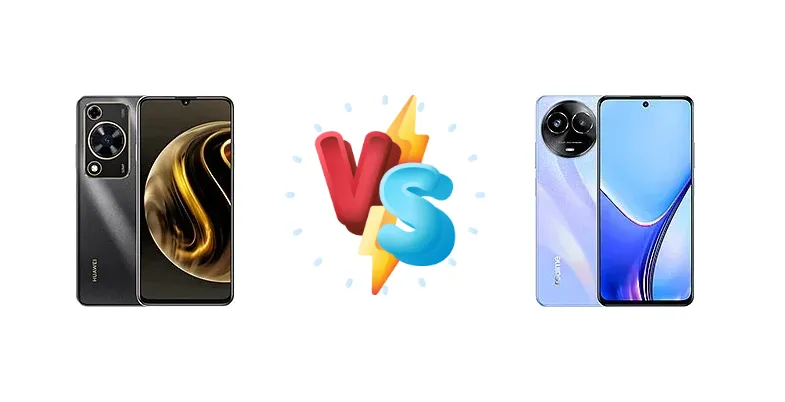
The budget smartphone market is fiercely competitive, and the Huawei Enjoy 70 and Realme 11x represent compelling options for users seeking value. However, beneath the similar price points lie significant differences in chipset architecture and charging capabilities, impacting real-world performance and user experience. This comparison dissects these differences to determine which device delivers the most bang for your buck.
🏆 Quick Verdict
For the average user prioritizing performance and convenience, the Realme 11x is the superior choice. Its Mediatek Dimensity 6100+ chipset, built on a more efficient 6nm process, provides a noticeable performance uplift over the Huawei Enjoy 70’s older Kirin 710A, coupled with significantly faster 33W charging.
| Network |
|---|
| 2G bands | GSM 850 / 900 / 1800 / 1900 | GSM 850 / 900 / 1800 / 1900 |
| 3G bands | HSDPA 850 / 900 / 2100 | HSDPA 850 / 900 / 2100 |
| 4G bands | LTE | 1, 3, 5, 8, 28, 40, 41 |
| 5G bands | - | 1, 3, 5, 8, 28, 40, 41, 77, 78 SA/NSA |
| Speed | HSPA, LTE | HSPA, LTE, 5G |
| Technology | GSM / HSPA / LTE | GSM / HSPA / LTE / 5G |
| Launch |
|---|
| Announced | 2023, December 05 | 2023, August 23 |
| Status | Available. Released 2023, December 13 | Available. Released 2023, August 30 |
| Body |
|---|
| Build | - | Glass front, aluminum frame, plastic back |
| Dimensions | 168.3 x 77.7 x 8.9 mm (6.63 x 3.06 x 0.35 in) | 165.7 x 76 x 7.9 mm (6.52 x 2.99 x 0.31 in) |
| SIM | Nano-SIM + Nano-SIM | Nano-SIM + Nano-SIM |
| Weight | 207 g (7.30 oz) | 190 g (6.70 oz) |
| Display |
|---|
| Resolution | 720 x 1600 pixels, 20:9 ratio (~260 ppi density) | 1080 x 2400 pixels, 20:9 ratio (~392 ppi density) |
| Size | 6.75 inches, 110.0 cm2 (~84.1% screen-to-body ratio) | 6.72 inches, 109.0 cm2 (~86.6% screen-to-body ratio) |
| Type | TFT LCD | IPS LCD, 120Hz, 550 nits (typ), 680 nits (HBM) |
| Platform |
|---|
| CPU | Octa-core (4x2.0 GHz Cortex-A73 & 4x1.7 GHz Cortex-A53) | Octa-core (2x2.2 GHz Cortex-A76 & 6x2.0 GHz Cortex-A55) |
| Chipset | Kirin 710A (14 nm) | Mediatek Dimensity 6100+ (6 nm) |
| GPU | Mali-G51 MP4 | Mali-G57 MC2 |
| OS | HarmonyOS 4.0 | Android 13, Realme UI 4.0 |
| Memory |
|---|
| Card slot | Nano Memory (uses shared SIM slot) | microSDXC (dedicated slot) |
| Internal | 128GB 6GB RAM, 128GB 8GB RAM, 256GB 8GB RAM | 128GB 6GB RAM, 128GB 8GB RAM |
| Main Camera |
|---|
| Dual | 50 MP, f/1.8, (wide), AF
2 MP (macro) | 64 MP, f/1.8, 25mm (wide), 1/2.0", 0.7µm, PDAF
Auxiliary lens |
| Features | LED flash, HDR, panorama | LED flash, HDR, panorama |
| Video | 1080p@30fps | 1080p@30fps |
| Selfie camera |
|---|
| Features | - | Panorama |
| Single | 8 MP, f/2.0, (wide) | 8 MP, f/2.1, 26mm (wide) |
| Video | 1080p@30fps | 1080p@30fps |
| Sound |
|---|
| 35mm jack | No | Yes |
| Loudspeaker | Yes | Yes |
| Comms |
|---|
| Bluetooth | 5.1, A2DP, LE | 5.2, A2DP, LE |
| NFC | No | No |
| Positioning | GPS, GLONASS, GALILEO, BDS, QZSS | GPS, GALILEO, GLONASS, BDS |
| Radio | No | Unspecified |
| USB | USB Type-C 2.0, OTG | USB Type-C 2.0 |
| WLAN | Wi-Fi 802.11 a/b/g/n/ac, dual-band | Wi-Fi 802.11 a/b/g/n/ac, dual-band, Wi-Fi Direct |
| Features |
|---|
| Sensors | Fingerprint (side-mounted), accelerometer, proximity, compass | Fingerprint (side-mounted), accelerometer, proximity, compass |
| Battery |
|---|
| Charging | 22.5W wired | 33W wired, 50% in 29 min |
| Type | Li-Po 6000 mAh | 5000 mAh |
| Misc |
|---|
| Colors | Black, White, Green | Midnight Black, Purple Dawn |
| Models | FGD-AL00 | RMX3785 |
| Price | About 160 EUR | About 170 EUR |
Huawei Enjoy 70
- Potential Huawei ecosystem integration
- Established Huawei brand recognition
- Potentially optimized software experience for Huawei users
- Older Kirin 710A chipset
- Slower 22.5W charging
- Less efficient 14nm process
Realme 11x
- More efficient Mediatek Dimensity 6100+ chipset
- Faster 33W charging (50% in 29 mins)
- Modern 6nm process node
- Realme’s UI may not appeal to all users
- Potentially less brand recognition than Huawei in some markets
Display Comparison
Neither device’s display specifications are provided, so a direct comparison is limited. However, given the market segment, both likely feature LCD panels with 60Hz refresh rates. The Realme 11x, being a newer device, *may* benefit from slightly improved color calibration and viewing angles. The absence of high refresh rates on both devices suggests a focus on battery life over visual fluidity.
Camera Comparison
Without detailed camera specifications, a precise comparison is difficult. However, the market positioning suggests both phones will feature a primary camera and potentially depth/macro sensors. The Realme 11x, being a newer model, is more likely to incorporate improved image processing algorithms and potentially a larger sensor size, resulting in better low-light performance and dynamic range. The Enjoy 70’s camera system will likely prioritize Huawei’s established image processing style, which often emphasizes vibrant colors.
Performance
The Realme 11x’s Mediatek Dimensity 6100+ (6nm) represents a substantial leap forward compared to the Huawei Enjoy 70’s Kirin 710A (14nm). The 6nm process node inherently offers better power efficiency, translating to less heat generation and sustained performance. While both are octa-core CPUs, the Dimensity 6100+ utilizes newer Cortex-A76 cores (2x2.2 GHz) compared to the Enjoy 70’s Cortex-A73 cores (4x2.0 GHz), providing a significant advantage in single-core performance – crucial for responsive app launches and smoother UI navigation. The 6x2.0 GHz Cortex-A55 cores in the 11x also offer improved efficiency over the Enjoy 70’s 4x1.7 GHz Cortex-A53 cores. This translates to a more fluid experience during multitasking and demanding applications.
Battery Life
While battery capacities are not specified, the Realme 11x’s 33W wired charging is a clear advantage over the Enjoy 70’s 22.5W charging. The 33W charging can deliver a 50% charge in just 29 minutes, significantly reducing downtime. This faster charging speed is particularly beneficial for users who frequently find themselves needing a quick power boost. Even with a similar battery capacity, the Dimensity 6100+'s 6nm efficiency will likely result in longer battery life on the Realme 11x.
Buying Guide
Buy the Huawei Enjoy 70 if you prioritize brand familiarity within the Huawei ecosystem and are comfortable with a more basic user experience. Its strength lies in its potential software integration with other Huawei devices. Buy the Realme 11x if you value raw performance, faster charging speeds, and a more modern chipset architecture, making it ideal for multitasking, gaming, and users who demand quicker power-ups.
Frequently Asked Questions
❓ Is the Kirin 710A chipset still capable of handling modern mobile games?
While the Kirin 710A can run many mobile games, it will likely struggle with graphically demanding titles at higher settings. Expect lower frame rates and potential stuttering compared to the Realme 11x’s Dimensity 6100+, which is designed for smoother gaming experiences.
❓ How much faster is the 33W charging on the Realme 11x compared to the 22.5W on the Huawei Enjoy 70 in real-world use?
The Realme 11x’s 33W charging can deliver a 50% charge in approximately 29 minutes, while the Enjoy 70’s 22.5W charging will take considerably longer – likely over an hour to reach the same level. This difference is significant for users who need a quick top-up before leaving the house.
❓ Does the Realme 11x’s Dimensity 6100+ chipset generate more heat than the Kirin 710A during prolonged use?
Despite being more powerful, the Dimensity 6100+’s 6nm process is more efficient than the Kirin 710A’s 14nm process. This means it generates less heat for the same level of performance, reducing the likelihood of thermal throttling during extended gaming sessions or demanding tasks.