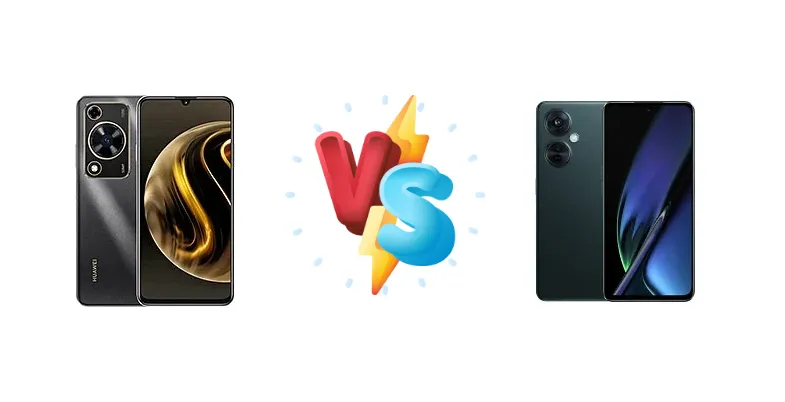
The budget 5G smartphone market is fiercely competitive. The Huawei Enjoy 70 and Oppo K11x both aim to deliver connectivity and functionality without breaking the bank, but they take distinctly different approaches. The Enjoy 70 relies on Huawei’s in-house Kirin chipset, while the K11x leverages Qualcomm’s Snapdragon 695. This comparison dissects the key differences to help you choose the right device.
🏆 Quick Verdict
For most users, the Oppo K11x is the superior choice. Its Snapdragon 695 chipset, built on a more efficient 6nm process, offers better performance and future-proofing. The standout 67W charging is a game-changer in this price bracket, significantly reducing downtime compared to the Enjoy 70’s 22.5W charging.
| Network |
|---|
| 2G bands | GSM 850 / 900 / 1800 / 1900 | GSM 850 / 900 / 1800 / 1900 |
| 3G bands | HSDPA 850 / 900 / 2100 | HSDPA 850 / 900 / 1700(AWS) / 2100 |
| 4G bands | LTE | 1, 3, 4, 5, 8, 28, 34, 38, 39, 40, 41 |
| 5G bands | - | 1, 5, 8, 28, 41, 77, 78 SA/NSA |
| Speed | HSPA, LTE | HSPA, LTE, 5G |
| Technology | GSM / HSPA / LTE | GSM / HSPA / LTE / 5G |
| Launch |
|---|
| Announced | 2023, December 05 | 2023, May 25 |
| Status | Available. Released 2023, December 13 | Available. Released 2023, May 25 |
| Body |
|---|
| Build | - | Glass front, plastic frame, plastic back |
| Dimensions | 168.3 x 77.7 x 8.9 mm (6.63 x 3.06 x 0.35 in) | 165.5 x 76 x 8.3 mm (6.52 x 2.99 x 0.33 in) |
| SIM | Nano-SIM + Nano-SIM | Nano-SIM + Nano-SIM |
| Weight | 207 g (7.30 oz) | 195 g (6.88 oz) |
| Display |
|---|
| Protection | - | Corning Gorilla Glass |
| Resolution | 720 x 1600 pixels, 20:9 ratio (~260 ppi density) | 1080 x 2400 pixels, 20:9 ratio (~392 ppi density) |
| Size | 6.75 inches, 110.0 cm2 (~84.1% screen-to-body ratio) | 6.72 inches, 109.0 cm2 (~86.7% screen-to-body ratio) |
| Type | TFT LCD | IPS LCD, 120Hz, 550 nits (typ), 680 nits (peak) |
| Platform |
|---|
| CPU | Octa-core (4x2.0 GHz Cortex-A73 & 4x1.7 GHz Cortex-A53) | Octa-core (2x2.2 GHz Kryo 660 Gold & 6x1.7 GHz Kryo 660 Silver) |
| Chipset | Kirin 710A (14 nm) | Qualcomm SM6375 Snapdragon 695 5G (6 nm) |
| GPU | Mali-G51 MP4 | Adreno 619 |
| OS | HarmonyOS 4.0 | Android 13, ColorOS 13.1 |
| Memory |
|---|
| Card slot | Nano Memory (uses shared SIM slot) | microSDXC (uses shared SIM slot) |
| Internal | 128GB 6GB RAM, 128GB 8GB RAM, 256GB 8GB RAM | 128GB 8GB RAM, 256GB 8GB RAM, 256GB 12GB RAM |
| Main Camera |
|---|
| Dual | 50 MP, f/1.8, (wide), AF
2 MP (macro) | 108 MP, f/1.8, 24mm (wide), 1/1.67", 0.64µm, PDAF
Auxiliary lens |
| Features | LED flash, HDR, panorama | LED flash, HDR, panorama |
| Video | 1080p@30fps | 1080p@30fps |
| Selfie camera |
|---|
| Features | - | HDR, panorama |
| Single | 8 MP, f/2.0, (wide) | 16 MP, f/2.4, (wide), 1.0µm |
| Video | 1080p@30fps | 1080p@30fps |
| Sound |
|---|
| 35mm jack | No | Yes |
| Loudspeaker | Yes | Yes, with stereo speakers |
| Comms |
|---|
| Bluetooth | 5.1, A2DP, LE | 5.1, A2DP, LE, aptX HD |
| NFC | No | No |
| Positioning | GPS, GLONASS, GALILEO, BDS, QZSS | GPS, GALILEO, GLONASS, BDS, QZSS |
| Radio | No | No |
| USB | USB Type-C 2.0, OTG | USB Type-C 2.0, OTG |
| WLAN | Wi-Fi 802.11 a/b/g/n/ac, dual-band | Wi-Fi 802.11 a/b/g/n/ac, dual-band |
| Features |
|---|
| Sensors | Fingerprint (side-mounted), accelerometer, proximity, compass | Fingerprint (side-mounted), accelerometer, gyro, proximity, compass |
| Battery |
|---|
| Charging | 22.5W wired | 67W wired, 80% in 33 min |
| Type | Li-Po 6000 mAh | Li-Po 5000 mAh |
| Misc |
|---|
| Colors | Black, White, Green | Jade Black, Pearl Blue |
| Models | FGD-AL00 | - |
| Price | About 160 EUR | About 250 EUR |
Huawei Enjoy 70
- Huawei Brand Recognition
- Potentially more conservative software
- May be more readily available in certain markets
- Older 14nm Kirin 710A chipset
- Slow 22.5W charging
- Less efficient processor
Oppo K11x
- Modern 6nm Snapdragon 695 5G
- Ultra-fast 67W charging (80% in 33 min)
- Better performance and efficiency
- Oppo’s ColorOS may not appeal to all users
- Potential for more bloatware
Display Comparison
Neither device boasts a particularly standout display. While specific panel details (like peak brightness or color gamut coverage) are unavailable, the focus here is on core functionality. Both likely utilize LCD panels given the price point. The absence of high refresh rates is expected. The real difference lies elsewhere.
Camera Comparison
Without detailed camera specs beyond the core chipsets, a direct comparison is limited. However, the Snapdragon 695 typically supports more advanced image signal processors (ISPs) than the Kirin 710A, potentially leading to better image processing, especially in low-light conditions. The K11x is likely to benefit from Qualcomm’s computational photography algorithms. The presence of a dedicated ISP on the Snapdragon 695 allows for faster image capture and processing, which is crucial for capturing sharp photos and videos.
Performance
The Oppo K11x’s Qualcomm Snapdragon 695 5G (6nm) represents a significant architectural leap over the Huawei Enjoy 70’s Kirin 710A (14nm). The 6nm process inherently provides better power efficiency, translating to less heat generation and potentially sustained performance during demanding tasks. The Snapdragon 695’s Kryo 660 Gold cores, clocked at 2.2 GHz, offer a performance advantage over the Kirin 710A’s Cortex-A73 cores at 2.0 GHz. While both are octa-core CPUs, the Snapdragon’s architecture is more modern and optimized for 5G workloads. This means smoother multitasking and a more responsive user experience on the K11x.
Battery Life
The Oppo K11x’s 67W wired charging is the clear winner here. Achieving 80% charge in just 33 minutes is a substantial advantage over the Huawei Enjoy 70’s 22.5W charging. While battery capacity isn’t specified for either device, the faster charging speed of the K11x mitigates any potential disadvantage from a slightly smaller battery. Users who frequently find themselves needing to top up their phone will greatly appreciate the K11x’s charging capabilities.
Buying Guide
Buy the Huawei Enjoy 70 if you prioritize brand loyalty within the Huawei ecosystem and prefer a potentially more conservative software experience. Buy the Oppo K11x if you value faster charging speeds, a more modern and efficient chipset, and are comfortable with Oppo’s ColorOS. The K11x is the better option for users who frequently game or stream content.
Frequently Asked Questions
❓ Will the Snapdragon 695 in the Oppo K11x handle demanding games like PUBG Mobile smoothly?
The Snapdragon 695 is capable of running PUBG Mobile at medium settings with stable frame rates. While it won't deliver a flagship gaming experience, it provides a noticeable improvement over the Kirin 710A, especially in sustained performance due to its more efficient 6nm process. Expect playable frame rates, but don't anticipate maxing out all graphics settings.
❓ Is Huawei’s EMUI/HarmonyOS on the Enjoy 70 significantly different from Oppo’s ColorOS on the K11x?
Yes, the software experiences are quite different. Huawei’s EMUI (or HarmonyOS, depending on the region) is known for its more conservative approach and focus on security. Oppo’s ColorOS is more feature-rich and customizable, but often includes more pre-installed apps (bloatware). The choice depends on your preference for a cleaner, simpler interface versus a more customizable one.
❓ Does the Oppo K11x support VoLTE/VoWiFi on all carriers?
Carrier compatibility can vary. While the Snapdragon 695 generally supports a wide range of 4G and 5G bands, it’s crucial to check with your specific carrier to ensure VoLTE and VoWiFi are supported on the Oppo K11x in your region. Compatibility issues are common with budget 5G phones.