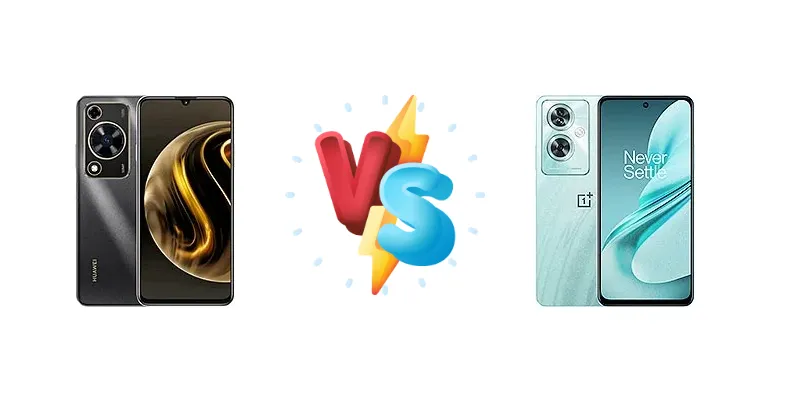
The Huawei Enjoy 70 and OnePlus Nord N30 SE represent compelling options in the increasingly competitive sub-$250 smartphone market. While both aim to deliver a solid experience without breaking the bank, they take distinctly different approaches to achieving this goal, primarily through their chipset choices and charging capabilities. This comparison dives deep into the specifics to determine which device offers the best value.
🏆 Quick Verdict
For the average user prioritizing overall performance and future-proofing, the OnePlus Nord N30 SE is the better choice. Its Mediatek Dimensity 6020, built on a more efficient 7nm process, provides a noticeable performance uplift over the Huawei Enjoy 70’s Kirin 710A. While the Enjoy 70 offers a respectable experience, the N30 SE’s faster charging and more modern architecture give it the edge.
| Network |
|---|
| 2G bands | GSM 850 / 900 / 1800 / 1900 | GSM 850 / 900 / 1800 / 1900 |
| 3G bands | HSDPA 850 / 900 / 2100 | HSDPA 850 / 900 / 1700(AWS) / 1900 / 2100 |
| 4G bands | LTE | 1, 2, 3, 4, 5, 7, 8, 12, 13, 17, 18, 19, 20, 26, 28, 38, 39, 40, 41, 66 |
| 5G bands | - | 1, 3, 5, 7, 8, 20, 28, 38, 40, 41, 66, 77, 78 SA/NSA |
| Speed | HSPA, LTE | HSPA, LTE, 5G |
| Technology | GSM / HSPA / LTE | GSM / HSPA / LTE / 5G |
| Launch |
|---|
| Announced | 2023, December 05 | 2024, January 29 |
| Status | Available. Released 2023, December 13 | Available. Released 2024, January 31 |
| Body |
|---|
| Build | - | Glass front, plastic frame, plastic back |
| Dimensions | 168.3 x 77.7 x 8.9 mm (6.63 x 3.06 x 0.35 in) | 165.6 x 76 x 8 mm (6.52 x 2.99 x 0.31 in) |
| SIM | Nano-SIM + Nano-SIM | Nano-SIM + Nano-SIM |
| Weight | 207 g (7.30 oz) | 193 g (6.81 oz) |
| Display |
|---|
| Resolution | 720 x 1600 pixels, 20:9 ratio (~260 ppi density) | 1080 x 2400 pixels, 20:9 ratio (~392 ppi density) |
| Size | 6.75 inches, 110.0 cm2 (~84.1% screen-to-body ratio) | 6.72 inches, 109.0 cm2 (~86.6% screen-to-body ratio) |
| Type | TFT LCD | IPS LCD |
| Platform |
|---|
| CPU | Octa-core (4x2.0 GHz Cortex-A73 & 4x1.7 GHz Cortex-A53) | Octa-core (2x2.2 GHz Cortex-A76 & 6x2.0 GHz Cortex-A55) |
| Chipset | Kirin 710A (14 nm) | Mediatek Dimensity 6020 (7 nm) |
| GPU | Mali-G51 MP4 | Mali-G57 MC2 |
| OS | HarmonyOS 4.0 | Android 13, OxygenOS 13.1 |
| Memory |
|---|
| Card slot | Nano Memory (uses shared SIM slot) | No |
| Internal | 128GB 6GB RAM, 128GB 8GB RAM, 256GB 8GB RAM | 128GB 4GB RAM |
| Main Camera |
|---|
| Dual | 50 MP, f/1.8, (wide), AF
2 MP (macro) | 50 MP, f/1.8, (wide), 1/2.76", 0.64µm, PDAF
Auxiliary lens |
| Features | LED flash, HDR, panorama | LED flash, HDR, panorama |
| Video | 1080p@30fps | 1080p@30fps |
| Selfie camera |
|---|
| Single | 8 MP, f/2.0, (wide) | 8 MP, f/2.0, (wide), 1/4.0", 1.12µm |
| Video | 1080p@30fps | 1080p@30fps |
| Sound |
|---|
| 35mm jack | No | Yes |
| Loudspeaker | Yes | Yes, with stereo speakers |
| Comms |
|---|
| Bluetooth | 5.1, A2DP, LE | 5.3, A2DP, LE |
| NFC | No | Yes |
| Positioning | GPS, GLONASS, GALILEO, BDS, QZSS | GPS, GALILEO, GLONASS, BDS |
| Radio | No | No |
| USB | USB Type-C 2.0, OTG | USB Type-C 2.0, OTG |
| WLAN | Wi-Fi 802.11 a/b/g/n/ac, dual-band | Wi-Fi 802.11 a/b/g/n/ac, dual-band |
| Features |
|---|
| Sensors | Fingerprint (side-mounted), accelerometer, proximity, compass | Fingerprint (side-mounted), accelerometer, gyro, proximity, compass |
| Battery |
|---|
| Charging | 22.5W wired | 33W wired, 51% in 30 min |
| Type | Li-Po 6000 mAh | 5000 mAh |
| Misc |
|---|
| Colors | Black, White, Green | Black Satin, Cyan |
| Models | FGD-AL00 | CPH2605 |
| Price | About 160 EUR | About 510 EUR |
Huawei Enjoy 70
- Familiar Huawei software experience
- Potentially lower price point
- Reliable performance for basic tasks
- Older, less efficient chipset
- Slower charging speed
- Limited future software support
OnePlus Nord N30 SE
- More powerful and efficient processor
- Faster 33W charging
- Likely longer software support
- Improved image processing capabilities
- OxygenOS may not appeal to all users
- Potentially slightly higher price
Display Comparison
Neither device boasts a standout display. While specific panel details (like peak brightness or color gamut coverage) are unavailable, the core difference lies elsewhere. The focus here is on the underlying processing power needed to drive a smooth visual experience, which favors the N30 SE. Bezels are likely comparable given the price point, and color accuracy will be typical for this segment – adequate but not exceptional.
Camera Comparison
Without detailed camera specs beyond the presence of sensors, a direct comparison is difficult. However, the chipset’s image signal processor (ISP) plays a vital role. The Dimensity 6020’s ISP is likely more advanced, offering better noise reduction, dynamic range, and image processing capabilities than the Kirin 710A’s. This doesn’t guarantee superior photos, but it provides a stronger foundation for image quality. The prevalence of 2MP macro lenses on both devices suggests they are largely marketing features and shouldn’t be a deciding factor.
Performance
The performance gap is the most significant differentiator. The OnePlus Nord N30 SE’s Mediatek Dimensity 6020, fabricated on a 7nm process, offers a substantial advantage over the Huawei Enjoy 70’s Kirin 710A (14nm). The 7nm node translates to greater transistor density and improved power efficiency, resulting in better sustained performance and reduced thermal throttling. The Dimensity 6020’s CPU configuration – 2x2.2 GHz Cortex-A76 and 6x2.0 GHz Cortex-A55 – also represents a generational leap over the Enjoy 70’s 4x2.0 GHz Cortex-A73 and 4x1.7 GHz Cortex-A53. This means faster app launch times, smoother multitasking, and a more responsive user experience on the N30 SE. While both utilize octa-core CPUs, the architectural improvements in the Dimensity 6020 are crucial.
Battery Life
The OnePlus Nord N30 SE’s 33W wired charging is a clear advantage over the Huawei Enjoy 70’s 22.5W charging. The N30 SE claims a 51% charge in 30 minutes, significantly faster than the Enjoy 70. While battery capacity isn’t specified, the faster charging speed is a tangible benefit for users who need to quickly top up their device. The Dimensity 6020’s improved power efficiency also contributes to potentially longer battery life, offsetting any potential capacity differences.
Buying Guide
Buy the Huawei Enjoy 70 if you prioritize a familiar Huawei software experience and are comfortable with a slightly older chipset. It’s a good option for basic tasks and users who don’t heavily rely on demanding applications. Buy the OnePlus Nord N30 SE if you value smoother performance in apps and games, faster charging speeds, and a more modern processor that will likely receive longer software support.
Frequently Asked Questions
❓ Will the Kirin 710A struggle with graphically intensive games like PUBG Mobile?
The Kirin 710A will likely be able to run PUBG Mobile, but expect to play at lower graphics settings and potentially experience frame drops during intense moments. The Dimensity 6020 in the Nord N30 SE offers a significantly smoother gaming experience with higher settings and more consistent frame rates.
❓ How much faster is the 33W charging on the OnePlus Nord N30 SE compared to the 22.5W on the Huawei Enjoy 70 in real-world use?
The OnePlus Nord N30 SE’s 33W charging can add approximately 50% battery in 30 minutes, while the Enjoy 70 will take considerably longer to reach the same level. This difference is particularly noticeable for users who frequently need to quickly top up their battery throughout the day.
❓ Does the OnePlus Nord N30 SE support software updates for a longer period than the Huawei Enjoy 70?
Generally, OnePlus provides longer software support for its devices compared to Huawei, especially given current geopolitical factors impacting Huawei’s access to Google Mobile Services. The Nord N30 SE is likely to receive more Android version updates and security patches over its lifespan.