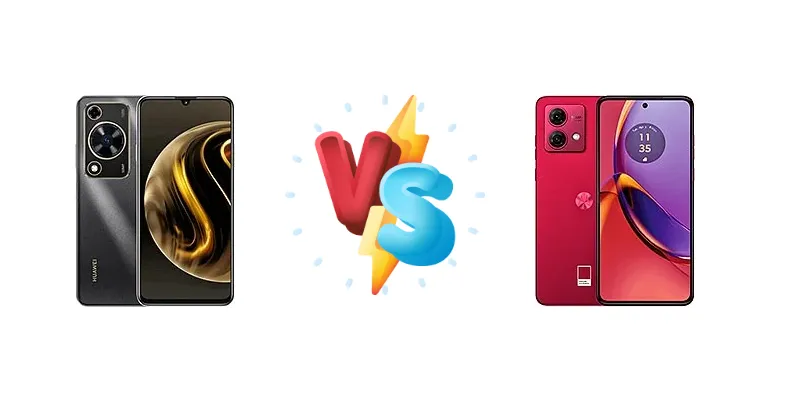
The sub-$250 smartphone market is fiercely competitive. The Huawei Enjoy 70 and Motorola Moto G84 both aim to deliver 5G connectivity and essential features at an accessible price point. However, they take different approaches – Huawei relies on its in-house Kirin chipset, while Motorola opts for Qualcomm’s Snapdragon. This comparison dissects their strengths and weaknesses to determine which phone offers the best value.
🏆 Quick Verdict
For most users, the Motorola Moto G84 emerges as the stronger choice. Its Snapdragon 695 chipset, fabricated on a more efficient 6nm process, provides a performance edge and better thermal management. Coupled with a brighter display and faster charging, the Moto G84 offers a more well-rounded experience despite the Enjoy 70's potential software advantages.
| Network |
|---|
| 2G bands | GSM 850 / 900 / 1800 / 1900 | GSM 850 / 900 / 1800 / 1900 |
| 3G bands | HSDPA 850 / 900 / 2100 | HSDPA 850 / 900 / 1700(AWS) / 1900 / 2100 - LATAM |
| 4G bands | LTE | 1, 2, 3, 4, 5, 7, 8, 12, 13, 17, 25, 26, 28, 38, 40, 41, 42, 66 - LATAM |
| 5G bands | - | 1, 2, 3, 5, 7, 26, 28, 40, 66, 78 SA/NSA/Sub6 - LATAM |
| Speed | HSPA, LTE | HSPA, LTE, 5G |
| Technology | GSM / HSPA / LTE | GSM / HSPA / LTE / 5G |
| Launch |
|---|
| Announced | 2023, December 05 | 2023, August 24 |
| Status | Available. Released 2023, December 13 | Available. Released 2023, September 08 |
| Body |
|---|
| Build | - | Glass front, plastic frame, plastic back or eco leather back |
| Dimensions | 168.3 x 77.7 x 8.9 mm (6.63 x 3.06 x 0.35 in) | 160 x 74.4 x 7.6 mm (6.30 x 2.93 x 0.30 in) |
| SIM | Nano-SIM + Nano-SIM | Nano-SIM + Nano-SIM |
| Weight | 207 g (7.30 oz) | 166.8 g (5.86 oz) |
| Display |
|---|
| Resolution | 720 x 1600 pixels, 20:9 ratio (~260 ppi density) | 1080 x 2400 pixels, 20:9 ratio (~405 ppi density) |
| Size | 6.75 inches, 110.0 cm2 (~84.1% screen-to-body ratio) | 6.5 inches, 102.0 cm2 (~85.7% screen-to-body ratio) |
| Type | TFT LCD | P-OLED, 1B colors, 120Hz, 1300 nits (peak) |
| Platform |
|---|
| CPU | Octa-core (4x2.0 GHz Cortex-A73 & 4x1.7 GHz Cortex-A53) | Octa-core (2x2.2 GHz Kryo 660 Gold & 6x1.7 GHz Kryo 660 Silver) |
| Chipset | Kirin 710A (14 nm) | Qualcomm SM6375 Snapdragon 695 5G (6 nm) |
| GPU | Mali-G51 MP4 | Adreno 619 |
| OS | HarmonyOS 4.0 | Android 13, upgradable to Android 15 |
| Memory |
|---|
| Card slot | Nano Memory (uses shared SIM slot) | microSDXC (uses shared SIM slot) |
| Internal | 128GB 6GB RAM, 128GB 8GB RAM, 256GB 8GB RAM | 256GB 8GB RAM, 256GB 12GB RAM |
| Main Camera |
|---|
| Dual | 50 MP, f/1.8, (wide), AF
2 MP (macro) | 50 MP, f/1.9 (wide), 1/1.5", 1.0µm, PDAF, OIS
8 MP, f/2.2, 120˚ (ultrawide), 1/4.0", 1.12µm, AF |
| Features | LED flash, HDR, panorama | LED flash, HDR, panorama |
| Video | 1080p@30fps | 1080p@30/60fps |
| Selfie camera |
|---|
| Single | 8 MP, f/2.0, (wide) | 16 MP, f/2.5, (wide), 1.0µm |
| Video | 1080p@30fps | 1080p@30fps |
| Sound |
|---|
| 35mm jack | No | Yes |
| Loudspeaker | Yes | Yes, with stereo speakers |
| Comms |
|---|
| Bluetooth | 5.1, A2DP, LE | 5.1, A2DP, LE |
| NFC | No | Yes (market/region dependent) |
| Positioning | GPS, GLONASS, GALILEO, BDS, QZSS | GPS, GLONASS, GALILEO |
| Radio | No | FM radio (market/region dependent) |
| USB | USB Type-C 2.0, OTG | USB Type-C 2.0 |
| WLAN | Wi-Fi 802.11 a/b/g/n/ac, dual-band | Wi-Fi 802.11 a/b/g/n/ac, dual-band, Wi-Fi Direct |
| Features |
|---|
| Sensors | Fingerprint (side-mounted), accelerometer, proximity, compass | Fingerprint (under display, optical), accelerometer, gyro, proximity, compass |
| Battery |
|---|
| Charging | 22.5W wired | 30W wired |
| Type | Li-Po 6000 mAh | Li-Po 5000 mAh |
| Misc |
|---|
| Colors | Black, White, Green | Marshmallow Blue, Midnight Blue, Viva Magenta |
| Models | FGD-AL00 | XT2347, XT2347-1, XT2347-2 |
| Price | About 160 EUR | $ 399.00 / £ 189.99 / € 169.00 |
Huawei Enjoy 70
- Potential for Huawei’s EMUI software features.
- May offer a more competitive price point (depending on region).
- Huawei’s established brand recognition in some markets.
- Older Kirin 710A chipset with less efficient 14nm process.
- Slower 22.5W charging.
- Likely lacks Google Mobile Services (GMS) depending on region.
Motorola Moto G84
- More efficient Snapdragon 695 (6nm) chipset.
- Brighter 996 nit display for better outdoor visibility.
- Faster 30W wired charging.
- Likely includes full Google Mobile Services (GMS).
- Motorola’s software update commitment can be inconsistent.
- May be slightly more expensive than the Enjoy 70.
Display Comparison
The Motorola Moto G84 boasts a significantly brighter display, reaching a measured 996 nits. This is crucial for outdoor usability, where the Enjoy 70’s unspecified brightness will likely struggle. While both likely utilize LCD panels (given the price bracket), the G84’s higher peak brightness provides a tangible advantage. We lack detailed color accuracy data for either, but Motorola’s track record suggests reasonable calibration. Bezels are likely comparable, focusing on maximizing screen real estate within the budget constraints.
Camera Comparison
Both phones likely feature a multi-camera setup, but detailed sensor information is limited. The Motorola Moto G84’s camera is listed as 'Photo / Video', suggesting a focus on versatility. The Enjoy 70’s camera specs are absent, making a direct comparison difficult. Given the price point, expect a primary sensor around 48-50MP on both. Optical Image Stabilization (OIS) is unlikely on either. Image processing will be a key differentiator – Huawei’s software often emphasizes vibrant colors, while Motorola tends towards a more natural look. We can assume both will include a basic depth or macro sensor, but these are unlikely to be significant contributors to image quality.
Performance
The core difference lies in the chipsets. The Motorola Moto G84’s Qualcomm Snapdragon 695 (6nm) is a clear upgrade over the Huawei Enjoy 70’s Kirin 710A (14nm). The 6nm process node translates to superior power efficiency and reduced thermal throttling, meaning sustained performance during demanding tasks. While both CPUs feature octa-core configurations, the Snapdragon 695’s Kryo 660 Gold cores at 2.2 GHz offer a performance boost over the Kirin 710A’s Cortex-A73 cores at 2.0 GHz. The Enjoy 70’s older architecture will likely show its age in multitasking and graphically intensive applications. RAM configurations are unknown, but LPDDR4X is probable on both, limiting memory bandwidth.
Battery Life
The Motorola Moto G84 demonstrates a strong battery performance with an active use score of 12:31h and an endurance rating of 117h. While the Enjoy 70’s battery capacity is unknown, the Moto G84’s efficiency, stemming from the 6nm Snapdragon 695, is a significant advantage. The Moto G84 also supports 30W wired charging, faster than the Enjoy 70’s 22.5W, resulting in quicker top-ups. This faster charging is particularly beneficial for users who frequently need to recharge throughout the day.
Buying Guide
Buy the Huawei Enjoy 70 if you prioritize Huawei’s EMUI software ecosystem and are comfortable with potential limitations regarding Google Mobile Services. Buy the Motorola Moto G84 if you value a smoother, more responsive user experience, a brighter display for outdoor visibility, and faster charging speeds, all powered by a more modern and efficient chipset.
Frequently Asked Questions
❓ Does the Kirin 710A chipset struggle with demanding games like PUBG Mobile?
The Kirin 710A, being an older chipset built on a 14nm process, will likely exhibit frame rate drops and thermal throttling during extended gaming sessions in PUBG Mobile. While playable at lower settings, the experience won't be as smooth or consistent as on the Snapdragon 695-powered Moto G84.
❓ Is the lack of Google Mobile Services (GMS) on the Huawei Enjoy 70 a dealbreaker for most users?
For many users, yes. GMS provides access to essential apps like Google Maps, Gmail, and the Google Play Store. The Enjoy 70 relies on Huawei’s AppGallery and HMS Core, which, while improving, still lacks the breadth and convenience of the Google ecosystem. Sideloading apps is possible, but can be cumbersome.
❓ How does the Snapdragon 695 handle multitasking and app switching?
The Snapdragon 695, with its more modern architecture and efficient 6nm process, handles multitasking and app switching noticeably smoother than the Kirin 710A. Expect fewer instances of app reloading and a more responsive overall user experience, especially with multiple apps open simultaneously.