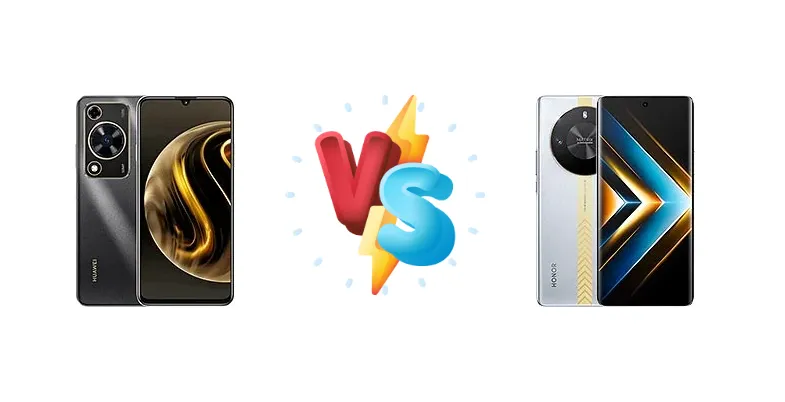
The Huawei Enjoy 70 and Honor X50 GT represent distinct approaches to the mid-range smartphone market. The Enjoy 70 focuses on providing a functional experience at an accessible price point, while the X50 GT aims to deliver near-flagship performance without the flagship price tag. This comparison dissects their core components to determine which device best suits your needs.
🏆 Quick Verdict
For the average user prioritizing performance and future-proofing, the Honor X50 GT is the clear winner. Its Snapdragon 8+ Gen 1 chipset offers a substantial leap in processing power and gaming capabilities compared to the Huawei Enjoy 70’s Kirin 710A. While the Enjoy 70 offers a more economical entry point, the X50 GT’s superior hardware justifies the price difference.
| Network |
|---|
| 2G bands | GSM 850 / 900 / 1800 / 1900 | GSM 850 / 900 / 1800 / 1900 |
| 3G bands | HSDPA 850 / 900 / 2100 | HSDPA 850 / 900 / 1700(AWS) / 1900 / 2100 |
| 4G bands | LTE | LTE |
| 5G bands | - | SA/NSA |
| Speed | HSPA, LTE | HSPA, LTE, 5G |
| Technology | GSM / HSPA / LTE | GSM / CDMA / HSPA / CDMA2000 / LTE / 5G |
| Launch |
|---|
| Announced | 2023, December 05 | 2024, January 04 |
| Status | Available. Released 2023, December 13 | Available. Released 2024, January 09 |
| Body |
|---|
| Dimensions | 168.3 x 77.7 x 8.9 mm (6.63 x 3.06 x 0.35 in) | 163.6 x 75.5 x 8 mm (6.44 x 2.97 x 0.31 in) |
| SIM | Nano-SIM + Nano-SIM | Nano-SIM + Nano-SIM |
| Weight | 207 g (7.30 oz) | 192 g (6.77 oz) |
| Display |
|---|
| Resolution | 720 x 1600 pixels, 20:9 ratio (~260 ppi density) | 1220 x 2652 pixels, 19.5:9 ratio (~431 ppi density) |
| Size | 6.75 inches, 110.0 cm2 (~84.1% screen-to-body ratio) | 6.78 inches, 112.6 cm2 (~91.2% screen-to-body ratio) |
| Type | TFT LCD | AMOLED, 1B colors, 120Hz |
| Platform |
|---|
| CPU | Octa-core (4x2.0 GHz Cortex-A73 & 4x1.7 GHz Cortex-A53) | Octa-core (1x3.0 GHz Cortex-X2 & 3x2.5 GHz Cortex-A710 & 4x1.80 GHz Cortex-A510) |
| Chipset | Kirin 710A (14 nm) | Qualcomm SM8475 Snapdragon 8+ Gen 1 (4 nm) |
| GPU | Mali-G51 MP4 | Adreno 730 |
| OS | HarmonyOS 4.0 | Android 13, MagicOS 7.2 |
| Memory |
|---|
| Card slot | Nano Memory (uses shared SIM slot) | No |
| Internal | 128GB 6GB RAM, 128GB 8GB RAM, 256GB 8GB RAM | 256GB 12GB RAM, 256GB 16GB RAM, 512GB 16GB RAM, 1TB 16GB RAM |
| Main Camera |
|---|
| Dual | 50 MP, f/1.8, (wide), AF
2 MP (macro) | 108 MP, f/1.8, (wide), 1/1.67", PDAF
Auxiliary lens |
| Features | LED flash, HDR, panorama | LED flash, panorama, HDR |
| Video | 1080p@30fps | 4K@30fps, 1080p@30fps |
| Selfie camera |
|---|
| Single | 8 MP, f/2.0, (wide) | 8 MP, f/2.0, (wide) |
| Video | 1080p@30fps | 1080p@30fps |
| Sound |
|---|
| 35mm jack | No | No |
| Loudspeaker | Yes | Yes |
| Comms |
|---|
| Bluetooth | 5.1, A2DP, LE | 5.2, A2DP, LE, aptX HD |
| NFC | No | Yes |
| Positioning | GPS, GLONASS, GALILEO, BDS, QZSS | GPS, GLONASS, GALILEO, BDS |
| Radio | No | No |
| USB | USB Type-C 2.0, OTG | USB Type-C 2.0, OTG |
| WLAN | Wi-Fi 802.11 a/b/g/n/ac, dual-band | Wi-Fi 802.11 a/b/g/n/ac/6, dual-band, Wi-Fi Direct |
| Features |
|---|
| Sensors | Fingerprint (side-mounted), accelerometer, proximity, compass | Fingerprint (under display, optical), accelerometer, gyro, ultrasound proximity, compass |
| Battery |
|---|
| Charging | 22.5W wired | 35W wired
7.5W reverse wired |
| Type | Li-Po 6000 mAh | Li-Po 5800 mAh |
| Misc |
|---|
| Colors | Black, White, Green | Black, Silver |
| Models | FGD-AL00 | ALP-AN00 |
| Price | About 160 EUR | About 260 EUR |
Huawei Enjoy 70
- More affordable price point
- Potentially longer software support (Huawei's ecosystem)
- Simpler user interface (potentially)
- Significantly weaker performance
- Slower charging speeds
- Less capable camera system
Honor X50 GT
- Flagship-level performance with Snapdragon 8+ Gen 1
- Faster 35W charging with reverse wired charging
- Likely superior display and camera quality
- Higher price tag
- Potential for more aggressive thermal throttling under sustained load (though mitigated by 4nm process)
- Honor's software update track record is less consistent than Huawei's
Display Comparison
Neither device's display specifications are provided, so a direct comparison is limited. However, given the X50 GT's positioning, it likely features a higher-quality panel with a faster refresh rate. The Enjoy 70, targeting a lower price bracket, likely utilizes a standard 60Hz LCD. Color accuracy and peak brightness are also expected to be superior on the X50 GT, enhancing media consumption.
Camera Comparison
Without detailed camera specifications, analysis is limited. However, the X50 GT, being a more premium device, likely incorporates a more sophisticated camera system with a larger sensor and improved image processing. The Enjoy 70 likely features a more basic camera setup focused on adequate image capture in good lighting conditions. The X50 GT’s ISP (Image Signal Processor) within the Snapdragon 8+ Gen 1 will offer superior noise reduction and dynamic range.
Performance
The performance disparity is the most significant difference. The Honor X50 GT’s Qualcomm Snapdragon 8+ Gen 1 (4nm) is a flagship-level chipset, featuring a Cortex-X2 prime core clocked at 3.0 GHz. This contrasts sharply with the Huawei Enjoy 70’s Kirin 710A (14nm), which utilizes older Cortex-A73 and A53 cores clocked at lower frequencies. The 4nm fabrication process of the Snapdragon 8+ Gen 1 provides significantly better power efficiency and thermal management, resulting in sustained performance during demanding tasks. The X50 GT will handle graphically intensive games and multitasking with ease, while the Enjoy 70 will struggle with more complex applications.
Battery Life
The Honor X50 GT’s 35W wired charging is considerably faster than the Huawei Enjoy 70’s 22.5W charging. This translates to significantly reduced charging times, allowing users to quickly top up their battery. The X50 GT also includes 7.5W reverse wired charging, a feature absent on the Enjoy 70. While battery capacity isn't specified, the Snapdragon 8+ Gen 1’s efficiency may offset a potentially smaller battery size on the X50 GT, resulting in comparable or even better real-world battery life.
Buying Guide
Buy the Huawei Enjoy 70 if you need a reliable, basic smartphone for everyday tasks like calling, texting, and light social media use, and prioritize affordability above all else. Buy the Honor X50 GT if you prefer a smoother, more responsive experience, enjoy mobile gaming, and want a device that will remain capable for years to come. The X50 GT is for users who value performance and longevity.
Frequently Asked Questions
❓ Will the Kirin 710A in the Enjoy 70 struggle with demanding games like Genshin Impact?
Yes, the Kirin 710A is not designed for graphically intensive games. While you might be able to run Genshin Impact at the lowest settings, expect significant frame rate drops and potential overheating. The Honor X50 GT’s Snapdragon 8+ Gen 1 will provide a much smoother and more enjoyable gaming experience.
❓ Does the Honor X50 GT get excessively hot during prolonged gaming sessions?
The Snapdragon 8+ Gen 1 is known for its efficiency, and the 4nm process helps mitigate thermal throttling. While some heat is inevitable during extended gaming, the X50 GT is expected to manage temperatures effectively, preventing significant performance degradation. The Enjoy 70, with its less efficient chipset, is more likely to throttle under load.
❓ Is the 7.5W reverse charging on the Honor X50 GT useful for topping up accessories?
Yes, the 7.5W reverse charging is convenient for slowly charging accessories like wireless earbuds or a smartwatch. It won't rapidly charge devices, but it's a useful feature for emergencies or when a power outlet isn't readily available.
❓ How does Huawei's software experience differ on the Enjoy 70 compared to Honor's on the X50 GT?
Huawei's EMUI (or HarmonyOS) on the Enjoy 70 is generally considered more mature and stable, with a focus on functionality. Honor's Magic UI on the X50 GT is more visually customizable and aims for a more modern aesthetic, but update consistency has been a concern in the past.