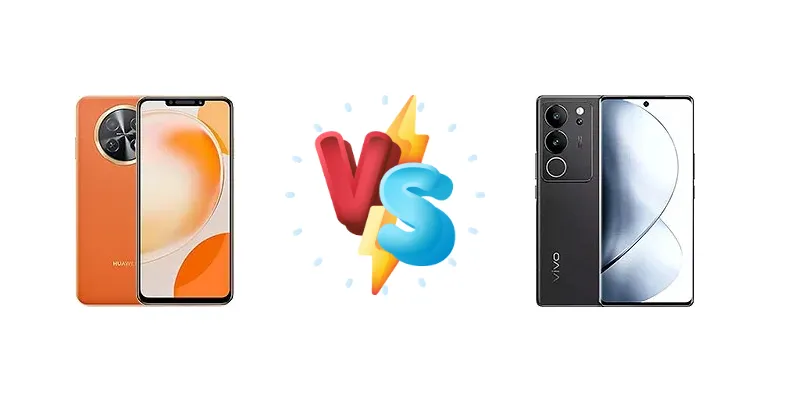
The Huawei Enjoy 60X and vivo V29 Pro represent distinct approaches to the mid-range smartphone market. The Enjoy 60X focuses on affordability and efficiency with a Snapdragon 680 chipset, while the V29 Pro aims for a more premium experience with the significantly more powerful Dimensity 8200. This comparison dissects their key differences to help you determine which device best suits your priorities.
🏆 Quick Verdict
For the average user prioritizing performance and fast charging, the vivo V29 Pro is the clear winner. Its Dimensity 8200 chipset offers a substantial leap in processing power, complemented by 80W charging. However, the Huawei Enjoy 60X remains a compelling option for budget-conscious users who value efficiency and don't require demanding performance.
| Network |
|---|
| 2G bands | GSM 850 / 900 / 1800 / 1900 | GSM 850 / 900 / 1800 / 1900 |
| 3G bands | HSDPA 850 / 900 / 2100 | HSDPA 850 / 900 / 1700(AWS) / 1900 / 2100 |
| 4G bands | 1, 3, 5, 8, 34, 38, 39, 40, 41 | 1, 3, 4, 5, 8, 19, 28, 34, 38, 39, 40, 41 |
| 5G bands | - | 1, 3, 5, 8, 28, 40, 77, 78 SA/NSA |
| Speed | HSPA, LTE | HSPA, LTE, 5G |
| Technology | GSM / HSPA / LTE | GSM / HSPA / LTE / 5G |
| Launch |
|---|
| Announced | 2023, April 17 | 2023, October 04 |
| Status | Available. Released 2023, April 27 | Available. Released 2023, October 10 |
| Body |
|---|
| Build | - | Glass front, glass back, plastic frame |
| Dimensions | 171.6 x 79.9 x 8.9 mm (6.76 x 3.15 x 0.35 in) | 164.2 x 74.4 x 7.5 mm (6.46 x 2.93 x 0.30 in) |
| SIM | Nano-SIM + Nano-SIM | Nano-SIM + Nano-SIM |
| Weight | 216 g (7.62 oz) | 188 g (6.63 oz) |
| Display |
|---|
| Resolution | 1080 x 2376 pixels (~376 ppi density) | 1260 x 2800 pixels, 20:9 ratio (~453 ppi density) |
| Size | 6.95 inches, 117.4 cm2 (~85.6% screen-to-body ratio) | 6.78 inches, 111.0 cm2 (~90.8% screen-to-body ratio) |
| Type | TFT LCD, 90Hz | AMOLED, 120Hz |
| Platform |
|---|
| CPU | Octa-core (4x2.4 GHz Kryo 265 Gold & 4x1.9 GHz Kryo 265 Silver) | Octa-core (1x3.1 GHz Cortex-A78 & 3x3.0 GHz Cortex-A78 & 4x2.0 GHz Cortex-A55) |
| Chipset | Qualcomm SM6225 Snapdragon 680 4G (6 nm) | Mediatek Dimensity 8200 (4 nm) |
| GPU | Adreno 610 | Mali-G610 MC6 |
| OS | HarmonyOS 3.0 | Android 13, up to 3 major Android upgrades, Funtouch 13 |
| Memory |
|---|
| Card slot | No | No |
| Internal | 128GB 8GB RAM, 256GB 8GB RAM, 512GB 8GB RAM | 256GB 8GB RAM, 256GB 12GB RAM |
| Main Camera |
|---|
| Dual | 50 MP, 26mm (wide), 1/1.8", PDAF
Auxiliary lens | 50 MP, f/1.9, (wide), 1/1.56", 1.0µm, PDAF, OIS
12 MP, f/2.0, (telephoto), 1/2.93", 1.22µm, PDAF, 2x optical zoom
8 MP, f/2.2, (ultrawide), 1/4.0", 1.12µm |
| Features | LED flash, HDR, panorama | Ring-LED flash, panorama, HDR |
| Video | 1080p@30fps | 4K@30fps, 1080p@30fps |
| Selfie camera |
|---|
| Single | 8 MP, f/2.0, (wide) | 50 MP, f/2.0, 22mm (wide), 1/2.76", 0.64µm, AF |
| Video | 1080p@30fps | 1080p@30fps |
| Sound |
|---|
| 3.5mm jack | No | - |
| 35mm jack | No | No |
| Loudspeaker | Yes, with stereo speakers | Yes |
| Comms |
|---|
| Bluetooth | 5.0, A2DP, LE | 5.3, A2DP, LE |
| NFC | Yes | No |
| Positioning | GPS, GLONASS, GALILEO, BDS, QZSS | GPS (L1), GLONASS (G1), BDS (B1I), GALILEO (E1), QZSS (L1), NavIC |
| Radio | Unspecified | No |
| USB | USB Type-C 2.0, OTG | USB Type-C 2.0, OTG |
| WLAN | Wi-Fi 802.11 a/b/g/n/ac, dual-band | Wi-Fi 802.11 a/b/g/n/ac, dual-band |
| Features |
|---|
| Sensors | Fingerprint (side-mounted), accelerometer, gyro, proximity, compass | Fingerprint (under display, optical), accelerometer, gyro, proximity, compass |
| Battery |
|---|
| Charging | 22.5W wired
22.5W reverse wired (512GB only) | 80W wired, 50% in 18 min |
| Type | Li-Po 7000 mAh | 4600 mAh |
| Misc |
|---|
| Colors | Black, Silver, Green, Orange | Himalayan Blue, Space Black, Pink |
| Models | STG-AL00 | V2251 |
| Price | About 230 EUR | About 460 EUR |
| SAR | - | 1.17 W/kg (head) 0.77 W/kg (body) |
Huawei Enjoy 60X
- Excellent power efficiency with Snapdragon 680
- Potentially lower price point
- Reverse wired charging (512GB model)
- Significantly weaker performance compared to the V29 Pro
- Slower charging speed (22.5W)
- Limited camera capabilities (specifications unknown)
vivo V29 Pro
- Powerful Dimensity 8200 chipset for smooth performance
- Ultra-fast 80W charging
- Bright and vibrant display (1029 nits)
- Higher price tag
- Potentially shorter battery life compared to Enjoy 60X (despite good endurance rating)
- No reverse charging mentioned
Display Comparison
The vivo V29 Pro boasts a significantly brighter display, reaching a measured peak of 1029 nits, ensuring excellent visibility even in direct sunlight. While the Enjoy 60X’s display specifications are not provided, it’s likely to be considerably dimmer. The V29 Pro’s brightness advantage is crucial for outdoor use and HDR content consumption. We lack information on panel technology (e.g., AMOLED vs. LCD) for the Enjoy 60X, but the V29 Pro’s brightness suggests a higher-quality panel overall.
Camera Comparison
The context data only mentions 'Photo / Video' capabilities for the vivo V29 Pro, lacking specific sensor details. However, given its positioning, it likely features a more sophisticated camera system than the Enjoy 60X. The Enjoy 60X’s camera specs are also absent, suggesting a more basic setup. The Dimensity 8200’s integrated ISP (Image Signal Processor) in the V29 Pro will also contribute to better image processing and low-light performance. Without detailed sensor information, it’s difficult to make a precise comparison, but the V29 Pro’s chipset and likely sensor quality give it a clear advantage.
Performance
The performance gap between these two devices is substantial. The vivo V29 Pro’s Mediatek Dimensity 8200, built on a 4nm process, is a flagship-level chipset, featuring an octa-core configuration with a high-clocked Cortex-A78 prime core. This contrasts sharply with the Huawei Enjoy 60X’s Qualcomm Snapdragon 680 (6nm), which prioritizes efficiency over outright speed. The Dimensity 8200’s architecture allows for significantly faster app loading, smoother multitasking, and a far superior gaming experience. The Snapdragon 680 is adequate for everyday tasks, but will struggle with graphically intensive applications.
Battery Life
The vivo V29 Pro achieves an impressive active use score of 12:07h and an endurance rating of 113h, indicating excellent battery life. While the Enjoy 60X’s battery capacity is unknown, its Snapdragon 680 chipset is known for its power efficiency. However, the V29 Pro’s 80W wired charging, capable of reaching 50% charge in just 18 minutes, is a game-changer. The Enjoy 60X’s 22.5W charging is significantly slower, requiring considerably more time to fully recharge. The V29 Pro’s faster charging mitigates any potential battery capacity disadvantage.
Buying Guide
Buy the Huawei Enjoy 60X if you need a reliable, long-lasting phone for basic tasks like calling, texting, and social media, and prioritize battery life over raw speed. Buy the vivo V29 Pro if you prefer a smoother, more responsive experience for gaming, multitasking, and photography, and are willing to pay a premium for faster charging and a more powerful processor.
Frequently Asked Questions
❓ Does the Dimensity 8200 in the vivo V29 Pro get hot during extended gaming sessions?
While the Dimensity 8200 is a powerful chip, its 4nm fabrication process and the V29 Pro’s likely thermal management system should prevent significant overheating during typical gaming. However, prolonged, high-intensity gaming will inevitably generate heat, potentially leading to some performance throttling, though less so than with less efficient chipsets.
❓ Is the 22.5W charging on the Huawei Enjoy 60X slow enough to be a major inconvenience?
For casual users, 22.5W charging is adequate, but it will take considerably longer to fully charge the device compared to the V29 Pro’s 80W charging. Expect a full charge to take well over an hour, which may be inconvenient for users accustomed to faster charging speeds.
❓ What kind of gaming performance can I expect from the Snapdragon 680 in the Huawei Enjoy 60X?
The Snapdragon 680 can handle less demanding mobile games at medium settings. However, graphically intensive titles like PUBG or Genshin Impact will likely require significant compromises in graphics settings to achieve playable frame rates. It's best suited for casual gaming rather than competitive or visually demanding experiences.