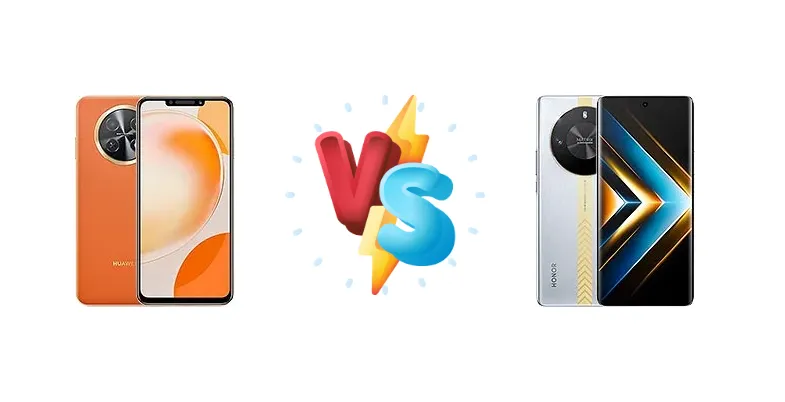
The Huawei Enjoy 60X and Honor X50 GT represent distinct approaches to the mid-range smartphone market. The Enjoy 60X prioritizes affordability and potentially longer software support within the Huawei ecosystem, while the X50 GT aggressively targets gamers and power users with a significantly more potent chipset. This comparison dissects the core differences to determine which device delivers the best experience for your needs.
🏆 Quick Verdict
For the average user prioritizing smooth performance and gaming capabilities, the Honor X50 GT is the clear winner. Its Snapdragon 8+ Gen 1 chipset offers a substantial leap in processing power compared to the Enjoy 60X’s Snapdragon 680. While the Enjoy 60X offers respectable battery life, the X50 GT’s faster charging and superior performance justify the price difference.
| Network |
|---|
| 2G bands | GSM 850 / 900 / 1800 / 1900 | GSM 850 / 900 / 1800 / 1900 |
| 3G bands | HSDPA 850 / 900 / 2100 | HSDPA 850 / 900 / 1700(AWS) / 1900 / 2100 |
| 4G bands | 1, 3, 5, 8, 34, 38, 39, 40, 41 | LTE |
| 5G bands | - | SA/NSA |
| Speed | HSPA, LTE | HSPA, LTE, 5G |
| Technology | GSM / HSPA / LTE | GSM / CDMA / HSPA / CDMA2000 / LTE / 5G |
| Launch |
|---|
| Announced | 2023, April 17 | 2024, January 04 |
| Status | Available. Released 2023, April 27 | Available. Released 2024, January 09 |
| Body |
|---|
| Dimensions | 171.6 x 79.9 x 8.9 mm (6.76 x 3.15 x 0.35 in) | 163.6 x 75.5 x 8 mm (6.44 x 2.97 x 0.31 in) |
| SIM | Nano-SIM + Nano-SIM | Nano-SIM + Nano-SIM |
| Weight | 216 g (7.62 oz) | 192 g (6.77 oz) |
| Display |
|---|
| Resolution | 1080 x 2376 pixels (~376 ppi density) | 1220 x 2652 pixels, 19.5:9 ratio (~431 ppi density) |
| Size | 6.95 inches, 117.4 cm2 (~85.6% screen-to-body ratio) | 6.78 inches, 112.6 cm2 (~91.2% screen-to-body ratio) |
| Type | TFT LCD, 90Hz | AMOLED, 1B colors, 120Hz |
| Platform |
|---|
| CPU | Octa-core (4x2.4 GHz Kryo 265 Gold & 4x1.9 GHz Kryo 265 Silver) | Octa-core (1x3.0 GHz Cortex-X2 & 3x2.5 GHz Cortex-A710 & 4x1.80 GHz Cortex-A510) |
| Chipset | Qualcomm SM6225 Snapdragon 680 4G (6 nm) | Qualcomm SM8475 Snapdragon 8+ Gen 1 (4 nm) |
| GPU | Adreno 610 | Adreno 730 |
| OS | HarmonyOS 3.0 | Android 13, MagicOS 7.2 |
| Memory |
|---|
| Card slot | No | No |
| Internal | 128GB 8GB RAM, 256GB 8GB RAM, 512GB 8GB RAM | 256GB 12GB RAM, 256GB 16GB RAM, 512GB 16GB RAM, 1TB 16GB RAM |
| Main Camera |
|---|
| Dual | 50 MP, 26mm (wide), 1/1.8", PDAF
Auxiliary lens | 108 MP, f/1.8, (wide), 1/1.67", PDAF
Auxiliary lens |
| Features | LED flash, HDR, panorama | LED flash, panorama, HDR |
| Video | 1080p@30fps | 4K@30fps, 1080p@30fps |
| Selfie camera |
|---|
| Single | 8 MP, f/2.0, (wide) | 8 MP, f/2.0, (wide) |
| Video | 1080p@30fps | 1080p@30fps |
| Sound |
|---|
| 3.5mm jack | No | - |
| 35mm jack | No | No |
| Loudspeaker | Yes, with stereo speakers | Yes |
| Comms |
|---|
| Bluetooth | 5.0, A2DP, LE | 5.2, A2DP, LE, aptX HD |
| NFC | Yes | Yes |
| Positioning | GPS, GLONASS, GALILEO, BDS, QZSS | GPS, GLONASS, GALILEO, BDS |
| Radio | Unspecified | No |
| USB | USB Type-C 2.0, OTG | USB Type-C 2.0, OTG |
| WLAN | Wi-Fi 802.11 a/b/g/n/ac, dual-band | Wi-Fi 802.11 a/b/g/n/ac/6, dual-band, Wi-Fi Direct |
| Features |
|---|
| Sensors | Fingerprint (side-mounted), accelerometer, gyro, proximity, compass | Fingerprint (under display, optical), accelerometer, gyro, ultrasound proximity, compass |
| Battery |
|---|
| Charging | 22.5W wired
22.5W reverse wired (512GB only) | 35W wired
7.5W reverse wired |
| Type | Li-Po 7000 mAh | Li-Po 5800 mAh |
| Misc |
|---|
| Colors | Black, Silver, Green, Orange | Black, Silver |
| Models | STG-AL00 | ALP-AN00 |
| Price | About 230 EUR | About 260 EUR |
Huawei Enjoy 60X
- Potentially longer battery life (depending on capacity)
- More affordable price point
- Reverse wired charging (512GB model)
- Significantly weaker performance
- Slower charging speeds
- Limited gaming capabilities
Honor X50 GT
- Exceptional performance with Snapdragon 8+ Gen 1
- Faster 35W wired charging
- Superior gaming experience
- Potentially shorter battery life
- Higher price tag
- May run warmer under heavy load
Display Comparison
Neither device boasts a standout display. While specific panel details (like peak brightness in nits or color gamut coverage) are absent, the core difference lies elsewhere. Both likely utilize LCD panels given their price points. The focus here isn't display quality, but rather the performance driving what's *on* the display.
Camera Comparison
Without detailed camera specs beyond the chipsets, a direct comparison is limited. However, the processing power of the Snapdragon 8+ Gen 1 in the X50 GT will enable more sophisticated image processing algorithms, potentially leading to better dynamic range and low-light performance. The Enjoy 60X will likely rely on simpler algorithms, resulting in less refined images. The absence of OIS information for either device suggests a reliance on software stabilization.
Performance
The performance gap is the defining characteristic of this comparison. The Honor X50 GT’s Snapdragon 8+ Gen 1 (4nm) is a flagship-level chipset, featuring a Cortex-X2 prime core clocked at 3.0 GHz, alongside three Cortex-A710 performance cores and four Cortex-A510 efficiency cores. This architecture delivers a dramatically superior experience compared to the Huawei Enjoy 60X’s Snapdragon 680 (6nm). The 680, with its Kryo 265 Gold and Silver cores peaking at 2.4 GHz, is designed for efficiency, not raw power. The 4nm process node of the 8+ Gen 1 also contributes to better thermal efficiency, meaning sustained performance under load will be significantly higher on the X50 GT, crucial for gaming. The X50 GT will handle graphically intensive games and multitasking with ease, while the Enjoy 60X will struggle with demanding titles.
Battery Life
The Huawei Enjoy 60X benefits from a potentially larger battery capacity (spec not provided), aiming for all-day battery life with moderate usage. However, the Honor X50 GT compensates with significantly faster 35W wired charging, allowing for a quicker top-up. The Enjoy 60X’s 22.5W charging is comparatively slow. While the X50 GT’s more powerful chipset consumes more energy, the faster charging mitigates this concern, offering more flexibility for users who frequently need to recharge. The 22.5W reverse wired charging on the 512GB Enjoy 60X variant is a niche feature, while the X50 GT offers 7.5W reverse charging.
Buying Guide
Buy the Huawei Enjoy 60X if you need a reliable, budget-friendly device for everyday tasks like calling, texting, social media, and light web browsing, and value a potentially more stable software experience within the Huawei ecosystem. Buy the Honor X50 GT if you prioritize gaming, demanding applications, and future-proofing, and are willing to trade some battery life for significantly enhanced performance and faster charging.
Frequently Asked Questions
❓ Will the Snapdragon 680 in the Enjoy 60X struggle with demanding games like Genshin Impact?
Yes, the Snapdragon 680 is not designed for graphically intensive games like Genshin Impact. You'll likely experience significant frame rate drops and stuttering, even on low settings. The Honor X50 GT’s Snapdragon 8+ Gen 1 is far better equipped to handle such titles smoothly.
❓ How much faster is the 35W charging on the Honor X50 GT compared to the 22.5W on the Enjoy 60X?
The 35W charging on the X50 GT will significantly reduce charging times. While exact 0-100% times are unavailable, expect a noticeably quicker top-up compared to the Enjoy 60X. This is particularly beneficial for users who frequently need to recharge their phones throughout the day.
❓ Does the Honor X50 GT get excessively hot during prolonged gaming sessions?
The Snapdragon 8+ Gen 1 is known for its thermal efficiency, but it can still generate heat under sustained load. The X50 GT likely incorporates thermal management solutions to mitigate overheating, but some warmth is expected during extended gaming. The 680 in the Enjoy 60X will generate less heat, but at the cost of performance.