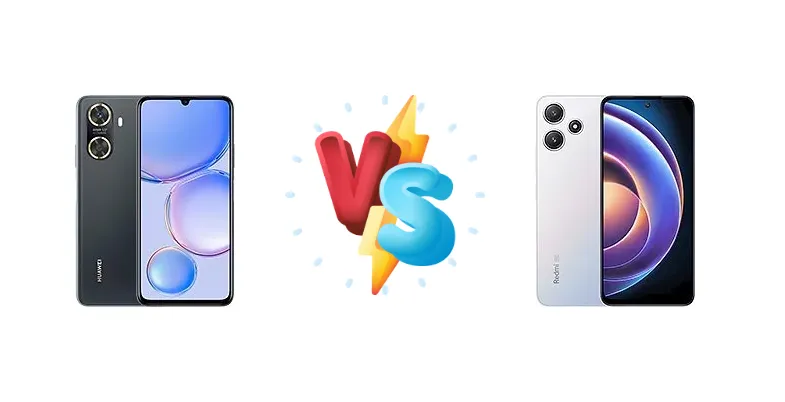
The Huawei Enjoy 60 and Xiaomi Redmi Note 12R represent two distinct approaches to the budget smartphone market. The Enjoy 60 focuses on a streamlined user experience within Huawei’s ecosystem, while the Redmi Note 12R leverages Qualcomm’s latest entry-level silicon for a performance boost. This comparison dissects their key differences to determine which device offers the best value.
🏆 Quick Verdict
For most users, the Xiaomi Redmi Note 12R is the superior choice. Its Qualcomm Snapdragon 4 Gen 2 chipset, built on a 4nm process, delivers noticeably better performance and efficiency compared to the Enjoy 60. While the Enjoy 60 may appeal to those deeply invested in the Huawei ecosystem, the Redmi Note 12R offers a more future-proof and capable experience.
| Network |
|---|
| 2G bands | GSM 850 / 900 / 1800 / 1900 | GSM 850 / 900 / 1800 / 1900 |
| 3G bands | HSDPA 850 / 900 / 2100 | HSDPA 850 / 900 / 2100 |
| 4G bands | 1, 3, 5, 8, 34, 38, 39, 40, 41 | 1, 3, 5, 8, 34, 38, 39, 40, 41 |
| 5G bands | - | 1, 5, 8, 28, 41, 78 SA/NSA |
| Speed | HSPA, LTE | HSPA, LTE, 5G |
| Technology | GSM / HSPA / LTE | GSM / CDMA / HSPA / EVDO / LTE / 5G |
| Launch |
|---|
| Announced | 2023, March 23 | 2023, June 28 |
| Status | Available. Released 2023, March 26 | Available. Released 2023, June 28 |
| Body |
|---|
| Build | - | Glass front, plastic frame, glass back |
| Dimensions | 168.3 x 77.7 x 9 mm (6.63 x 3.06 x 0.35 in) | 168.6 x 76.3 x 8.2 mm (6.64 x 3.00 x 0.32 in) |
| SIM | Nano-SIM + Nano-SIM | Nano-SIM + Nano-SIM |
| Weight | 199 g (7.02 oz) | 199 g (7.02 oz) |
| Display |
|---|
| Resolution | 720 x 1600 pixels, 20:9 ratio (~260 ppi density) | 1080 x 2460 pixels (~396 ppi density) |
| Size | 6.75 inches, 110.0 cm2 (~84.1% screen-to-body ratio) | 6.79 inches, 109.5 cm2 (~85.1% screen-to-body ratio) |
| Type | TFT LCD | IPS LCD, 90Hz, 550 nits |
| Platform |
|---|
| CPU | - | Octa-core (2x2.2 GHz Cortex-A78 & 6x1.95 GHz Cortex-A55) |
| Chipset | - | Qualcomm SM4450 Snapdragon 4 Gen 2 (4 nm) |
| GPU | - | Adreno 613 |
| OS | HarmonyOS 3.0 | Android 13, MIUI 14 |
| Memory |
|---|
| Card slot | microSDXC | microSDXC (uses shared SIM slot) |
| Internal | 128GB 8GB RAM, 256GB 8GB RAM | 128GB 4GB RAM, 128GB 6GB RAM, 128GB 8GB RAM, 256GB 8GB RAM |
| Main Camera |
|---|
| Dual | 48 MP, f/1.8, (wide), 1/2.0", AF
Auxiliary lens | 50 MP, f/1.8, (wide), PDAF
2 MP (macro) |
| Features | Dual-LED dual-tone flash, HDR, panorama | LED flash, HDR |
| Video | 1080p@30fps | 1080p@30fps |
| Selfie camera |
|---|
| Features | - | HDR |
| Single | 8 MP, f/2.0, (wide) | 5 MP, f/2.2, (wide), 1/5.0", 1.12µm |
| Video | 1080p@30fps | 1080p@30fps |
| Sound |
|---|
| 3.5mm jack | Yes | - |
| 35mm jack | Yes | Yes |
| Loudspeaker | Yes | Yes |
| Comms |
|---|
| Bluetooth | 5.1, A2DP, LE | 5.3, A2DP, LE |
| Infrared port | - | Yes |
| NFC | No | Yes (market/region dependent) |
| Positioning | GPS, GLONASS, GALILEO, BDS, QZSS | GPS, GLONASS, GALILEO, BDS |
| Radio | FM radio | No |
| USB | USB Type-C 2.0, OTG | USB Type-C |
| WLAN | Wi-Fi 802.11 b/g/n | Wi-Fi 802.11 a/b/g/n/ac, dual-band |
| Features |
|---|
| Sensors | Fingerprint (side-mounted), accelerometer, compass | Fingerprint (side-mounted), accelerometer, compass |
| Battery |
|---|
| Charging | 22.5W wired | 18W wired, PD |
| Type | Li-Po 6000 mAh | Li-Po 5000 mAh |
| Misc |
|---|
| Colors | Black, Blue, Gold | Black, Blue, Silver |
| Models | MGA-AL40 | 23076RA4BC |
| Price | About 170 EUR | About 150 EUR |
Huawei Enjoy 60
- Potentially simpler, Huawei-centric software experience.
- May appeal to existing Huawei ecosystem users.
- 22.5W charging (potentially faster, but lacks PD)
- Likely weaker processor performance.
- Less efficient chipset.
- Limited future-proofing.
Xiaomi Redmi Note 12R
- More powerful and efficient Snapdragon 4 Gen 2 (4nm).
- PD charging for wider compatibility.
- Better multitasking and gaming performance.
- Xiaomi’s MIUI software can be polarizing.
- May lack some of Huawei’s software optimizations.
Display Comparison
Neither device boasts a standout display. Given the lack of detailed display specs for the Enjoy 60, we can assume it utilizes a standard LCD panel typical of its price range. The Redmi Note 12R, similarly, is expected to feature an LCD. The key difference lies in software optimization; Huawei often emphasizes color calibration, while Xiaomi tends towards more vibrant, saturated colors. Without specific nit brightness or color gamut data, it’s difficult to declare a clear winner, but the Redmi Note 12R’s potential for higher peak brightness due to its more modern chipset could give it a slight edge.
Camera Comparison
Without detailed camera specifications for the Huawei Enjoy 60, a direct comparison is challenging. However, both devices likely feature a primary camera paired with depth or macro sensors. The Redmi Note 12R’s image processing benefits from Qualcomm’s ISP, potentially offering better dynamic range and noise reduction. While neither phone is expected to compete with flagship camera systems, the Redmi Note 12R’s chipset provides a more robust foundation for computational photography, potentially resulting in more detailed and vibrant images. We anticipate both phones will feature similar low-light performance, limited by sensor size and aperture.
Performance
The Xiaomi Redmi Note 12R’s Qualcomm Snapdragon 4 Gen 2 (4nm) is the clear performance champion. This chipset features an octa-core configuration with 2x 2.2 GHz Cortex-A78 cores and 6x 1.95 GHz Cortex-A55 cores, offering a significant upgrade over the likely MediaTek or Unisoc chip found in the Huawei Enjoy 60. The 4nm fabrication process is crucial, delivering superior power efficiency and reduced thermal throttling during sustained workloads. This translates to smoother multitasking, faster app loading times, and a more enjoyable gaming experience on the Redmi Note 12R. The Enjoy 60 will likely struggle with demanding applications and may exhibit noticeable lag.
Battery Life
The Redmi Note 12R’s 18W charging with Power Delivery (PD) offers a more versatile charging experience than the Enjoy 60’s 22.5W wired charging. PD allows for compatibility with a wider range of chargers and accessories. While the Enjoy 60’s higher wattage *suggests* faster charging, the Redmi Note 12R’s more efficient chipset and PD support could result in comparable or even faster real-world charging times. Battery capacity is not specified for either device, but given their market segment, we can expect capacities around 5000mAh. The Snapdragon 4 Gen 2’s efficiency will likely translate to longer battery life on the Redmi Note 12R, even with a similar capacity.
Buying Guide
Buy the Huawei Enjoy 60 if you prioritize a simple, Huawei-centric software experience and are already invested in their ecosystem. It’s a good option for basic tasks and users who value simplicity over raw power. Buy the Xiaomi Redmi Note 12R if you prioritize performance, efficiency, and future-proofing. The Snapdragon 4 Gen 2 provides a significant advantage for gaming, multitasking, and overall responsiveness, making it ideal for users who demand more from their smartphone.
Frequently Asked Questions
❓ Does the Redmi Note 12R’s Snapdragon 4 Gen 2 handle popular games like PUBG Mobile and Call of Duty?
Yes, the Snapdragon 4 Gen 2 is capable of running PUBG Mobile and Call of Duty at medium settings with playable frame rates. While it won’t deliver a flagship gaming experience, it provides a significant improvement over older entry-level chipsets, allowing for enjoyable gaming sessions without excessive lag or overheating.
❓ Is the 18W charging on the Redmi Note 12R slow compared to other phones?
While 18W isn't the fastest charging available, the Redmi Note 12R’s support for Power Delivery (PD) and the Snapdragon 4 Gen 2’s efficiency mean it can charge relatively quickly. Expect a full charge in around 2-2.5 hours, and the PD support allows you to use a wider range of chargers, including those from laptops and tablets.
❓ How does Huawei’s software experience differ on the Enjoy 60 compared to Xiaomi’s MIUI on the Redmi Note 12R?
Huawei’s software is known for its simplicity and focus on core functionality, but it lacks full Google Mobile Services (GMS) due to ongoing restrictions. This means no pre-installed Google apps and reliance on Huawei’s AppGallery. Xiaomi’s MIUI is more feature-rich and customizable, but it can also be more bloated with pre-installed apps and advertisements. The choice depends on your preference for a streamlined or feature-packed experience.