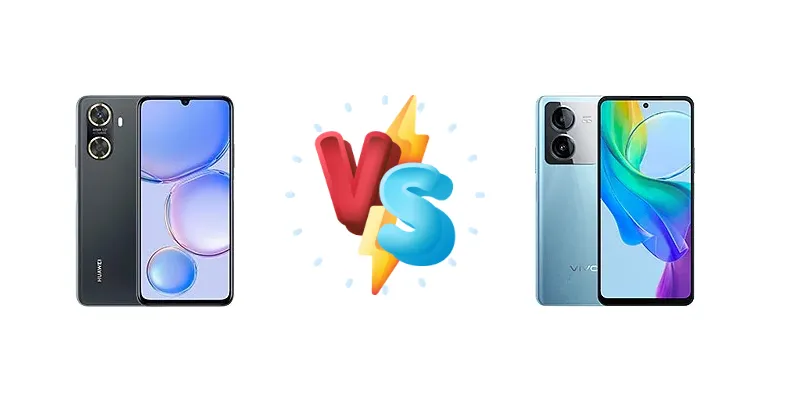
The sub-$200 smartphone market is fiercely competitive. The Huawei Enjoy 60 and vivo Y78t represent two distinct approaches: Huawei prioritizing a streamlined experience, while vivo leverages Qualcomm's Snapdragon 6 Gen 1 for a performance boost. This comparison dissects their key differences to help you choose the right device.
🏆 Quick Verdict
For users prioritizing raw performance and faster charging, the vivo Y78t is the clear winner. Its Snapdragon 6 Gen 1 chipset and 44W charging significantly outperform the Enjoy 60's more modest specifications. However, the Enjoy 60 may appeal to those seeking a simpler, potentially more efficient experience.
| Network |
|---|
| 2G bands | GSM 850 / 900 / 1800 / 1900 | GSM 850 / 900 / 1800 / 1900 |
| 3G bands | HSDPA 850 / 900 / 2100 | HSDPA 850 / 900 / 2100 |
| 4G bands | 1, 3, 5, 8, 34, 38, 39, 40, 41 | 1, 3, 5, 8, 28, 34, 38, 39, 40, 41 |
| 5G bands | - | 1, 3, 5, 8, 28, 38, 40, 41, 77, 78 SA/NSA |
| Speed | HSPA, LTE | HSPA, LTE, 5G |
| Technology | GSM / HSPA / LTE | GSM / CDMA / HSPA / CDMA2000 / LTE / 5G |
| Launch |
|---|
| Announced | 2023, March 23 | 2023, October 20 |
| Status | Available. Released 2023, March 26 | Available. Released 2023, October 24 |
| Body |
|---|
| Build | - | Glass front, plastic frame, plastic back |
| Dimensions | 168.3 x 77.7 x 9 mm (6.63 x 3.06 x 0.35 in) | 164.6 x 75.8 x 9.1 mm (6.48 x 2.98 x 0.36 in) |
| SIM | Nano-SIM + Nano-SIM | Nano-SIM + Nano-SIM |
| Weight | 199 g (7.02 oz) | 199.6 g (7.05 oz) |
| Display |
|---|
| Resolution | 720 x 1600 pixels, 20:9 ratio (~260 ppi density) | 1080 x 2388 pixels (~395 ppi density) |
| Size | 6.75 inches, 110.0 cm2 (~84.1% screen-to-body ratio) | 6.64 inches, 106.8 cm2 (~85.6% screen-to-body ratio) |
| Type | TFT LCD | IPS LCD, 120Hz |
| Platform |
|---|
| CPU | - | Octa-core (4x2.2 GHz Cortex-A78 & 4x1.8 GHz Cortex-A55) |
| Chipset | - | Qualcomm SM6450 Snapdragon 6 Gen 1 (4 nm) |
| GPU | - | Adreno 710 |
| OS | HarmonyOS 3.0 | Android 13, OriginOS 3 |
| Memory |
|---|
| Card slot | microSDXC | No |
| Internal | 128GB 8GB RAM, 256GB 8GB RAM | 128GB 8GB RAM, 256GB 8GB RAM, 256GB 12GB RAM |
| Main Camera |
|---|
| Dual | 48 MP, f/1.8, (wide), 1/2.0", AF
Auxiliary lens | 50 MP, f/1.8, (wide), PDAF
Auxiliary lens |
| Features | Dual-LED dual-tone flash, HDR, panorama | Dual-LED dual-tone flash, HDR, panorama |
| Video | 1080p@30fps | 4K@30fps |
| Selfie camera |
|---|
| Single | 8 MP, f/2.0, (wide) | 8 MP, f/2.0, (wide) |
| Video | 1080p@30fps | 1080p@30fps |
| Sound |
|---|
| 3.5mm jack | Yes | - |
| 35mm jack | Yes | Yes |
| Loudspeaker | Yes | Yes |
| Comms |
|---|
| Bluetooth | 5.1, A2DP, LE | 5.1, A2DP, LE, aptX HD, aptX Adaptive |
| NFC | No | No |
| Positioning | GPS, GLONASS, GALILEO, BDS, QZSS | GPS (L1), GLONASS (G1), BDS (B1c), GALILEO (E1), QZSS (L1) |
| Radio | FM radio | No |
| USB | USB Type-C 2.0, OTG | USB Type-C 2.0, OTG |
| WLAN | Wi-Fi 802.11 b/g/n | Wi-Fi 802.11 a/b/g/n/ac, dual-band, Wi-Fi Direct |
| Features |
|---|
| Sensors | Fingerprint (side-mounted), accelerometer, compass | Fingerprint (side-mounted), accelerometer, gyro, proximity, compass |
| Battery |
|---|
| Charging | 22.5W wired | 44W wired |
| Type | Li-Po 6000 mAh | 6000 mAh |
| Misc |
|---|
| Colors | Black, Blue, Gold | Black, Blue, Silver |
| Models | MGA-AL40 | - |
| Price | About 170 EUR | About 200 EUR |
Huawei Enjoy 60
- Potentially better battery efficiency (depending on chipset)
- Simplified user experience (typical of Huawei)
- Likely more affordable
- Significantly weaker performance (due to unknown chipset)
- Slower 22.5W charging
- Limited camera capabilities (based on market segment)
vivo Y78t
- Powerful Snapdragon 6 Gen 1 (4nm)
- Fast 44W wired charging
- Improved multitasking and gaming performance
- Potentially shorter battery life (due to more powerful chipset)
- May be slightly more expensive
- Software experience may be less streamlined than Huawei
Display Comparison
Display specifications are currently unavailable for both devices. However, given their price points, we anticipate both will utilize LCD panels. The absence of information regarding refresh rates suggests a standard 60Hz experience on both. Bezels are likely to be comparable, prioritizing cost-effectiveness over premium aesthetics. Color accuracy will likely be tuned for vibrant, rather than color-accurate, visuals.
Camera Comparison
Camera details for the Huawei Enjoy 60 are unavailable. The vivo Y78t’s camera specifications are also limited, but the presence of a Qualcomm chipset suggests potentially better image signal processing (ISP) capabilities. Without sensor size or aperture information, a direct comparison is difficult. It's reasonable to assume both devices will feature a primary camera and depth/macro sensors, but image quality will heavily depend on software optimization and sensor quality, which are currently unknown. We anticipate both will struggle in low-light conditions.
Performance
The vivo Y78t’s Qualcomm Snapdragon 6 Gen 1 (4nm) represents a substantial advantage over the Huawei Enjoy 60, which lacks chipset information. The Snapdragon 6 Gen 1’s octa-core configuration – 4x2.2 GHz Cortex-A78 and 4x1.8 GHz Cortex-A55 – provides a significant uplift in CPU performance, benefiting multitasking and app loading times. The 4nm process node is crucial; it delivers superior power efficiency compared to older, larger nodes, translating to less heat generation and potentially sustained performance during extended use. This benefits gamers and users running demanding applications. The Enjoy 60, lacking a specified chipset, likely relies on a less powerful, older generation processor.
Battery Life
Battery capacity for both devices is currently unknown. However, the vivo Y78t’s 44W wired charging is a significant advantage over the Huawei Enjoy 60’s 22.5W charging. This translates to a considerably faster 0-100% charge time for the Y78t, offering greater convenience for users who frequently need to top up their battery. While a larger battery capacity on the Enjoy 60 could partially offset the slower charging, the Y78t’s faster charging speed is a compelling benefit.
Buying Guide
Buy the Huawei Enjoy 60 if you need a reliable, basic smartphone with a focus on simplicity and potentially longer battery life due to the less power-hungry chipset. Buy the vivo Y78t if you prefer a smoother, more responsive experience for gaming and multitasking, and value the convenience of significantly faster 44W wired charging.
Frequently Asked Questions
❓ Will the Snapdragon 6 Gen 1 in the vivo Y78t handle demanding games like PUBG Mobile?
The Snapdragon 6 Gen 1 is capable of running PUBG Mobile, but expect to play at medium settings for a smooth experience. The 4nm process helps with thermal management, but extended gaming sessions may still result in some throttling. The Huawei Enjoy 60, with its unknown chipset, is likely to struggle with demanding titles.
❓ How long will it take to fully charge the vivo Y78t with the 44W charger?
While a precise time is unavailable, 44W charging typically takes around 60-90 minutes for a full charge, depending on the battery capacity (which is currently unknown). This is significantly faster than the Huawei Enjoy 60’s 22.5W charging, which could take over two hours.
❓ Is the lack of detailed camera information a concern for both phones?
Yes, the limited camera specifications are a significant drawback. Both phones likely feature basic camera setups suitable for casual photography, but don't expect flagship-level image quality. The image processing capabilities of the Snapdragon 6 Gen 1 in the Y78t *may* offer a slight advantage.