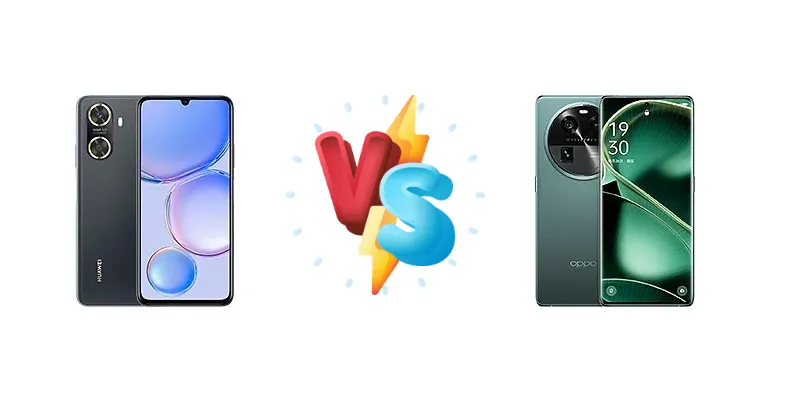
The smartphone market is brimming with options, making it tough to choose. Today, we pit the budget-friendly Huawei Enjoy 60 against the flagship Oppo Find X6. This comparison will break down their key differences to help you determine which device best suits your needs and budget.
🏆 Quick Verdict
The Oppo Find X6 is the clear winner, boasting a significantly more powerful chipset, faster charging, and a superior camera system. However, the Huawei Enjoy 60 offers a more accessible price point for budget-conscious buyers seeking a reliable daily driver.
| Network |
|---|
| 2G bands | GSM 850 / 900 / 1800 / 1900 | GSM 850 / 900 / 1800 / 1900 |
| 3G bands | HSDPA 850 / 900 / 2100 | HSDPA 800 / 850 / 900 / 1700(AWS) / 1900 / 2100 |
| 4G bands | 1, 3, 5, 8, 34, 38, 39, 40, 41 | 1, 2, 3, 4, 5, 7, 8, 12, 17, 18, 19, 20, 26, 28, 34, 38, 39, 40, 41, 66 |
| 5G bands | - | 1, 3, 5, 7, 8, 20, 28, 38, 40, 41, 66, 77, 78, 79 SA/NSA |
| Speed | HSPA, LTE | HSPA, LTE, 5G |
| Technology | GSM / HSPA / LTE | GSM / CDMA / HSPA / CDMA2000 / LTE / 5G |
| | - | CDMA2000 1x |
| Launch |
|---|
| Announced | 2023, March 23 | 2023, March 21 |
| Status | Available. Released 2023, March 26 | Available. Released 2023, March 24 |
| Body |
|---|
| Dimensions | 168.3 x 77.7 x 9 mm (6.63 x 3.06 x 0.35 in) | 162.9 x 74.1 x 9 mm (6.41 x 2.92 x 0.35 in) |
| SIM | Nano-SIM + Nano-SIM | Nano-SIM + Nano-SIM |
| Weight | 199 g (7.02 oz) | 207 g (7.30 oz) |
| | - | IP64 dustproof and water splashproof |
| Display |
|---|
| Protection | - | Unspecified |
| Resolution | 720 x 1600 pixels, 20:9 ratio (~260 ppi density) | 1240 x 2772 pixels, 20:9 ratio (~451 ppi density) |
| Size | 6.75 inches, 110.0 cm2 (~84.1% screen-to-body ratio) | 6.74 inches, 109.2 cm2 (~90.5% screen-to-body ratio) |
| Type | TFT LCD | AMOLED, 1B colors, 120Hz, HDR10+, 1100 nits (HBM), 1450 nits (peak) |
| Platform |
|---|
| CPU | - | Octa-core (1x3.05 GHz Cortex-X3 & 3x2.85 GHz Cortex-A715 & 4x1.80 GHz Cortex-A510) |
| Chipset | - | Mediatek Dimensity 9200 (4 nm) |
| GPU | - | Immortalis-G715 MC11 |
| OS | HarmonyOS 3.0 | Android 13, ColorOS 13.1 |
| Memory |
|---|
| Card slot | microSDXC | No |
| Internal | 128GB 8GB RAM, 256GB 8GB RAM | 256GB 12GB RAM, 512GB 16GB RAM |
| | - | UFS 4.0 |
| Main Camera |
|---|
| Dual | 48 MP, f/1.8, (wide), 1/2.0", AF
Auxiliary lens | - |
| Features | Dual-LED dual-tone flash, HDR, panorama | Hasselblad Color Calibration, color spectrum sensor, LED flash, HDR, panorama |
| Triple | - | 50 MP, f/1.8, 24mm (wide), 1/1.56", 1.0µm, multi-directional PDAF, OIS
50 MP, f/2.6, 65mm (periscope telephoto), 1/1.56", 1.0µm, 2.8x optical zoom, PDAF, OIS
50 MP, f/2.0, 15mm, 112˚, (ultrawide), 1/2.76", 0.64µm, PDAF |
| Video | 1080p@30fps | 4K@30/60fps, 1080p@30/60/240fps; gyro-EIS; HDR, 10‑bit video |
| Selfie camera |
|---|
| Features | - | Panorama |
| Single | 8 MP, f/2.0, (wide) | 32 MP, f/2.4, 21mm (wide), 1/2.74", 0.8µm, PDAF |
| Video | 1080p@30fps | 1080p@30fps, gyro-EIS |
| Sound |
|---|
| 3.5mm jack | Yes | No |
| 35mm jack | Yes | No |
| Loudspeaker | Yes | Yes, with stereo speakers |
| Comms |
|---|
| Bluetooth | 5.1, A2DP, LE | 5.3, A2DP, LE, aptX HD |
| Infrared port | - | Yes |
| NFC | No | Yes |
| Positioning | GPS, GLONASS, GALILEO, BDS, QZSS | GPS (L1+L5), GLONASS (G1), BDS (B1I+B1c+B2a++B2b), GALILEO (E1+E5a+E5b), QZSS (L1+L5) |
| Radio | FM radio | No |
| USB | USB Type-C 2.0, OTG | USB Type-C, OTG |
| WLAN | Wi-Fi 802.11 b/g/n | Wi-Fi 802.11 a/b/g/n/ac/6/7, tri-band, Wi-Fi Direct |
| Features |
|---|
| Sensors | Fingerprint (side-mounted), accelerometer, compass | Fingerprint (under display, optical), accelerometer, gyro, proximity, compass |
| Battery |
|---|
| Charging | 22.5W wired | 80W wired, PD, 50% in 12 min |
| Type | Li-Po 6000 mAh | Li-Po 4800 mAh |
| Misc |
|---|
| Colors | Black, Blue, Gold | Black, Green, Gold |
| Models | MGA-AL40 | PGFM10 |
| Price | About 170 EUR | About 760 EUR |
Huawei Enjoy 60
- Affordable
- Reliable daily driver
- Decent battery life
- Good value for money
- Lower performance
- Less impressive camera
- Slower charging
- Likely LCD display
Oppo Find X6
- Flagship performance
- Excellent camera system
- Fast charging (80W)
- Premium design
- Superior display
- Higher price
- Potentially less accessible to budget users
Display Comparison
The Oppo Find X6 likely features a superior AMOLED display with a higher refresh rate and better color accuracy compared to the Enjoy 60's likely LCD panel. Expect vibrant visuals and smoother scrolling on the Find X6. The Enjoy 60 will still offer a decent viewing experience, but won't match the flagship quality.
Camera Comparison
The Oppo Find X6 is expected to have a significantly better camera system, likely featuring larger sensors, advanced image processing, and superior low-light performance. Expect sharper images, better dynamic range, and more detailed photos compared to the Enjoy 60.
Performance
The Oppo Find X6's Mediatek Dimensity 9200 chipset is a beast, offering significantly faster processing speeds and smoother multitasking than the Enjoy 60. Gaming and demanding applications will run flawlessly on the Find X6, while the Enjoy 60 might struggle with heavier workloads.
Battery Life
While both phones offer decent battery life, the Oppo Find X6's 80W wired charging is a game-changer, allowing for incredibly fast charging times. The Enjoy 60's 22.5W charging is slower but still adequate.
Buying Guide
The Huawei Enjoy 60 is ideal for users prioritizing affordability and basic smartphone functionality. The Oppo Find X6 is perfect for power users, photography enthusiasts, and those who demand top-tier performance and cutting-edge features.
Frequently Asked Questions
❓ Is the Oppo Find X6 worth the extra money?
If you prioritize performance, camera quality, and fast charging, the Oppo Find X6 is definitely worth the investment. However, if you're on a tight budget, the Enjoy 60 offers a solid experience for the price.
❓ What kind of processor does the Huawei Enjoy 60 have?
While specific details are often not released until closer to launch, the Enjoy 60 likely uses a mid-range Snapdragon or Kirin processor, suitable for everyday tasks but not high-end gaming.