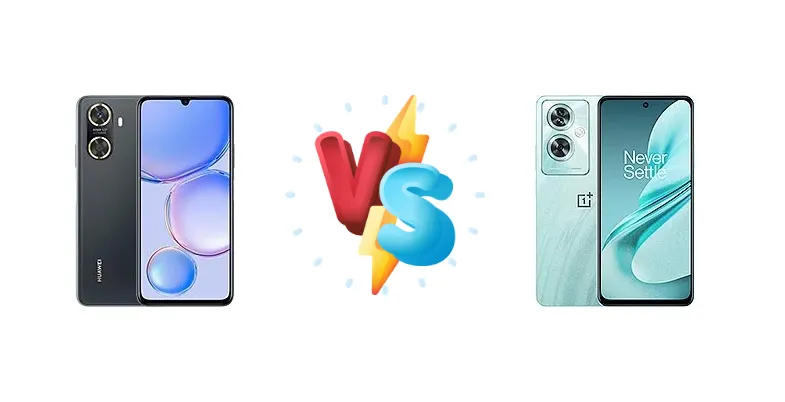
The sub-$200 smartphone market is fiercely competitive. The Huawei Enjoy 60 and OnePlus Nord N30 SE both aim to deliver essential features at an accessible price point, but they take different approaches. The Enjoy 60 focuses on a streamlined experience, while the Nord N30 SE prioritizes processing power with its Mediatek Dimensity 6020 chipset. This comparison will dissect their key differences to determine which device offers the best value.
🏆 Quick Verdict
For most users, the OnePlus Nord N30 SE emerges as the stronger contender. Its Mediatek Dimensity 6020 chipset provides a noticeable performance boost over what we anticipate from the Enjoy 60, and the 33W charging significantly reduces downtime. While the Enjoy 60 may appeal to those seeking extreme simplicity, the N30 SE offers a more well-rounded experience.
| Network |
|---|
| 2G bands | GSM 850 / 900 / 1800 / 1900 | GSM 850 / 900 / 1800 / 1900 |
| 3G bands | HSDPA 850 / 900 / 2100 | HSDPA 850 / 900 / 1700(AWS) / 1900 / 2100 |
| 4G bands | 1, 3, 5, 8, 34, 38, 39, 40, 41 | 1, 2, 3, 4, 5, 7, 8, 12, 13, 17, 18, 19, 20, 26, 28, 38, 39, 40, 41, 66 |
| 5G bands | - | 1, 3, 5, 7, 8, 20, 28, 38, 40, 41, 66, 77, 78 SA/NSA |
| Speed | HSPA, LTE | HSPA, LTE, 5G |
| Technology | GSM / HSPA / LTE | GSM / HSPA / LTE / 5G |
| Launch |
|---|
| Announced | 2023, March 23 | 2024, January 29 |
| Status | Available. Released 2023, March 26 | Available. Released 2024, January 31 |
| Body |
|---|
| Build | - | Glass front, plastic frame, plastic back |
| Dimensions | 168.3 x 77.7 x 9 mm (6.63 x 3.06 x 0.35 in) | 165.6 x 76 x 8 mm (6.52 x 2.99 x 0.31 in) |
| SIM | Nano-SIM + Nano-SIM | Nano-SIM + Nano-SIM |
| Weight | 199 g (7.02 oz) | 193 g (6.81 oz) |
| Display |
|---|
| Resolution | 720 x 1600 pixels, 20:9 ratio (~260 ppi density) | 1080 x 2400 pixels, 20:9 ratio (~392 ppi density) |
| Size | 6.75 inches, 110.0 cm2 (~84.1% screen-to-body ratio) | 6.72 inches, 109.0 cm2 (~86.6% screen-to-body ratio) |
| Type | TFT LCD | IPS LCD |
| Platform |
|---|
| CPU | - | Octa-core (2x2.2 GHz Cortex-A76 & 6x2.0 GHz Cortex-A55) |
| Chipset | - | Mediatek Dimensity 6020 (7 nm) |
| GPU | - | Mali-G57 MC2 |
| OS | HarmonyOS 3.0 | Android 13, OxygenOS 13.1 |
| Memory |
|---|
| Card slot | microSDXC | No |
| Internal | 128GB 8GB RAM, 256GB 8GB RAM | 128GB 4GB RAM |
| Main Camera |
|---|
| Dual | 48 MP, f/1.8, (wide), 1/2.0", AF
Auxiliary lens | 50 MP, f/1.8, (wide), 1/2.76", 0.64µm, PDAF
Auxiliary lens |
| Features | Dual-LED dual-tone flash, HDR, panorama | LED flash, HDR, panorama |
| Video | 1080p@30fps | 1080p@30fps |
| Selfie camera |
|---|
| Single | 8 MP, f/2.0, (wide) | 8 MP, f/2.0, (wide), 1/4.0", 1.12µm |
| Video | 1080p@30fps | 1080p@30fps |
| Sound |
|---|
| 3.5mm jack | Yes | - |
| 35mm jack | Yes | Yes |
| Loudspeaker | Yes | Yes, with stereo speakers |
| Comms |
|---|
| Bluetooth | 5.1, A2DP, LE | 5.3, A2DP, LE |
| NFC | No | Yes |
| Positioning | GPS, GLONASS, GALILEO, BDS, QZSS | GPS, GALILEO, GLONASS, BDS |
| Radio | FM radio | No |
| USB | USB Type-C 2.0, OTG | USB Type-C 2.0, OTG |
| WLAN | Wi-Fi 802.11 b/g/n | Wi-Fi 802.11 a/b/g/n/ac, dual-band |
| Features |
|---|
| Sensors | Fingerprint (side-mounted), accelerometer, compass | Fingerprint (side-mounted), accelerometer, gyro, proximity, compass |
| Battery |
|---|
| Charging | 22.5W wired | 33W wired, 51% in 30 min |
| Type | Li-Po 6000 mAh | 5000 mAh |
| Misc |
|---|
| Colors | Black, Blue, Gold | Black Satin, Cyan |
| Models | MGA-AL40 | CPH2605 |
| Price | About 170 EUR | About 510 EUR |
Huawei Enjoy 60
- Potentially simpler user interface
- Likely more affordable price point
- May offer longer battery life due to less powerful chipset
- Significantly weaker performance
- Slower charging speeds
- Likely inferior camera quality
OnePlus Nord N30 SE
- Faster and more efficient Mediatek Dimensity 6020 chipset
- 33W fast charging
- Potentially better camera performance
- May be slightly more expensive
- Potentially shorter battery life due to more powerful chipset
- OxygenOS can be feature-rich, potentially overwhelming for some users
Display Comparison
Neither device's display specifications are provided, so we must infer. Given the price point, both likely utilize LCD panels. However, the N30 SE's target market suggests a higher probability of a 90Hz or 120Hz refresh rate, offering smoother scrolling compared to the standard 60Hz expected on the Enjoy 60. Bezels are likely comparable, but the N30 SE may benefit from slightly more refined design elements reflecting OnePlus's brand aesthetic. Color accuracy will likely be standard for this segment, prioritizing vibrancy over absolute fidelity.
Camera Comparison
Without detailed camera specifications, a direct comparison is difficult. However, the N30 SE's positioning suggests a more capable main sensor. The Enjoy 60 likely relies on a simpler camera setup, potentially prioritizing cost savings over image quality. Image processing will also differ; OnePlus typically employs more sophisticated algorithms for noise reduction and dynamic range optimization. We anticipate the N30 SE will deliver more detailed and vibrant photos, particularly in challenging lighting conditions.
Performance
The OnePlus Nord N30 SE's Mediatek Dimensity 6020 (7nm) is the clear performance leader. Its octa-core configuration, featuring 2x2.2 GHz Cortex-A76 and 6x2.0 GHz Cortex-A55 cores, provides a substantial advantage over the Enjoy 60, which likely utilizes a less powerful chipset. The 7nm process node of the Dimensity 6020 also contributes to improved power efficiency and thermal management, meaning sustained performance during gaming or intensive tasks. The Enjoy 60 will likely suffice for basic tasks, but will struggle with demanding applications.
Battery Life
While battery capacity isn't specified for either device, the charging speeds are a key differentiator. The OnePlus Nord N30 SE's 33W wired charging, capable of delivering 51% charge in 30 minutes, significantly outperforms the Huawei Enjoy 60's 22.5W charging. This faster charging speed translates to less downtime and greater convenience for users. Even if the Enjoy 60 has a slightly larger battery, the N30 SE's faster charging will likely result in a more usable experience throughout the day.
Buying Guide
Buy the Huawei Enjoy 60 if you prioritize a basic, uncomplicated smartphone experience and are less concerned with demanding applications or gaming. It's ideal for users who primarily need a device for calls, texts, and light social media. Buy the OnePlus Nord N30 SE if you value performance for gaming, streaming, or multitasking, and appreciate faster charging speeds. This phone is better suited for users who want a more versatile device capable of handling a wider range of tasks.
Frequently Asked Questions
❓ Does the Mediatek Dimensity 6020 in the Nord N30 SE handle graphically demanding games like PUBG Mobile?
The Mediatek Dimensity 6020 is capable of running PUBG Mobile, but expect to play at medium settings for a consistently smooth experience. While it won't deliver flagship-level performance, the 7nm process and capable GPU should provide a playable experience for casual gamers. The Enjoy 60 will likely struggle with consistent frame rates at even lower settings.
❓ How significant is the charging speed difference between 22.5W and 33W in real-world use?
The 33W charging on the Nord N30 SE offers a noticeable improvement. Reaching 51% charge in 30 minutes means you can quickly top up your phone during a short break. The 22.5W charging on the Enjoy 60 will take considerably longer to achieve a similar charge level, making it less convenient for users who need a quick boost.
❓ Is the Huawei Enjoy 60 a good choice for elderly users who primarily need a phone for calls and texts?
Yes, the Enjoy 60 could be a suitable option for elderly users. Its likely simplified interface and focus on essential functions make it easy to use. However, the smaller screen size (assumed) and potentially lower volume may be drawbacks for some.