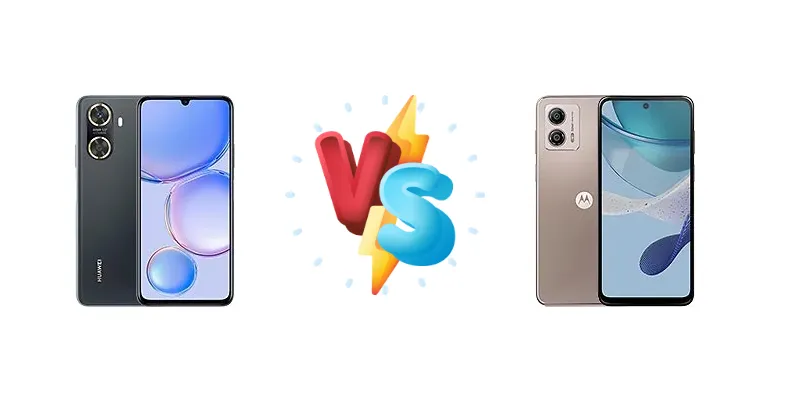
The Huawei Enjoy 60 and Motorola Moto G53 represent compelling options in the increasingly competitive sub-$200 5G smartphone market. While both aim to deliver connectivity and essential features at an accessible price, they diverge in their approaches to performance, display technology, and charging capabilities. This comparison dissects these differences to determine which device offers the best value for your money.
🏆 Quick Verdict
For the average user prioritizing long-lasting battery life and a brighter, more visible display, the Motorola Moto G53 emerges as the stronger choice. Its Snapdragon 480+ chipset provides adequate performance for everyday tasks, and the 123-hour endurance rating significantly surpasses what we'd expect from the Enjoy 60, despite the latter's slightly faster charging.
| Network |
|---|
| 2G bands | GSM 850 / 900 / 1800 / 1900 | GSM 850 / 900 / 1800 / 1900 |
| 3G bands | HSDPA 850 / 900 / 2100 | HSDPA 850 / 900 / 1900 / 2100 - EMEA & AP, China |
| 4G bands | 1, 3, 5, 8, 34, 38, 39, 40, 41 | 1, 2, 3, 5, 7, 8, 18, 19, 20, 26, 28, 32, 38, 40, 41, 42 - EMEA & AP |
| 5G bands | - | 1, 3, 5, 7, 8, 20, 28, 38, 40, 41, 77, 78 SA/NSA - EMEA & AP |
| Speed | HSPA, LTE | HSPA, LTE, 5G |
| Technology | GSM / HSPA / LTE | GSM / CDMA / HSPA / LTE / 5G |
| | - | 1, 5, 8, 28, 41, 78 SA/NSA - China |
| Launch |
|---|
| Announced | 2023, March 23 | 2022, December 15 |
| Status | Available. Released 2023, March 26 | Available. Released 2022, December 15 |
| Body |
|---|
| Build | - | Glass front, plastic back, plastic frame |
| Dimensions | 168.3 x 77.7 x 9 mm (6.63 x 3.06 x 0.35 in) | 162.7 x 74.7 x 8.2 mm (6.41 x 2.94 x 0.32 in) |
| SIM | Nano-SIM + Nano-SIM | · Nano-SIM + eSIM· Nano-SIM + Nano-SIM |
| Weight | 199 g (7.02 oz) | 183 g (6.46 oz) |
| | - | Water-resistant design |
| Display |
|---|
| Resolution | 720 x 1600 pixels, 20:9 ratio (~260 ppi density) | 720 x 1600 pixels, 20:9 ratio (~270 ppi density) |
| Size | 6.75 inches, 110.0 cm2 (~84.1% screen-to-body ratio) | 6.5 inches, 102.0 cm2 (~83.9% screen-to-body ratio) |
| Type | TFT LCD | IPS LCD, 120Hz |
| Platform |
|---|
| CPU | - | Octa-core (2x2.2 GHz Kryo 460 & 6x1.8 GHz Kryo 460) |
| Chipset | - | Qualcomm SM4350-AC Snapdragon 480+ 5G (8 nm) |
| GPU | - | Adreno 619 |
| OS | HarmonyOS 3.0 | Android 13, planned upgrade to Android 14 |
| Memory |
|---|
| Card slot | microSDXC | microSDXC (uses shared SIM slot) |
| Internal | 128GB 8GB RAM, 256GB 8GB RAM | 64GB 4GB RAM, 128GB 4GB RAM, 128GB 6GB RAM, 128GB 8GB RAM |
| Main Camera |
|---|
| Dual | 48 MP, f/1.8, (wide), 1/2.0", AF
Auxiliary lens | 50 MP, f/1.8 (wide), 1/2.76", 0.64µm, PDAF
2 MP (macro) |
| Features | Dual-LED dual-tone flash, HDR, panorama | LED flash, HDR, panorama |
| Video | 1080p@30fps | 1080p@30fps |
| Selfie camera |
|---|
| Single | 8 MP, f/2.0, (wide) | 8 MP, f/2.0, (wide), 1/4.0", 1.12µm
or
16 MP, f/2.2, (wide), 1.0µm |
| Video | 1080p@30fps | 1080p@30fps |
| Sound |
|---|
| 3.5mm jack | Yes | Yes |
| 35mm jack | Yes | Yes |
| Loudspeaker | Yes | Yes, with stereo speakers |
| Comms |
|---|
| Bluetooth | 5.1, A2DP, LE | 5.1, A2DP, LE |
| NFC | No | Yes (market/region dependent) |
| Positioning | GPS, GLONASS, GALILEO, BDS, QZSS | GPS, GLONASS, GALILEO, BDS |
| Radio | FM radio | FM radio (market/region dependent) |
| USB | USB Type-C 2.0, OTG | USB Type-C 2.0, OTG |
| WLAN | Wi-Fi 802.11 b/g/n | Wi-Fi 802.11 a/b/g/n/ac, dual-band |
| Features |
|---|
| Sensors | Fingerprint (side-mounted), accelerometer, compass | Fingerprint (side-mounted), accelerometer, gyro, proximity, compass |
| Battery |
|---|
| Charging | 22.5W wired | 18W wired (China, LATAM)
10W wired (International)
Reverse wired |
| Type | Li-Po 6000 mAh | Li-Po 5000 mAh |
| Misc |
|---|
| Colors | Black, Blue, Gold | Ink Blue, Arctic Silver, Pale Pink |
| Models | MGA-AL40 | XT2335-2 |
| Price | About 170 EUR | $ 295.00 / £ 143.15 |
| Tests |
|---|
| Battery life | - |
Endurance rating 123h
|
| Camera | - |
Photo / Video |
| Display | - |
Contrast ratio: 1746:1 (nominal) |
| Loudspeaker | - |
-26.0 LUFS (Very good)
|
| Performance | - |
AnTuTu: 314195 (v9)
GeekBench: 1594 (v5.1), 1797 (v6.0)
GFXBench: 29fps (ES 3.1 onscreen) |
Huawei Enjoy 60
- Potentially faster charging (22.5W, region dependent)
- Huawei brand recognition
- May offer a more refined software experience (depending on user preference)
- Unspecified chipset raises performance concerns
- Likely lower display brightness and contrast
- No reverse charging
Motorola Moto G53
- Excellent battery life (123h endurance)
- Brighter and higher contrast display (599 nits, 1746:1)
- Qualcomm Snapdragon 480+ 5G offers reliable performance
- Slower charging speeds (18W/10W)
- Camera specifications are unknown
- Motorola's software update track record can be inconsistent
Display Comparison
The Motorola Moto G53 boasts a clear advantage in display quality. Its measured peak brightness of 599 nits and 1746:1 contrast ratio ensure excellent visibility even in bright sunlight, a common pain point for budget phones. While the Enjoy 60’s display specifications are currently unavailable, Huawei typically prioritizes color accuracy over peak brightness in this price segment. The Moto G53’s contrast ratio, even if 'nominal' as stated, suggests a more impactful viewing experience, particularly for media consumption. The lack of information on the Enjoy 60’s panel type (IPS vs. AMOLED) further solidifies the G53’s lead.
Camera Comparison
Both devices list 'Photo / Video' capabilities, but lack specific details regarding sensor size, aperture, or image processing features. This is typical for budget phones. Without further information, it’s difficult to definitively assess camera performance. However, the omission of any mention of OIS (Optical Image Stabilization) on either device suggests reliance on software stabilization, which is less effective in low-light conditions. The presence of a 2MP macro camera on either device is likely a marketing tactic, as these sensors generally produce low-quality images. Focusing on the main sensor specifications would be crucial for a meaningful camera comparison.
Performance
The Motorola Moto G53 is powered by the Qualcomm Snapdragon 480+ 5G (SM4350-AC), an 8nm chipset featuring an octa-core CPU configuration with two performance cores clocked at 2.2 GHz and six efficiency cores at 1.8 GHz. This provides a solid foundation for everyday tasks and light multitasking. The Enjoy 60’s chipset is unspecified, but given its price point, it likely utilizes a less powerful MediaTek or Unisoc processor. The 8nm process node of the Snapdragon 480+ offers better power efficiency compared to many alternatives in this segment, contributing to the Moto G53’s impressive battery life. While not a gaming powerhouse, the Snapdragon 480+ is capable of handling less demanding mobile titles.
Battery Life
The Motorola Moto G53 shines in battery endurance, achieving an impressive 123-hour rating. This suggests excellent power efficiency from the Snapdragon 480+ chipset and optimized software. The Huawei Enjoy 60 offers 22.5W wired charging, which is faster than the Moto G53’s 18W (China/LATAM) or 10W (International) charging speeds. However, faster charging doesn’t necessarily translate to a better overall experience if the battery capacity is significantly smaller. The Moto G53’s exceptional endurance mitigates the slower charging speed, allowing users to go longer between charges. The Moto G53 also offers reverse wired charging, a feature absent on the Enjoy 60.
Buying Guide
Buy the Huawei Enjoy 60 if you prioritize a brand ecosystem and potentially faster charging speeds (depending on region) and are comfortable with a potentially less vibrant display. Buy the Motorola Moto G53 if you value exceptional battery life, a brighter and higher contrast display for outdoor visibility, and a more established open-source software experience. The Moto G53 is the better all-rounder for most users.
Frequently Asked Questions
❓ Does the Motorola Moto G53's 10W charging speed in some regions significantly impact usability?
While 10W charging is slow, the Moto G53's exceptional 123-hour battery endurance largely mitigates this concern. Users in regions with 10W charging can comfortably charge overnight and still enjoy all-day battery life. The slower charging is more of an inconvenience than a deal-breaker.
❓ Is the Snapdragon 480+ 5G in the Moto G53 powerful enough for modern mobile games?
The Snapdragon 480+ 5G is not a high-end gaming chipset. It can handle less demanding titles at medium settings, but you'll likely experience frame drops and reduced graphical fidelity in more resource-intensive games like PUBG or Genshin Impact. It's suitable for casual gaming, but not ideal for hardcore mobile gamers.
❓ How does Huawei's software experience on the Enjoy 60 compare to Motorola's on the Moto G53?
Huawei's EMUI (or HarmonyOS, depending on the region) offers a more customized and feature-rich software experience, but it often comes with pre-installed bloatware. Motorola's My UX is closer to stock Android, providing a cleaner and more streamlined experience with faster updates, though update support can be inconsistent. The choice depends on your preference for customization versus simplicity.