
Huawei Enjoy 60 Pro vs Xiaomi Redmi Note 12 Pro 4G: A Detailed Comparison
| Phones Images | |||||
|---|---|---|---|---|---|
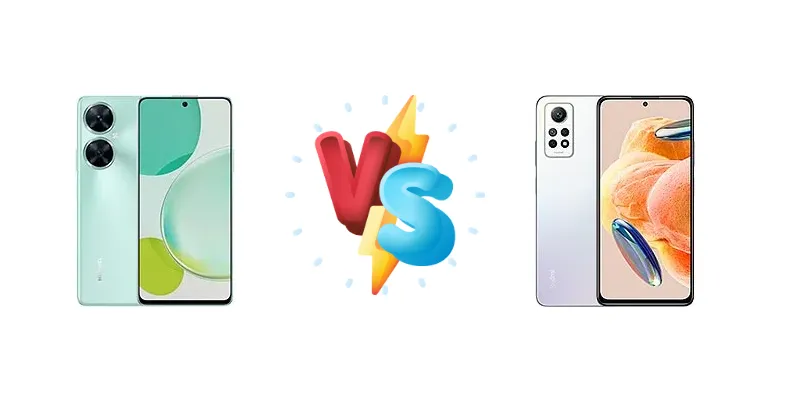
|
🏆 Quick Verdict
For most users, the Xiaomi Redmi Note 12 Pro 4G emerges as the stronger choice. Its Snapdragon 732G offers a noticeable performance uplift over the Enjoy 60 Pro’s Snapdragon 680, and the significantly faster 67W charging dramatically improves usability. While the Enjoy 60 Pro is a capable device, the Redmi Note 12 Pro 4G provides a more compelling overall experience.
| PHONES | ||
|---|---|---|
| Phone Names | Huawei Enjoy 60 Pro | Xiaomi Redmi Note 12 Pro 4G |
| Network | ||
|---|---|---|
| 2G bands | GSM 850 / 900 / 1800 / 1900 | GSM 850 / 900 / 1800 / 1900 |
| 3G bands | HSDPA 850 / 900 / 1900 / 2100 | HSDPA 850 / 900 / 1700(AWS) / 1900 / 2100 |
| 4G bands | 1, 2, 3, 4, 5, 7, 8, 12, 13, 17, 18, 19, 20, 26, 28, 34, 38, 39, 40, 41, 42, 66 | 1, 2, 3, 4, 5, 7, 8, 20, 28, 38, 40, 41, 66 |
| Speed | HSPA, LTE | HSPA, LTE |
| Technology | GSM / HSPA / LTE | GSM / HSPA / LTE |
| Launch | ||
|---|---|---|
| Announced | 2023, May | 2023, March 03 |
| Status | Available. Released 2023, May | Available. Released 2023, April 11 |
| Body | ||
|---|---|---|
| Dimensions | 164.6 x 75.6 x 8.6 mm (6.48 x 2.98 x 0.34 in) | 164.2 x 76.1 x 8.1 mm (6.46 x 3.00 x 0.32 in) |
| SIM | Nano-SIM + Nano-SIM | Nano-SIM + Nano-SIM |
| Weight | 193 g (6.81 oz) | 201.8 g (7.13 oz) |
| Display | ||
|---|---|---|
| Resolution | 1080 x 2388 pixels (~385 ppi density) | 1080 x 2400 pixels, 20:9 ratio (~395 ppi density) |
| Size | 6.8 inches, 112.0 cm2 (~90.0% screen-to-body ratio) | 6.67 inches, 107.4 cm2 (~86.0% screen-to-body ratio) |
| Type | TFT LCD, 90Hz | AMOLED, 120Hz, Dolby Vision, 700 nits (HBM), 1100 nits (peak) |
| Platform | ||
|---|---|---|
| CPU | Octa-core (4x2.4 GHz Kryo 265 Gold & 4x1.9 GHz Kryo 265 Silver) | Octa-core (2x2.2 GHz Kryo 470 Gold & 6x1.8 GHz Kryo 470 Silver) |
| Chipset | Qualcomm SM6225 Snapdragon 680 4G (6 nm) | Qualcomm SM7150 Snapdragon 732G (8 nm) |
| GPU | Adreno 610 | Adreno 618 |
| OS | HarmonyOS 3.0 | Android 11, MIUI 13 |
| Memory | ||
|---|---|---|
| Card slot | microSDXC | microSDXC (uses shared SIM slot) |
| Internal | 128GB 8GB RAM, 256GB 8GB RAM, 512GB 8GB RAM | 128GB 6GB RAM, 128GB 8GB RAM, 256GB 8GB RAM |
| - | UFS 2.2 | |
| Main Camera | ||
|---|---|---|
| Dual | 50 MP, f/1.8, (wide), PDAF Auxiliary lens | - |
| Features | LED flash, HDR, panorama | LED flash, HDR, panorama |
| Quad | - | 108 MP, f/1.9, (wide), 1/1.52", 0.7µm, PDAF 8 MP, 120˚, (ultrawide) 2 MP (macro) Auxiliary lens |
| Video | 1080p@30fps | 4K@30fps, 1080p@30/60fps |
| Selfie camera | ||
|---|---|---|
| Single | 8 MP, f/2.0, (wide) | 16 MP, f/2.4, (wide) |
| Video | 1080p@30fps | 1080p@30fps |
| Sound | ||
|---|---|---|
| 3.5mm jack | - | Yes |
| 35mm jack | Yes | Yes |
| Loudspeaker | Yes | Yes, with stereo speakers |
| Comms | ||
|---|---|---|
| Bluetooth | 5.0, A2DP, LE | 5.0, A2DP, LE |
| Infrared port | - | Yes |
| NFC | No | Yes (market/region dependent) |
| Positioning | GPS, GLONASS, GALILEO, BDS, QZSS | GPS, GLONASS, GALILEO, BDS |
| Radio | FM radio | Unspecified |
| USB | USB Type-C 2.0, OTG | USB Type-C 2.0, OTG |
| WLAN | Wi-Fi 802.11 a/b/g/n/ac, dual-band | Wi-Fi 802.11 a/b/g/n/ac, dual-band |
| Features | ||
|---|---|---|
| Sensors | Fingerprint (side-mounted), accelerometer, proximity, compass | Fingerprint (side-mounted), accelerometer, gyro, compass |
| Battery | ||
|---|---|---|
| Charging | 40W wired | 67W wired |
| Type | Li-Po 5000 mAh | Li-Po 5000 mAh |
| Misc | ||
|---|---|---|
| Colors | Green, Silver, Black | Star Blue, Graphite Gray, Polar White, Ice blue |
| Models | MAO-AL00 | 2209116AG, 2209116AG |
| Price | About 200 EUR | About 150 EUR |
Huawei Enjoy 60 Pro
- Potentially more streamlined software experience (depending on region)
- Efficient 6nm Snapdragon 680 chipset
- Competitive price point
- Slower Snapdragon 680 processor
- Slower 40W charging
- Less capable GPU for gaming
Xiaomi Redmi Note 12 Pro 4G
- More powerful Snapdragon 732G processor
- Significantly faster 67W charging
- Improved ISP for better image processing
- May have a slightly higher price
- Xiaomi’s MIUI can be feature-rich but also bloated
Display Comparison
Neither device boasts a cutting-edge display. While specific panel details (like peak brightness or color gamut coverage) are absent, the focus here is on the underlying processing power impacting display responsiveness. The Redmi Note 12 Pro 4G’s more powerful Snapdragon 732G can potentially drive a smoother user interface and faster app loading times, indirectly enhancing the perceived display experience. Bezels are likely comparable given the market segment, and color accuracy will depend on software calibration.
Camera Comparison
Without detailed camera specs beyond the chipsets, a direct comparison is limited. However, the Snapdragon 732G’s superior image signal processor (ISP) in the Redmi Note 12 Pro 4G will likely result in better image processing, particularly in low-light conditions. The ISP handles noise reduction, dynamic range, and overall image quality. While both phones likely feature similar primary camera resolutions, the Redmi Note 12 Pro 4G’s processing capabilities will give it an edge. We can assume both will include standard features like HDR and portrait modes.
Performance
The core difference lies in the chipsets. The Xiaomi Redmi Note 12 Pro 4G’s Snapdragon 732G (8nm) is a step up from the Huawei Enjoy 60 Pro’s Snapdragon 680 (6nm). The 732G features a more robust CPU configuration – 2x2.2 GHz Kryo 470 Gold cores versus the 680’s 4x2.4 GHz Kryo 265 Gold cores – and a more capable GPU. This translates to better performance in demanding applications and games. While the 680’s 6nm process *should* offer better efficiency, the 732G’s architectural advantages outweigh this benefit. Users who play graphically intensive games or frequently multitask will see a clear advantage with the Redmi Note 12 Pro 4G.
Battery Life
The Redmi Note 12 Pro 4G’s 67W wired charging is a game-changer. This allows for a significantly faster 0-100% charge compared to the Enjoy 60 Pro’s 40W charging. While battery capacity isn’t specified, the faster charging speed mitigates any potential disadvantage if the Redmi Note 12 Pro 4G has a slightly smaller battery. The convenience of quickly topping up the battery is a major benefit for users who are constantly on the go.
Buying Guide
Buy the Huawei Enjoy 60 Pro if you prioritize a potentially more streamlined software experience (depending on your region and preference for Huawei’s EMUI) and are on a very tight budget. Buy the Xiaomi Redmi Note 12 Pro 4G if you value faster performance for gaming and multitasking, and appreciate the convenience of significantly quicker charging speeds – a crucial factor for daily use.