
Huawei Enjoy 60 Pro vs. vivo S17t: A Detailed Comparison of Mid-Range Powerhouses
| Phones Images | |||||
|---|---|---|---|---|---|
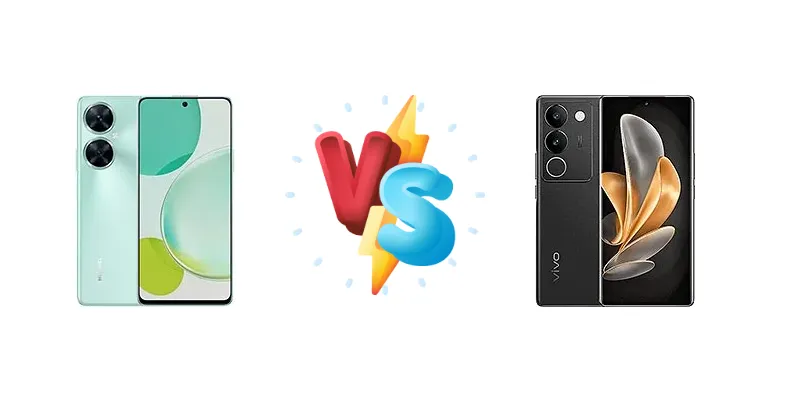
|
🏆 Quick Verdict
For the average user prioritizing battery life and a stable experience, the Huawei Enjoy 60 Pro offers a compelling package. However, the vivo S17t is the clear winner for those demanding faster performance, quicker charging, and a more responsive user experience, justifying its likely higher price point.
| PHONES | ||
|---|---|---|
| Phone Names | Huawei Enjoy 60 Pro | vivo S17t |
| Network | ||
|---|---|---|
| 2G bands | GSM 850 / 900 / 1800 / 1900 | GSM 850 / 900 / 1800 / 1900 |
| 3G bands | HSDPA 850 / 900 / 1900 / 2100 | HSDPA 850 / 900 / 1700(AWS) / 1900 / 2100 |
| 4G bands | 1, 2, 3, 4, 5, 7, 8, 12, 13, 17, 18, 19, 20, 26, 28, 34, 38, 39, 40, 41, 42, 66 | 1, 3, 4, 5, 8, 28, 34, 38, 39, 40, 41 |
| 5G bands | - | 1, 3, 5, 8, 28, 38, 40, 41, 77, 78 SA/NSA |
| Speed | HSPA, LTE | HSPA, LTE, 5G |
| Technology | GSM / HSPA / LTE | GSM / CDMA / HSPA / CDMA2000 / LTE / 5G |
| Launch | ||
|---|---|---|
| Announced | 2023, May | 2023, May 31 |
| Status | Available. Released 2023, May | Available. Released 2023, June 08 |
| Body | ||
|---|---|---|
| Dimensions | 164.6 x 75.6 x 8.6 mm (6.48 x 2.98 x 0.34 in) | 164.2 x 74.4 x 7.5 mm (6.46 x 2.93 x 0.30 in) |
| SIM | Nano-SIM + Nano-SIM | Nano-SIM + Nano-SIM |
| Weight | 193 g (6.81 oz) | 186 g (6.56 oz) |
| Display | ||
|---|---|---|
| Resolution | 1080 x 2388 pixels (~385 ppi density) | 1260 x 2800 pixels, 20:9 ratio (~453 ppi density) |
| Size | 6.8 inches, 112.0 cm2 (~90.0% screen-to-body ratio) | 6.78 inches, 111.0 cm2 (~90.8% screen-to-body ratio) |
| Type | TFT LCD, 90Hz | AMOLED, 1B colors, 120Hz, HDR10+, 1300 nits (peak) |
| Platform | ||
|---|---|---|
| CPU | Octa-core (4x2.4 GHz Kryo 265 Gold & 4x1.9 GHz Kryo 265 Silver) | Octa-core (1x3.0 GHz Cortex-A78 & 3x2.6 GHz Cortex-A78 & 4x2.0 GHz Cortex-A55) |
| Chipset | Qualcomm SM6225 Snapdragon 680 4G (6 nm) | Mediatek Dimensity 8050 (6 nm) |
| GPU | Adreno 610 | Mali-G77 MC9 |
| OS | HarmonyOS 3.0 | Android 13, OriginOS 3 |
| Memory | ||
|---|---|---|
| Card slot | microSDXC | No |
| Internal | 128GB 8GB RAM, 256GB 8GB RAM, 512GB 8GB RAM | 512GB 12GB RAM |
| Main Camera | ||
|---|---|---|
| Dual | 50 MP, f/1.8, (wide), PDAF Auxiliary lens | 50 MP, f/1.9, (wide), 1/1.56", 1.0µm, PDAF, OIS 8 MP, f/2.2, (ultrawide) |
| Features | LED flash, HDR, panorama | Color spectrum sensor, Ring-LED flash, panorama, HDR |
| Video | 1080p@30fps | 4K@30fps, 1080p@30fps |
| Selfie camera | ||
|---|---|---|
| Features | - | Dual-LED flash, HDR |
| Single | 8 MP, f/2.0, (wide) | 50 MP, f/2.0, 22mm (wide), AF |
| Video | 1080p@30fps | 1080p@30fps |
| Sound | ||
|---|---|---|
| 35mm jack | Yes | No |
| Loudspeaker | Yes | Yes |
| Comms | ||
|---|---|---|
| Bluetooth | 5.0, A2DP, LE | 5.2, A2DP, LE, aptX HD |
| NFC | No | Yes |
| Positioning | GPS, GLONASS, GALILEO, BDS, QZSS | GPS (L1), GLONASS (G1), BDS (B1I), GALILEO (E1), QZSS (L1) |
| Radio | FM radio | No |
| USB | USB Type-C 2.0, OTG | USB Type-C 2.0, OTG |
| WLAN | Wi-Fi 802.11 a/b/g/n/ac, dual-band | Wi-Fi 802.11 a/b/g/n/ac/6, dual-band, Wi-Fi Direct |
| Features | ||
|---|---|---|
| Sensors | Fingerprint (side-mounted), accelerometer, proximity, compass | Fingerprint (under display, optical), accelerometer, gyro, proximity, compass |
| Battery | ||
|---|---|---|
| Charging | 40W wired | 80W wired, 70% in 30 min |
| Type | Li-Po 5000 mAh | 4600 mAh |
| Misc | ||
|---|---|---|
| Colors | Green, Silver, Black | Black, Blue, Pink |
| Models | MAO-AL00 | - |
| Price | About 200 EUR | About 400 EUR |
Huawei Enjoy 60 Pro
- Potentially better battery life due to the efficient Snapdragon 680.
- Likely more affordable price point.
- Stable and reliable performance for basic tasks.
- Significantly slower performance compared to the Dimensity 8050.
- Slower charging speed (40W).
- Less capable for demanding games and applications.
vivo S17t
- Much faster performance with the Dimensity 8050.
- Ultra-fast 80W charging.
- Superior gaming experience.
- Potentially shorter battery life due to the more powerful chipset.
- Likely a higher price tag.
- May run warmer under sustained load.
Display Comparison
Neither device’s display specifications are provided, so a direct comparison is limited. However, given the target market, both likely utilize LCD panels. The vivo S17t, positioned slightly higher, may benefit from a higher resolution or improved color calibration. The absence of LTPO technology on either suggests standard refresh rates, impacting smoothness during scrolling and animations. Bezels are likely comparable, focusing on maximizing screen real estate within their respective price brackets.
Camera Comparison
Without detailed camera specs, analysis is limited. However, the vivo S17t, being a model marketed for its aesthetic appeal, likely prioritizes camera quality. A larger main sensor, potentially with OIS, is probable. The Snapdragon 680’s ISP is capable, but the Dimensity 8050’s ISP offers more advanced image processing capabilities, potentially leading to better dynamic range and low-light performance. The inclusion of a 2MP macro camera on either device is likely a marketing tactic with limited real-world benefit; focusing on the main sensor’s quality is more important.
Performance
The core difference lies in the chipsets. The vivo S17t’s MediaTek Dimensity 8050, built on a 6nm process, significantly outperforms the Huawei Enjoy 60 Pro’s Snapdragon 680. The Dimensity 8050’s octa-core configuration, featuring a 3.0 GHz Cortex-A78 prime core, provides a substantial boost in CPU performance, crucial for demanding tasks and multitasking. The Snapdragon 680, while efficient, is geared towards everyday use. The Dimensity 8050’s GPU will also deliver a far superior gaming experience. While both use a 6nm process, the architectural differences and clock speeds favor the Dimensity 8050 in both sustained performance and thermal management.
Battery Life
Battery capacity isn’t specified for either device. However, the charging speeds are drastically different. The vivo S17t’s 80W wired charging is a game-changer, promising a 70% charge in just 30 minutes. This is a significant advantage for users who need to quickly top up their battery. The Huawei Enjoy 60 Pro’s 40W charging is respectable but considerably slower. While a larger battery on the Enjoy 60 Pro could offset the slower charging, the convenience of the S17t’s rapid charging is a major selling point.
Buying Guide
Buy the Huawei Enjoy 60 Pro if you need a reliable daily driver with good battery life and aren’t heavily reliant on demanding applications or gaming. It’s ideal for users who prioritize efficiency and a lower price. Buy the vivo S17t if you prefer a smoother, faster experience for multitasking, gaming, and content creation, and value the convenience of 80W fast charging. This phone caters to users who want a more premium feel and performance within the mid-range segment.