
Huawei Enjoy 60 Pro vs Samsung Galaxy A54: A Detailed Comparison
| Phones Images | |||||
|---|---|---|---|---|---|
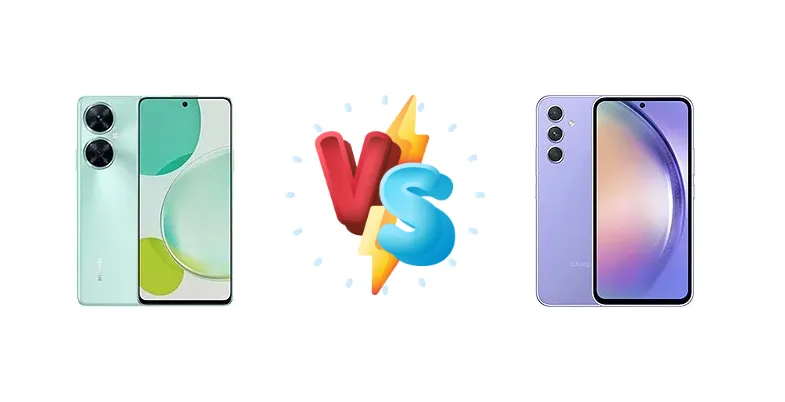
|
🏆 Quick Verdict
For the average user prioritizing overall performance and display quality, the Samsung Galaxy A54 emerges as the stronger contender. Its Exynos 1380 chipset offers a noticeable performance advantage, complemented by a brighter, more vibrant display. However, the Huawei Enjoy 60 Pro’s 40W charging provides a faster top-up experience.
| PHONES | ||
|---|---|---|
| Phone Names | Huawei Enjoy 60 Pro | Samsung Galaxy A54 |
| Network | ||
|---|---|---|
| 2G bands | GSM 850 / 900 / 1800 / 1900 | GSM 850 / 900 / 1800 / 1900 |
| 3G bands | HSDPA 850 / 900 / 1900 / 2100 | HSDPA 850 / 900 / 1700(AWS) / 1900 / 2100 |
| 4G bands | 1, 2, 3, 4, 5, 7, 8, 12, 13, 17, 18, 19, 20, 26, 28, 34, 38, 39, 40, 41, 42, 66 | 1, 2, 3, 4, 5, 7, 8, 12, 17, 20, 26, 28, 32, 38, 40, 41, 66 - International |
| 5G bands | - | 1, 3, 7, 8, 20, 28, 38, 40, 41, 77, 78 SA/NSA/Sub6 - International |
| Speed | HSPA, LTE | HSPA, LTE, 5G |
| Technology | GSM / HSPA / LTE | GSM / HSPA / LTE / 5G |
| - | 25, 41, 66, 71 SA/NSA/Sub6/mmWave - USA | |
| Launch | ||
|---|---|---|
| Announced | 2023, May | 2023, March 15 |
| Status | Available. Released 2023, May | Available. Released 2023, March 24 |
| Body | ||
|---|---|---|
| Build | - | Glass front (Gorilla Glass 5), glass back (Gorilla Glass 5), plastic frame |
| Dimensions | 164.6 x 75.6 x 8.6 mm (6.48 x 2.98 x 0.34 in) | 158.2 x 76.7 x 8.2 mm (6.23 x 3.02 x 0.32 in) |
| SIM | Nano-SIM + Nano-SIM | · Nano-SIM + eSIM· Nano-SIM + Nano-SIM |
| Weight | 193 g (6.81 oz) | 202 g (7.13 oz) |
| - | IP67 dust/water resistant (up to 1m for 30 min) | |
| Display | ||
|---|---|---|
| Protection | - | Corning Gorilla Glass 5 |
| Resolution | 1080 x 2388 pixels (~385 ppi density) | 1080 x 2340 pixels, 19.5:9 ratio (~403 ppi density) |
| Size | 6.8 inches, 112.0 cm2 (~90.0% screen-to-body ratio) | 6.4 inches, 100.5 cm2 (~82.9% screen-to-body ratio) |
| Type | TFT LCD, 90Hz | Super AMOLED, 120Hz, HDR10+, 1000 nits (HBM) |
| Platform | ||
|---|---|---|
| CPU | Octa-core (4x2.4 GHz Kryo 265 Gold & 4x1.9 GHz Kryo 265 Silver) | Octa-core (4x2.4 GHz Cortex-A78 & 4x2.0 GHz Cortex-A55) |
| Chipset | Qualcomm SM6225 Snapdragon 680 4G (6 nm) | Exynos 1380 (5 nm) |
| GPU | Adreno 610 | Mali-G68 MP5 |
| OS | HarmonyOS 3.0 | Android 13, up to 4 major Android upgrades, One UI 7 |
| Memory | ||
|---|---|---|
| Card slot | microSDXC | microSDXC (uses shared SIM slot) |
| Internal | 128GB 8GB RAM, 256GB 8GB RAM, 512GB 8GB RAM | 128GB 4GB RAM, 128GB 6GB RAM, 128GB 8GB RAM, 256GB 6GB RAM, 256GB 8GB RAM |
| Main Camera | ||
|---|---|---|
| Dual | 50 MP, f/1.8, (wide), PDAF Auxiliary lens | - |
| Features | LED flash, HDR, panorama | LED flash, panorama, HDR |
| Single | - | 32 MP, f/2.2, 26mm (wide), 1/2.8", 0.8µm |
| Triple | - | 50 MP, f/1.8, 23mm (wide), 1/1.56", 1.0µm, PDAF, OIS 12 MP, f/2.2, 13mm, 123˚ (ultrawide), 1/3.X", 1.12µm 5 MP (macro) |
| Video | 1080p@30fps | 4K@30fps, 1080p@30/60fps, 720p@480fps, gyro-EIS |
| Selfie camera | ||
|---|---|---|
| Single | 8 MP, f/2.0, (wide) | 32 MP, f/2.2, 26mm (wide), 1/2.8", 0.8µm |
| Video | 1080p@30fps | 4K@30fps, 1080p@30/60fps |
| Sound | ||
|---|---|---|
| 3.5mm jack | - | No |
| 35mm jack | Yes | No |
| Loudspeaker | Yes | Yes, with stereo speakers |
| Comms | ||
|---|---|---|
| Bluetooth | 5.0, A2DP, LE | 5.3, A2DP, LE |
| NFC | No | Yes (market/region dependent) |
| Positioning | GPS, GLONASS, GALILEO, BDS, QZSS | GPS, GLONASS, GALILEO, BDS |
| Radio | FM radio | No |
| USB | USB Type-C 2.0, OTG | USB Type-C 2.0, OTG |
| WLAN | Wi-Fi 802.11 a/b/g/n/ac, dual-band | Wi-Fi 802.11 a/b/g/n/ac/6, dual-band, Wi-Fi Direct |
| Features | ||
|---|---|---|
| Sensors | Fingerprint (side-mounted), accelerometer, proximity, compass | Fingerprint (under display, optical), accelerometer, gyro, compass, barometer (USA only) |
| - | Virtual proximity sensing | |
| Battery | ||
|---|---|---|
| Charging | 40W wired | 25W wired |
| Type | Li-Po 5000 mAh | 5000 mAh |
| Misc | ||
|---|---|---|
| Colors | Green, Silver, Black | Lime, Graphite, Violet, White |
| Models | MAO-AL00 | SM-A546V, SM-A546U, SM-A546U1, SM-A546B, SM-A546B/DS, SM-A546E, SM-A546E/DS, SM-A5460, SM-A546M, SM-A546M/DS, SM-A546W |
| Price | About 200 EUR | € 210.00 / $ 119.11 / £ 169.95 / ₹ 28,999 |
| SAR | - | 0.81 W/kg (head) 0.67 W/kg (body) |
| SAR EU | - | 0.69 W/kg (head) 1.34 W/kg (body) |
| Tests | ||
|---|---|---|
| Battery life | - | Endurance rating 119h |
| Camera | - | Photo / Video |
| Display | - | Contrast ratio: Infinite (nominal) |
| Loudspeaker | - | -26.6 LUFS (Good) |
| Performance | - | AnTuTu: 506678 (v9) GeekBench: 2703 (v5.1), 2797 (v6) GFXBench: 25fps (ES 3.1 onscreen) |
Huawei Enjoy 60 Pro
- Faster 40W charging
- Potentially lower price point
- Efficient Snapdragon 680 chipset for basic tasks
- Less powerful chipset compared to Exynos 1380
- Likely inferior display quality
- Limited camera details
Samsung Galaxy A54
- More powerful Exynos 1380 chipset
- Brighter and more vibrant display
- Likely superior camera performance
- Slower 25W charging
- Potentially higher price
- May experience more thermal throttling under sustained load
Display Comparison
The Samsung Galaxy A54 boasts a significantly brighter display, reaching a measured 980 nits, compared to an unstated value for the Enjoy 60 Pro. This brightness advantage translates to better visibility outdoors. While both displays are described as having an 'infinite' contrast ratio (typical for OLED/AMOLED panels), the A54’s superior peak brightness and likely better color calibration provide a more immersive viewing experience. The Enjoy 60 Pro’s display specs are less defined, suggesting a more budget-oriented panel.
Camera Comparison
Both devices feature photo and video capabilities, but detailed sensor information is lacking for the Enjoy 60 Pro. The Galaxy A54 likely benefits from Samsung’s established image processing pipeline and potentially a larger main sensor (though not specified). The presence of OIS (Optical Image Stabilization) on the A54, a common feature in this price range, would further enhance image quality, particularly in low-light conditions. The Enjoy 60 Pro’s camera system is likely more basic, focusing on providing adequate results for casual photography.
Performance
The core difference lies in the chipsets: the Huawei Enjoy 60 Pro utilizes the Qualcomm Snapdragon 680 (6nm), while the Samsung Galaxy A54 is powered by the Exynos 1380 (5nm). The Exynos 1380, built on a smaller 5nm process, offers greater transistor density and thus, improved performance and efficiency. The A54’s CPU features Cortex-A78 cores, a more powerful architecture than the Kryo 265 Gold cores in the Snapdragon 680. This translates to faster app loading times, smoother multitasking, and a more responsive user experience on the A54. While both are octa-core CPUs with similar clock speeds (2.4GHz), the architectural differences are key.
Battery Life
Both phones achieve an endurance rating of 119 hours, suggesting comparable overall battery life. However, the charging speeds differ significantly. The Huawei Enjoy 60 Pro supports 40W wired charging, while the Samsung Galaxy A54 is limited to 25W. This means the Enjoy 60 Pro will charge considerably faster, potentially reaching a full charge in under an hour, while the A54 will take longer. The A54’s 11:15h active use score indicates strong real-world performance, but the faster charging of the Enjoy 60 Pro is a notable advantage for users who frequently need to top up their battery.
Buying Guide
Buy the Huawei Enjoy 60 Pro if you prioritize fast charging and a lower price point, and your usage primarily revolves around everyday tasks like calling, texting, and light social media. Buy the Samsung Galaxy A54 if you value a superior display, smoother performance for gaming and multitasking, and a more refined camera experience, even if it means slightly slower charging.