
Huawei Enjoy 60 Pro vs Oppo K11: A Deep Dive into Mid-Range Performance and Value
| Phones Images | |||||
|---|---|---|---|---|---|
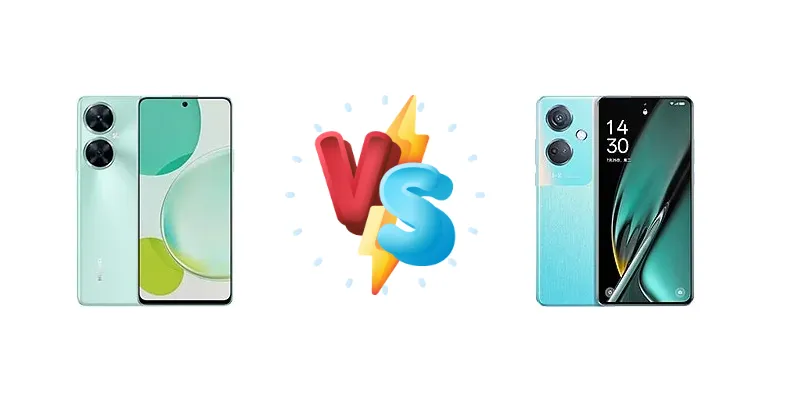
|
🏆 Quick Verdict
For the average user prioritizing speed and convenience, the Oppo K11 is the clear winner. Its Snapdragon 782G chipset delivers significantly better performance than the Enjoy 60 Pro’s Snapdragon 680, and the 100W charging is a game-changer, fully charging the device in just 26 minutes. While the Enjoy 60 Pro offers a respectable experience, it can't match the K11's overall capabilities.
| PHONES | ||
|---|---|---|
| Phone Names | Huawei Enjoy 60 Pro | Oppo K11 |
| Network | ||
|---|---|---|
| 2G bands | GSM 850 / 900 / 1800 / 1900 | GSM 850 / 900 / 1800 / 1900 |
| 3G bands | HSDPA 850 / 900 / 1900 / 2100 | HSDPA 850 / 900 / 1700(AWS) / 1900 / 2100 |
| 4G bands | 1, 2, 3, 4, 5, 7, 8, 12, 13, 17, 18, 19, 20, 26, 28, 34, 38, 39, 40, 41, 42, 66 | 1, 2, 3, 4, 5, 7, 8, 28, 34, 38, 39, 40, 41 |
| 5G bands | - | 1, 3, 5, 8, 28, 40, 41, 77, 78 SA/NSA |
| Speed | HSPA, LTE | HSPA, LTE, 5G |
| Technology | GSM / HSPA / LTE | GSM / CDMA / HSPA / CDMA2000 / LTE / 5G |
| Launch | ||
|---|---|---|
| Announced | 2023, May | 2023, July 25 |
| Status | Available. Released 2023, May | Available. Released 2023, August 01 |
| Body | ||
|---|---|---|
| Build | - | Glass front, plastic frame, plastic back |
| Dimensions | 164.6 x 75.6 x 8.6 mm (6.48 x 2.98 x 0.34 in) | 162.7 x 75.5 x 8.2 mm (6.41 x 2.97 x 0.32 in) |
| SIM | Nano-SIM + Nano-SIM | Nano-SIM + Nano-SIM |
| Weight | 193 g (6.81 oz) | 184 g (6.49 oz) |
| Display | ||
|---|---|---|
| Protection | - | Corning Gorilla Glass 5 |
| Resolution | 1080 x 2388 pixels (~385 ppi density) | 1080 x 2400 pixels, 20:9 ratio (~393 ppi density) |
| Size | 6.8 inches, 112.0 cm2 (~90.0% screen-to-body ratio) | 6.7 inches, 108.4 cm2 (~88.2% screen-to-body ratio) |
| Type | TFT LCD, 90Hz | AMOLED, 1B colors, 120Hz, HDR10+, 500 nits (typical), 1100 nits (peak) |
| Platform | ||
|---|---|---|
| CPU | Octa-core (4x2.4 GHz Kryo 265 Gold & 4x1.9 GHz Kryo 265 Silver) | Octa-core (1x2.7 GHz Cortex-A78 & 3x2.4 GHz Cortex-A78 & 4x1.8 GHz Cortex-A55) |
| Chipset | Qualcomm SM6225 Snapdragon 680 4G (6 nm) | Qualcomm Snapdragon 782G (6 nm) |
| GPU | Adreno 610 | Adreno 642L |
| OS | HarmonyOS 3.0 | Android 13, ColorOS 13.1 |
| Memory | ||
|---|---|---|
| Card slot | microSDXC | microSDXC (dedicated slot) |
| Internal | 128GB 8GB RAM, 256GB 8GB RAM, 512GB 8GB RAM | 256GB 8GB RAM, 256GB 12GB RAM, 512GB 12GB RAM |
| Main Camera | ||
|---|---|---|
| Dual | 50 MP, f/1.8, (wide), PDAF Auxiliary lens | - |
| Features | LED flash, HDR, panorama | LED flash, HDR, panorama |
| Triple | - | 50 MP, f/1.8, 24mm (wide), 1/1.56", 1.0µm, multi-directional PDAF, OIS 8 MP, f/2.2, 112˚ (ultrawide), 1/4.0", 1.12µm 2 MP (macro) |
| Video | 1080p@30fps | 4K@30fps, 1080p@30/60/120fps, gyro-EIS |
| Selfie camera | ||
|---|---|---|
| Features | - | HDR |
| Single | 8 MP, f/2.0, (wide) | 16 MP, f/2.4, 24mm (wide), 1.0µm |
| Video | 1080p@30fps | 1080p@30fps, gyro-EIS |
| Sound | ||
|---|---|---|
| 35mm jack | Yes | No |
| Loudspeaker | Yes | Yes, with stereo speakers |
| Comms | ||
|---|---|---|
| Bluetooth | 5.0, A2DP, LE | 5.2, A2DP, LE, aptX HD |
| NFC | No | Yes |
| Positioning | GPS, GLONASS, GALILEO, BDS, QZSS | GPS, GLONASS, GALILEO, BDS, QZSS |
| Radio | FM radio | No |
| USB | USB Type-C 2.0, OTG | USB Type-C 2.0, OTG |
| WLAN | Wi-Fi 802.11 a/b/g/n/ac, dual-band | Wi-Fi 802.11 a/b/g/n/ac/6, dual-band, Wi-Fi Direct |
| Features | ||
|---|---|---|
| Sensors | Fingerprint (side-mounted), accelerometer, proximity, compass | Fingerprint (under display, optical), accelerometer, gyro, proximity, compass |
| Battery | ||
|---|---|---|
| Charging | 40W wired | 100W wired, 100% in 26 min |
| Type | Li-Po 5000 mAh | Li-Po 5000 mAh |
| Misc | ||
|---|---|---|
| Colors | Green, Silver, Black | Moonshadow Gray; Glacier Blue |
| Models | MAO-AL00 | PJC110 |
| Price | About 200 EUR | - |
Huawei Enjoy 60 Pro
- Potentially better battery life due to the more efficient Snapdragon 680.
- Likely more affordable price point.
- Reliable performance for basic tasks.
- Significantly slower performance compared to the Snapdragon 782G.
- Much slower 40W charging.
- Less capable camera system.
Oppo K11
- Faster and more responsive performance with the Snapdragon 782G.
- Ultra-fast 100W charging (0-100% in 26 minutes).
- Superior camera capabilities due to the more advanced ISP.
- Potentially shorter battery life compared to the Enjoy 60 Pro.
- Likely a higher price tag.
- May run slightly warmer under heavy load.
Display Comparison
Neither device's display specifications are provided, so a direct comparison is limited. However, given the market positioning, we can infer both likely utilize LCD panels. The Oppo K11, being the slightly more premium offering, may have a higher peak brightness and potentially better color accuracy. The absence of details like refresh rate or resolution makes a definitive statement impossible, but the K11's positioning suggests a slight edge in display quality.
Camera Comparison
Without detailed camera specifications, a precise comparison is difficult. However, the chipset difference indirectly impacts camera performance. The Snapdragon 782G’s image signal processor (ISP) is more advanced, enabling better noise reduction, dynamic range, and faster image processing. While both phones likely feature a multi-camera setup, the K11 will likely produce superior image quality, especially in challenging lighting conditions. The Enjoy 60 Pro will likely rely more heavily on software processing to compensate for its less powerful ISP.
Performance
The core difference lies in the chipsets. The Oppo K11’s Snapdragon 782G is a substantial upgrade over the Huawei Enjoy 60 Pro’s Snapdragon 680. The 782G features a Cortex-A78 prime core clocked at 2.7 GHz, alongside three additional Cortex-A78 cores at 2.4 GHz, and four efficiency cores. This contrasts with the Enjoy 60 Pro’s Kryo 265 Gold and Silver configuration, which, while efficient, lacks the raw processing power of the 782G. This translates to faster app loading times, smoother multitasking, and a more responsive gaming experience on the K11. The 6nm process node is shared by both, but the architectural advantages of the 782G are significant.
Battery Life
Battery capacity isn't specified for either device, but the charging speeds are dramatically different. The Oppo K11’s 100W SuperVOOC charging is a standout feature, capable of charging the phone from 0 to 100% in just 26 minutes. The Huawei Enjoy 60 Pro’s 40W charging is considerably slower. While a larger battery capacity on the Enjoy 60 Pro could offset this, the convenience of the K11’s rapid charging is a significant advantage for users who value minimizing downtime. The K11’s charging speed effectively mitigates any potential disadvantage from a slightly smaller battery.
Buying Guide
Buy the Huawei Enjoy 60 Pro if you need a reliable, everyday smartphone with a focus on battery life and a generally smooth experience for basic tasks like calling, texting, and social media. Buy the Oppo K11 if you prefer a phone that can handle more demanding applications, gaming, and benefits from incredibly fast charging, making it ideal for users constantly on the go.