
Huawei Enjoy 60 Pro vs Motorola Edge 40 Neo: A Detailed Comparison
| Phones Images | |||||
|---|---|---|---|---|---|
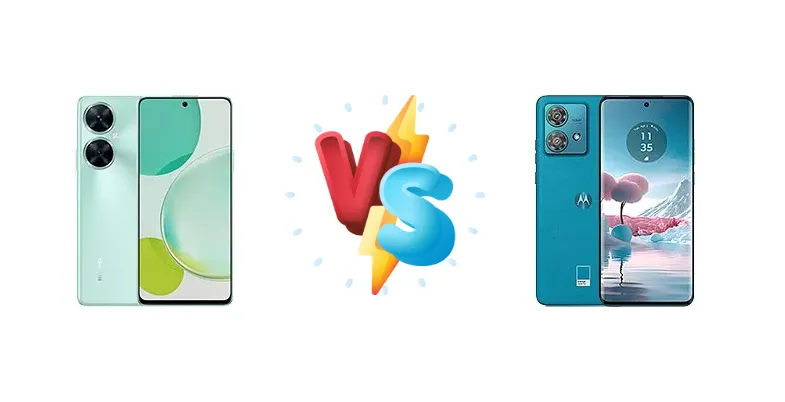
|
🏆 Quick Verdict
For the average user prioritizing fast charging and a brighter, more vibrant display, the Motorola Edge 40 Neo is the clear winner. Its Dimensity 7030 chipset provides a noticeable performance edge, and the 68W charging dramatically reduces downtime. However, users deeply embedded in the Huawei ecosystem might find the Enjoy 60 Pro a suitable, more affordable alternative.
| PHONES | ||
|---|---|---|
| Phone Names | Huawei Enjoy 60 Pro | Motorola Edge 40 Neo |
| Network | ||
|---|---|---|
| 2G bands | GSM 850 / 900 / 1800 / 1900 | GSM 850 / 900 / 1800 / 1900 |
| 3G bands | HSDPA 850 / 900 / 1900 / 2100 | HSDPA 800 / 850 / 900 / 1700(AWS) / 1900 / 2100 |
| 4G bands | 1, 2, 3, 4, 5, 7, 8, 12, 13, 17, 18, 19, 20, 26, 28, 34, 38, 39, 40, 41, 42, 66 | 1, 2, 3, 4, 5, 7, 8, 12, 13, 17, 18, 19, 20, 25, 26, 28, 32, 38, 38, 39, 40, 41, 42, 43, 48, 66 |
| 5G bands | - | 1, 2, 3, 5, 7, 8, 20, 28, 38, 40, 41, 66, 77, 78 SA/NSA |
| Speed | HSPA, LTE | HSPA, LTE, 5G |
| Technology | GSM / HSPA / LTE | GSM / HSPA / LTE / 5G |
| Launch | ||
|---|---|---|
| Announced | 2023, May | 2023, September 14 |
| Status | Available. Released 2023, May | Available. Released 2023, September 14 |
| Body | ||
|---|---|---|
| Build | - | Glass front (Gorilla Glass 3), plastic frame, plastic back |
| Dimensions | 164.6 x 75.6 x 8.6 mm (6.48 x 2.98 x 0.34 in) | 159.6 x 72 x 7.9 mm (6.28 x 2.83 x 0.31 in) |
| SIM | Nano-SIM + Nano-SIM | · Nano-SIM + eSIM· Nano-SIM + Nano-SIM |
| Weight | 193 g (6.81 oz) | 170 g or 172 g (6.00 oz) |
| Display | ||
|---|---|---|
| Protection | - | Corning Gorilla Glass 3 |
| Resolution | 1080 x 2388 pixels (~385 ppi density) | 1080 x 2400 pixels, 20:9 ratio (~402 ppi density) |
| Size | 6.8 inches, 112.0 cm2 (~90.0% screen-to-body ratio) | 6.55 inches, 103.6 cm2 (~90.1% screen-to-body ratio) |
| Type | TFT LCD, 90Hz | P-OLED, 1B colors, 144Hz, HDR10+, 1300 nits (peak) |
| Platform | ||
|---|---|---|
| CPU | Octa-core (4x2.4 GHz Kryo 265 Gold & 4x1.9 GHz Kryo 265 Silver) | Octa-core (2x2.5 GHz Cortex-A78 & 6x2.0 GHz Cortex-A55) |
| Chipset | Qualcomm SM6225 Snapdragon 680 4G (6 nm) | MediaTek Dimensity 7030 (6 nm) |
| GPU | Adreno 610 | Mali-G610 MC3 |
| OS | HarmonyOS 3.0 | Android 13, up to 2 major Android upgrades |
| Memory | ||
|---|---|---|
| Card slot | microSDXC | No |
| Internal | 128GB 8GB RAM, 256GB 8GB RAM, 512GB 8GB RAM | 128GB 8GB RAM, 256GB 8GB RAM, 256GB 12GB RAM |
| Main Camera | ||
|---|---|---|
| Dual | 50 MP, f/1.8, (wide), PDAF Auxiliary lens | 50 MP, f/1.8, (wide), 1/1.55", 1.0µm, multi-directional PDAF, OIS 13 MP, f/2.2, 120˚ (ultrawide), 1/3.0", 1.12µm, PDAF |
| Features | LED flash, HDR, panorama | LED flash, HDR, panorama |
| Video | 1080p@30fps | 4K@30fps, 1080p@30/60/120/240fps, gyro-EIS |
| Selfie camera | ||
|---|---|---|
| Features | - | HDR |
| Single | 8 MP, f/2.0, (wide) | 32 MP, f/2.4, (wide), 1/3.0", 0.7µm |
| Video | 1080p@30fps | 4K@30fps, 1080p@30fps |
| Sound | ||
|---|---|---|
| 35mm jack | Yes | No |
| Loudspeaker | Yes | Yes, with stereo speakers |
| Comms | ||
|---|---|---|
| Bluetooth | 5.0, A2DP, LE | 5.4, A2DP, LE |
| NFC | No | Yes |
| Positioning | GPS, GLONASS, GALILEO, BDS, QZSS | GPS, GLONASS, GALILEO |
| Radio | FM radio | No |
| USB | USB Type-C 2.0, OTG | USB Type-C 2.0, OTG |
| WLAN | Wi-Fi 802.11 a/b/g/n/ac, dual-band | Wi-Fi 802.11 a/b/g/n/ac/6e, tri-band, Wi-Fi Direct |
| Features | ||
|---|---|---|
| Sensors | Fingerprint (side-mounted), accelerometer, proximity, compass | Fingerprint (under display, optical), accelerometer, gyro, proximity, compass |
| Battery | ||
|---|---|---|
| Charging | 40W wired | 68W wired, 50% in 15 min |
| Type | Li-Po 5000 mAh | Li-Po 5000 mAh |
| Misc | ||
|---|---|---|
| Colors | Green, Silver, Black | Black, Soothing Sea, Caneel Bay, Peach Fuzz |
| Models | MAO-AL00 | XT2307-1 |
| Price | About 200 EUR | $ 299.00 / € 168.73 / ₹ 19,900 |
Huawei Enjoy 60 Pro
- Potentially lower price point
- Reliable Qualcomm chipset
- Huawei ecosystem integration
- Slower charging speed (40W)
- Likely less powerful processor
- Display brightness likely inferior
Motorola Edge 40 Neo
- Faster 68W charging
- Brighter 1073 nit display
- More powerful Dimensity 7030 chipset
- Potentially higher price
- Motorola’s software update track record is mixed
- May lack some Huawei-specific features
Display Comparison
The Motorola Edge 40 Neo boasts a significantly brighter display, reaching a measured peak of 1073 nits. This is a substantial advantage over what we’d expect from the Enjoy 60 Pro, making the Edge 40 Neo far more usable in direct sunlight. While the Enjoy 60 Pro’s display specifications are not provided, Motorola’s panel offers superior visibility. The Edge 40 Neo’s display technology likely incorporates features like high refresh rates (not specified in the data, but common in this segment) for smoother scrolling and animations, further enhancing the user experience.
Camera Comparison
Detailed camera analysis is limited by the provided data. Both phones are described as having 'Photo / Video' capabilities, but specifics are missing. We can assume the Motorola Edge 40 Neo, positioned as a slightly more premium device, likely features a more sophisticated camera system with a larger sensor and potentially optical image stabilization (OIS). The Enjoy 60 Pro likely relies on software processing to compensate for a potentially smaller sensor. Without further details, it’s difficult to definitively assess camera quality, but the Edge 40 Neo’s positioning suggests a stronger focus on imaging.
Performance
The chipset is where the two phones diverge most significantly. The Motorola Edge 40 Neo’s MediaTek Dimensity 7030, built on a 6nm process, features a more modern CPU architecture with 2x 2.5 GHz Cortex-A78 cores and 6x 2.0 GHz Cortex-A55 cores. This contrasts with the Huawei Enjoy 60 Pro’s Qualcomm Snapdragon 680, also 6nm, but utilizing older Kryo 265 cores clocked at 2.4 GHz and 1.9 GHz. The Cortex-A78 cores in the Dimensity 7030 offer a substantial performance uplift in single-core tasks and improved efficiency, translating to a snappier overall experience. While both are 6nm, the architectural differences favor the Motorola.
Battery Life
The Motorola Edge 40 Neo excels in charging speed, supporting 68W wired charging and claiming a 50% charge in just 15 minutes. This is double the 40W charging speed of the Huawei Enjoy 60 Pro. While the Enjoy 60 Pro’s battery capacity isn’t specified, the Edge 40 Neo’s endurance rating of 80 hours and active use score of 10:28h demonstrate excellent battery life. The faster charging of the Edge 40 Neo mitigates any potential disadvantage from a slightly smaller battery capacity, offering a more convenient user experience.
Buying Guide
Buy the Huawei Enjoy 60 Pro if you need a dependable smartphone with a focus on cost-effectiveness and are comfortable with the Huawei ecosystem. It’s ideal for users who prioritize longevity and aren’t demanding gamers or heavy multitaskers. Buy the Motorola Edge 40 Neo if you prefer a more responsive experience, a brighter display for outdoor visibility, and the convenience of incredibly fast charging – making it perfect for on-the-go users and those who value a modern smartphone experience.