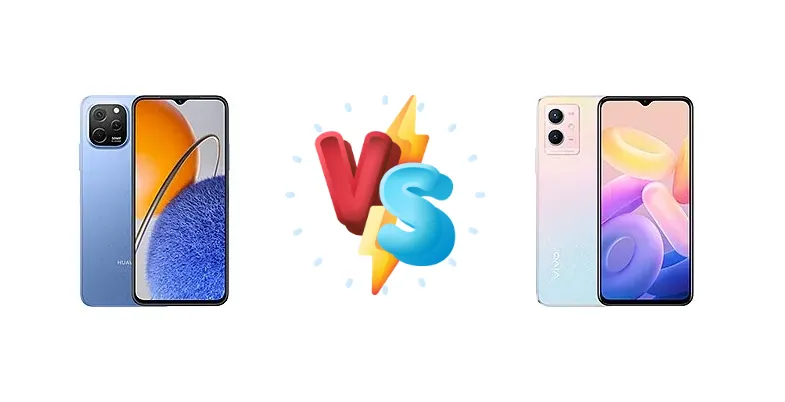
The Huawei Enjoy 50z and vivo Y33s 5G represent compelling options in the increasingly competitive sub-$200 5G smartphone market. While both aim to deliver 5G connectivity at an accessible price, they take different approaches to achieving this, particularly in chipset selection and charging technology. This comparison dissects these differences to help you determine which device best suits your needs.
🏆 Quick Verdict
For the average user prioritizing consistent performance and faster charging, the vivo Y33s 5G emerges as the better choice. Its Mediatek Dimensity 700 chipset offers a demonstrable performance advantage over the Huawei Enjoy 50z’s unspecified octa-core processor, and while the charging isn't dramatically faster, it's still a step up.
| Network |
|---|
| 2G bands | GSM 850 / 900 / 1800 / 1900 | GSM 850 / 900 / 1800 / 1900 |
| 3G bands | HSDPA 850 / 900 / 2100 | HSDPA 850 / 900 / 2100 |
| 4G bands | 1, 3, 5, 8, 18, 19, 26, 34, 38, 39, 40, 41 | 1, 3, 5, 8, 28, 34, 38, 39, 40, 41 |
| 5G bands | - | 1, 28, 41, 77, 78 SA/NSA |
| Speed | HSPA, LTE | HSPA, LTE, 5G |
| Technology | GSM / HSPA / LTE | GSM / CDMA / HSPA / CDMA2000 / LTE / 5G |
| | - | CDMA2000 1x |
| Launch |
|---|
| Announced | 2022, December 09 | 2022, March 01 |
| Status | Available. Released 2022, December 26 | Available. Released 2022, March 01 |
| Body |
|---|
| Build | - | Glass front, plastic frame, plastic back |
| Dimensions | 164.3 x 75.8 x 8.9 mm (6.47 x 2.98 x 0.35 in) | 164 x 75.9 x 8.3 mm (6.46 x 2.99 x 0.33 in) |
| SIM | Nano-SIM + Nano-SIM | Nano-SIM + Nano-SIM |
| Weight | 188 g (6.63 oz) | 185 g (6.53 oz) |
| Display |
|---|
| Resolution | 720 x 1600 pixels, 20:9 ratio (~269 ppi density) | 720 x 1600 pixels, 20:9 ratio (~269 ppi density) |
| Size | 6.52 inches, 102.6 cm2 (~82.4% screen-to-body ratio) | 6.51 inches, 103.1 cm2 (~82.8% screen-to-body ratio) |
| Type | IPS LCD | IPS LCD |
| Platform |
|---|
| CPU | Octa-core | Octa-core (2x2.2 GHz Cortex-A76 & 6x2.0 GHz Cortex-A55) |
| Chipset | - | Mediatek Dimensity 700 (7 nm) |
| GPU | - | Mali-G57 MC2 |
| OS | HarmonyOS 2.0 | Android 12, OriginOS Ocean |
| Memory |
|---|
| Card slot | microSDXC | microSDXC |
| Internal | 128GB 6GB RAM, 128GB 8GB RAM, 256GB 6GB RAM, 256GB 8GB RAM | 128GB 4GB RAM, 128GB 6GB RAM, 128GB 8GB RAM |
| | - | UFS 2.1 |
| Main Camera |
|---|
| Dual | - | 13 MP, f/2.2, 26mm (wide), AF
2 MP (macro) |
| Features | LED flash, HDR, panorama | LED flash, HDR, panorama |
| Single | 5 MP, f/2.2, (wide) | 8 MP, f/1.8, (wide) |
| Triple | 50 MP, f/1.8, (wide), AF
2 MP (macro)
Auxiliary lens | - |
| Video | 1080p@30fps | 1080p@30fps, gyro-EIS |
| Selfie camera |
|---|
| Single | 5 MP, f/2.2, (wide) | 8 MP, f/1.8, (wide) |
| Video | 1080p@30fps | 1080p@30fps |
| Sound |
|---|
| 3.5mm jack | Yes | Yes |
| 35mm jack | Yes | Yes |
| Loudspeaker | Yes | Yes |
| Comms |
|---|
| Bluetooth | 5.1, A2DP, LE | 5.1, A2DP, LE, aptX HD |
| NFC | No | - |
| Positioning | GPS, GLONASS, GALILEO, BDS, QZSS | GPS, GLONASS, GALILEO, BDS, QZSS |
| Radio | No | Unspecified |
| USB | USB Type-C 2.0, OTG | USB Type-C, OTG |
| WLAN | Wi-Fi 802.11 a/b/g/n/ac, dual-band | Wi-Fi 802.11 a/b/g/n/ac, dual-band, Wi-Fi Direct |
| Features |
|---|
| Sensors | Fingerprint (side-mounted), accelerometer, proximity, compass | Fingerprint (side-mounted), accelerometer, proximity, compass |
| Battery |
|---|
| Charging | 22.5W wired | 18W wired |
| Type | Li-Po 5000 mAh | 5000 mAh |
| Misc |
|---|
| Colors | Sapphire Blue, Mint Green, Midnight Black | Black, Blue, Gradient |
| Models | EVE-AL00 | - |
| Price | About 150 EUR | About 180 EUR |
Huawei Enjoy 50z
- Potentially faster charging with 22.5W support.
- Huawei brand recognition.
- Likely competitive pricing.
- Unspecified processor limits performance expectations.
- Lack of detailed specifications hinders accurate assessment.
vivo Y33s 5G
- Mediatek Dimensity 700 offers superior performance.
- 7nm process node for improved efficiency.
- Known chipset architecture provides confidence.
- Slower charging compared to the Huawei Enjoy 50z.
- May not be available in all markets due to brand restrictions.
Display Comparison
Neither device boasts a standout display. Given the price point, we anticipate both utilize LCD panels, though specific details like resolution and refresh rate are absent. The focus here isn't on visual fidelity, but rather functional usability. Without specific data, it's difficult to assess color accuracy or peak brightness, but both will likely suffice for everyday tasks.
Camera Comparison
Camera performance is likely to be similar, focusing on basic image capture. Both phones likely feature a primary camera accompanied by auxiliary sensors (potentially a depth or macro lens). Without sensor size or aperture information, it’s difficult to assess image quality. However, the Dimensity 700’s ISP (Image Signal Processor) in the vivo Y33s 5G may offer slightly better image processing capabilities, potentially resulting in more detailed and vibrant photos. The prevalence of 2MP macro lenses on both devices suggests limited utility for detailed close-up photography.
Performance
The core difference lies in the chipset. The vivo Y33s 5G’s Mediatek Dimensity 700 (7nm) is a known quantity, featuring a dual-cluster configuration with 2x2.2 GHz Cortex-A76 cores and 6x2.0 GHz Cortex-A55 cores. This architecture provides a significant performance boost over a generic 'octa-core' processor found in the Huawei Enjoy 50z. The 7nm process node of the Dimensity 700 also contributes to better power efficiency, potentially translating to longer battery life under load. The Huawei’s processor lacks this architectural detail, making a direct performance comparison difficult, but it’s reasonable to expect the Dimensity 700 to handle demanding tasks more smoothly.
Battery Life
Battery capacity is not specified for either device, but given the market segment, we can assume similar capacities around 5000mAh. The vivo Y33s 5G supports 18W wired charging, while the Huawei Enjoy 50z offers 22.5W. While 4.5W difference isn’t massive, the Enjoy 50z should theoretically achieve a slightly faster 0-100% charge time. However, the Dimensity 700’s power efficiency could offset this advantage, resulting in comparable real-world battery life.
Buying Guide
Buy the Huawei Enjoy 50z if you prioritize brand familiarity within the Huawei ecosystem and are comfortable with potentially lower performance in demanding applications. Buy the vivo Y33s 5G if you value a more capable processor for smoother multitasking, gaming, and a generally more responsive user experience, coupled with slightly faster charging capabilities.
Frequently Asked Questions
❓ Is the Mediatek Dimensity 700 in the vivo Y33s 5G capable of handling popular games like PUBG Mobile?
Yes, the Dimensity 700 is a capable chipset for gaming at medium settings in PUBG Mobile. While it won't deliver flagship-level performance, it provides a smooth and enjoyable gaming experience, especially considering the phone's price point. Expect playable frame rates with moderate graphics settings.
❓ Does the Huawei Enjoy 50z support Google Mobile Services (GMS)?
This is a critical consideration. Huawei phones, due to ongoing restrictions, often do not come with full Google Mobile Services (GMS) pre-installed. The Enjoy 50z likely relies on Huawei Mobile Services (HMS) and the AppGallery. This means access to apps like Gmail, YouTube, and Google Maps may require workarounds or alternative apps.
❓ How long will it take to fully charge the vivo Y33s 5G with the 18W charger?
Assuming a typical 5000mAh battery, a full charge with the 18W charger will likely take around 2.5 to 3 hours. While not the fastest charging available, it's sufficient for overnight charging or topping up during downtime.