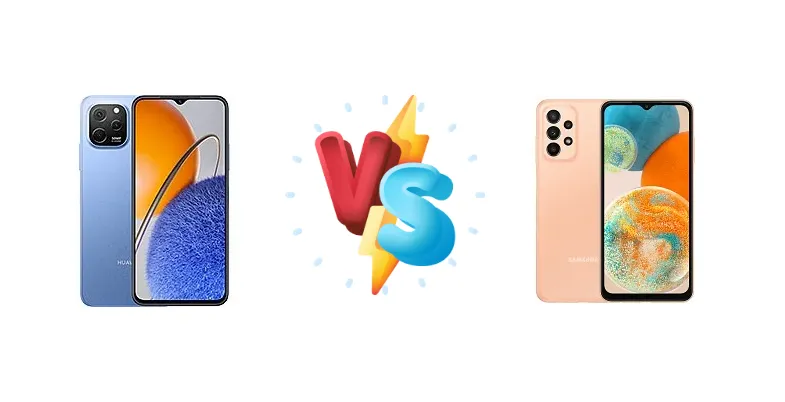
The Huawei Enjoy 50z and Samsung Galaxy A23 5G represent compelling options in the increasingly competitive sub-$250 5G smartphone market. While both aim to deliver 5G connectivity at an accessible price, they take different approaches to achieving this, particularly in chipset choice and display characteristics. This comparison dissects their key specifications to determine which device offers the best overall experience.
🏆 Quick Verdict
For the average user prioritizing consistent performance and a brighter, more viewable display, the Samsung Galaxy A23 5G emerges as the stronger choice. Its Snapdragon 695 chipset, while not a powerhouse, offers a more established and optimized experience than the Enjoy 50z’s unspecified chipset, and the 508 nits of brightness is a significant advantage.
| Network |
|---|
| 2G bands | GSM 850 / 900 / 1800 / 1900 | GSM 850 / 900 / 1800 / 1900 |
| 3G bands | HSDPA 850 / 900 / 2100 | HSDPA 850 / 900 / 1700(AWS) / 1900 / 2100 |
| 4G bands | 1, 3, 5, 8, 18, 19, 26, 34, 38, 39, 40, 41 | 1, 2, 3, 4, 5, 7, 8, 12, 17, 20, 26, 28, 32, 38, 40, 41, 66 - International |
| 5G bands | - | 1, 3, 7, 8, 20, 28, 38, 40, 41, 77, 78 SA/NSA/Sub6 - International |
| Speed | HSPA, LTE | HSPA, LTE, 5G |
| Technology | GSM / HSPA / LTE | GSM / HSPA / LTE / 5G |
| | - | 2, 5, 30, 66, 77 SA/NSA/Sub6/mmWave - USA |
| Launch |
|---|
| Announced | 2022, December 09 | 2022, August 05 |
| Status | Available. Released 2022, December 26 | Available. Released 2022, September 02 |
| Body |
|---|
| Build | - | Glass front (Gorilla Glass 5), plastic frame, plastic back |
| Dimensions | 164.3 x 75.8 x 8.9 mm (6.47 x 2.98 x 0.35 in) | 165.4 x 76.9 x 8.4 mm (6.51 x 3.03 x 0.33 in) |
| SIM | Nano-SIM + Nano-SIM | · Nano-SIM· Nano-SIM + Nano-SIM |
| Weight | 188 g (6.63 oz) | 197 g (6.95 oz) |
| Display |
|---|
| Protection | - | Corning Gorilla Glass 5 |
| Resolution | 720 x 1600 pixels, 20:9 ratio (~269 ppi density) | 1080 x 2408 pixels, 20:9 ratio (~400 ppi density) |
| Size | 6.52 inches, 102.6 cm2 (~82.4% screen-to-body ratio) | 6.6 inches, 104.9 cm2 (~82.5% screen-to-body ratio) |
| Type | IPS LCD | PLS LCD, 120Hz |
| Platform |
|---|
| CPU | Octa-core | Octa-core (2x2.2 GHz Kryo 660 Gold & 6x1.7 GHz Kryo 660 Silver) |
| Chipset | - | Qualcomm SM6375 Snapdragon 695 5G (6 nm) |
| GPU | - | Adreno 619 |
| OS | HarmonyOS 2.0 | Android 12, upgradable to Android 14, One UI 6 |
| Memory |
|---|
| Card slot | microSDXC | microSDXC (dedicated slot) |
| Internal | 128GB 6GB RAM, 128GB 8GB RAM, 256GB 6GB RAM, 256GB 8GB RAM | 64GB 4GB RAM, 64GB 6GB RAM, 128GB 4GB RAM, 128GB 6GB RAM, 128GB 8GB RAM |
| Main Camera |
|---|
| Features | LED flash, HDR, panorama | LED flash, panorama, HDR |
| Quad | - | 50 MP, f/1.8, 26mm (wide), 1/2.76", 0.64µm, PDAF, OIS
5 MP, f/2.2, 13mm, 123˚ (ultrawide), 1/5.0", 1.12µm
2 MP (macro)
Auxiliary lens |
| Single | 5 MP, f/2.2, (wide) | - |
| Triple | 50 MP, f/1.8, (wide), AF
2 MP (macro)
Auxiliary lens | - |
| Video | 1080p@30fps | 1080p@30fps |
| Selfie camera |
|---|
| Single | 5 MP, f/2.2, (wide) | 8 MP, f/2.0, 25mm (wide), 1/4.0", 1.12µm - USA
8 MP, f/2.2, 25mm (wide), 1/4.0", 1.12µm - International |
| Video | 1080p@30fps | 1080p@30fps |
| Sound |
|---|
| 3.5mm jack | Yes | Yes |
| 35mm jack | Yes | Yes |
| Loudspeaker | Yes | Yes |
| Comms |
|---|
| Bluetooth | 5.1, A2DP, LE | 5.1, A2DP, LE |
| NFC | No | Yes |
| Positioning | GPS, GLONASS, GALILEO, BDS, QZSS | GPS, GLONASS, GALILEO, BDS |
| Radio | No | FM radio (market/region dependent) |
| USB | USB Type-C 2.0, OTG | USB Type-C 2.0 |
| WLAN | Wi-Fi 802.11 a/b/g/n/ac, dual-band | Wi-Fi 802.11 a/b/g/n/ac, dual-band, Wi-Fi Direct |
| Features |
|---|
| Sensors | Fingerprint (side-mounted), accelerometer, proximity, compass | Fingerprint (side-mounted), accelerometer, gyro, compass, barometer (USA only) |
| | - | Virtual proximity sensing |
| Battery |
|---|
| Charging | 22.5W wired | 25W wired |
| Type | Li-Po 5000 mAh | Li-Po 5000 mAh |
| Misc |
|---|
| Colors | Sapphire Blue, Mint Green, Midnight Black | Black, White, Peach, Blue |
| Models | EVE-AL00 | SM-A236U, SM-A236U1, SM-A236B, SM-A236B/DS, SM-A236B/DSN, SM-A236E, SM-S236DL |
| Price | About 150 EUR | $ 84.44 / £ 129.00 / € 125.28 / ₹ 21,000 |
| SAR | - | 0.68 W/kg (head) 0.57 W/kg (body) |
| SAR EU | - | 1.49 W/kg (head) 1.25 W/kg (body) |
| Tests |
|---|
| Battery life | - |
Endurance rating 138h
|
| Camera | - |
Photo / Video |
| Display | - |
Contrast ratio: 1328:1 (nominal) |
| Loudspeaker | - |
-25.9 LUFS (Very good)
|
| Performance | - |
AnTuTu: 318821 (v9)
GeekBench: 1940 (v5.1)
GFXBench: 16fps (ES 3.1 onscreen) |
Huawei Enjoy 50z
- Potentially lower price point
- Huawei ecosystem integration
- 22.5W fast charging
- Unspecified chipset performance
- Missing display specifications
- Limited brand recognition outside China
Samsung Galaxy A23 5G
- Snapdragon 695 5G chipset
- Bright 508 nits display
- Established Samsung brand and support
- May be slightly more expensive
- Plastic build quality
- Average camera performance
Display Comparison
The Samsung Galaxy A23 5G boasts a measurable 508 nits of maximum brightness and a 1328:1 contrast ratio, indicating a significantly more vibrant and visible display, especially outdoors. While the Enjoy 50z’s display specifications are absent, it’s reasonable to assume it falls short of these figures given its price point. The contrast ratio, while similar on paper, will be more impactful on the A23 due to the higher peak brightness. This makes the A23 a better choice for media consumption and general usability in bright environments.
Camera Comparison
Both devices feature photo and video capabilities, but detailed camera specifications are lacking for the Enjoy 50z. The Galaxy A23 5G’s camera system, while not flagship-level, benefits from Samsung’s image processing algorithms. Without sensor size or aperture information for the Enjoy 50z, it’s difficult to make a direct comparison. It’s safe to assume the A23’s camera will offer more consistent results and potentially better low-light performance due to Samsung’s software enhancements.
Performance
The Samsung Galaxy A23 5G is powered by the Qualcomm Snapdragon 695 5G (6nm), an octa-core processor featuring 2x2.2 GHz Kryo 660 Gold and 6x1.7 GHz Kryo 660 Silver cores. This provides a known performance baseline and benefits from Qualcomm’s optimizations. The Huawei Enjoy 50z, conversely, utilizes an unspecified octa-core CPU. Without knowing the fabrication process or core architecture, it’s difficult to assess its performance relative to the Snapdragon 695. However, given the price difference, the Snapdragon 695 likely offers a more responsive and efficient experience, particularly in demanding tasks. The 6nm process node of the Snapdragon 695 also suggests better thermal efficiency.
Battery Life
Both the Huawei Enjoy 50z (22.5W charging) and the Samsung Galaxy A23 5G (25W charging) offer relatively fast charging speeds for their price range. Both devices achieve an endurance rating of 138 hours, suggesting similar battery life under typical usage. The slightly faster 25W charging on the A23 could translate to a marginally quicker 0-100% charge time, but the overall battery endurance is expected to be comparable.
Buying Guide
Buy the Huawei Enjoy 50z if you need a basic, functional 5G smartphone and are heavily invested in the Huawei ecosystem, potentially benefiting from software optimizations within that environment. Buy the Samsung Galaxy A23 5G if you prioritize a more refined user experience, a brighter and more easily viewable display in outdoor conditions, and the broader compatibility and support offered by the Samsung brand.
Frequently Asked Questions
❓ Is the Snapdragon 695 in the Galaxy A23 5G powerful enough for gaming?
The Snapdragon 695 is a capable mid-range chipset. While it won't deliver flagship-level gaming performance, it can handle most popular mobile games at medium settings. Expect playable frame rates in titles like PUBG Mobile and Call of Duty Mobile, but don't anticipate maxing out graphics settings.
❓ How does the charging speed of the Galaxy A23 5G compare to other phones in its price range?
The 25W charging on the Galaxy A23 5G is relatively fast for a budget 5G phone. While some competitors offer 33W or even 67W charging, 25W is still sufficient to top up the battery in a reasonable timeframe, typically around 1.5 to 2 hours for a full charge.
❓ Does the Huawei Enjoy 50z support Google Mobile Services (GMS)?
The Huawei Enjoy 50z, like many Huawei devices, does *not* natively support Google Mobile Services (GMS). It relies on Huawei Mobile Services (HMS) and the AppGallery. This means access to apps like Gmail, YouTube, and Google Maps requires workarounds, potentially impacting usability for users heavily reliant on the Google ecosystem.