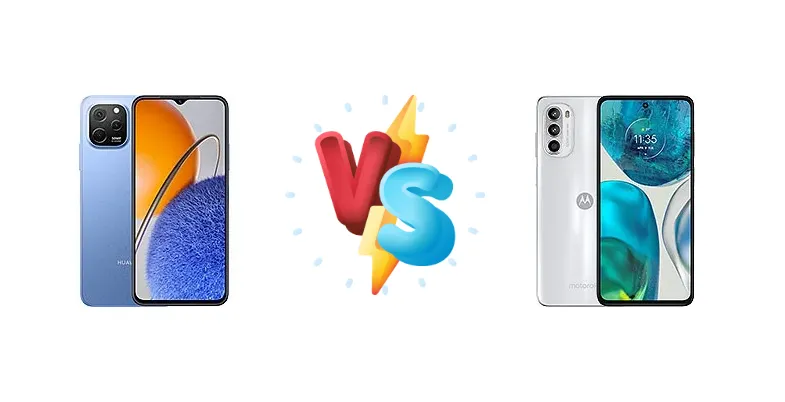
The Huawei Enjoy 50z and Motorola Moto G52 represent compelling options in the crowded budget smartphone market. While both aim to deliver essential features at an accessible price point, they take different approaches to performance and charging. This comparison dissects their key specifications to determine which device offers the best overall experience for the average user.
🏆 Quick Verdict
For most users, the Motorola Moto G52 emerges as the stronger choice. Its Qualcomm Snapdragon 680 chipset, built on a 6nm process, provides a noticeable performance advantage and improved efficiency compared to the Enjoy 50z’s unspecified octa-core processor. The 30W charging also offers a faster top-up time.
| Network |
|---|
| 2G bands | GSM 850 / 900 / 1800 / 1900 | GSM 850 / 900 / 1800 / 1900 |
| 3G bands | HSDPA 850 / 900 / 2100 | HSDPA 850 / 900 / 1700(AWS) / 1900 / 2100 |
| 4G bands | 1, 3, 5, 8, 18, 19, 26, 34, 38, 39, 40, 41 | LTE |
| Speed | HSPA, LTE | HSPA, LTE |
| Technology | GSM / HSPA / LTE | GSM / HSPA / LTE |
| Launch |
|---|
| Announced | 2022, December 09 | 2022, April 12 |
| Status | Available. Released 2022, December 26 | Available. Released 2022, April 20 |
| Body |
|---|
| Dimensions | 164.3 x 75.8 x 8.9 mm (6.47 x 2.98 x 0.35 in) | 160.1 x 74.5 x 8 mm (6.30 x 2.93 x 0.31 in) |
| SIM | Nano-SIM + Nano-SIM | Nano-SIM + Nano-SIM |
| Weight | 188 g (6.63 oz) | 169 g (5.96 oz) |
| | - | Water-repellent design |
| Display |
|---|
| Resolution | 720 x 1600 pixels, 20:9 ratio (~269 ppi density) | 1080 x 2400 pixels, 20:9 ratio (~402 ppi density) |
| Size | 6.52 inches, 102.6 cm2 (~82.4% screen-to-body ratio) | 6.6 inches, 103.6 cm2 (~86.9% screen-to-body ratio) |
| Type | IPS LCD | AMOLED, 90Hz |
| Platform |
|---|
| CPU | Octa-core | Octa-core (4x2.4 GHz Kryo 265 Gold & 4x1.9 GHz Kryo 265 Silver) |
| Chipset | - | Qualcomm SM6225 Snapdragon 680 4G (6 nm) |
| GPU | - | Adreno 610 |
| OS | HarmonyOS 2.0 | Android 12, planned upgrade to Android 13 |
| Memory |
|---|
| Card slot | microSDXC | microSDXC (uses shared SIM slot) |
| Internal | 128GB 6GB RAM, 128GB 8GB RAM, 256GB 6GB RAM, 256GB 8GB RAM | 64GB 4GB RAM, 128GB 4GB RAM, 128GB 6GB RAM, 256GB 6GB RAM |
| Main Camera |
|---|
| Features | LED flash, HDR, panorama | LED flash, HDR, panorama |
| Single | 5 MP, f/2.2, (wide) | - |
| Triple | 50 MP, f/1.8, (wide), AF
2 MP (macro)
Auxiliary lens | 50 MP, f/1.8 (wide), 1/2.76", 0.64µm, PDAF
8 MP, f/2.2, 118˚ (ultrawide), 1/4.0", 1.12µm
2 MP (macro) |
| Video | 1080p@30fps | 1080p@30fps |
| Selfie camera |
|---|
| Single | 5 MP, f/2.2, (wide) | 16 MP, f/2.5, (wide), 1.0µm |
| Video | 1080p@30fps | 1080p@30fps |
| Sound |
|---|
| 3.5mm jack | Yes | Yes |
| 35mm jack | Yes | Yes |
| Loudspeaker | Yes | Yes, with stereo speakers |
| Comms |
|---|
| Bluetooth | 5.1, A2DP, LE | 5.0, A2DP, LE |
| NFC | No | Yes (market/region dependent) |
| Positioning | GPS, GLONASS, GALILEO, BDS, QZSS | GPS, GLONASS, GALILEO |
| Radio | No | Unspecified |
| USB | USB Type-C 2.0, OTG | USB Type-C 2.0 |
| WLAN | Wi-Fi 802.11 a/b/g/n/ac, dual-band | Wi-Fi 802.11 a/b/g/n/ac, dual-band, Wi-Fi Direct |
| Features |
|---|
| Sensors | Fingerprint (side-mounted), accelerometer, proximity, compass | Fingerprint (side-mounted), accelerometer, gyro, proximity, compass |
| Battery |
|---|
| Charging | 22.5W wired | 30W wired |
| Type | Li-Po 5000 mAh | Li-Po 5000 mAh |
| Misc |
|---|
| Colors | Sapphire Blue, Mint Green, Midnight Black | Charcoal Gray, Porcelain White |
| Models | EVE-AL00 | XT2221-1, XT2221-2 |
| Price | About 150 EUR | About 470 EUR |
Huawei Enjoy 50z
- Potentially lower price point
- May offer longer standby time due to less powerful processor
- Huawei’s EMUI software (preference-based)
- Inferior processor performance compared to Snapdragon 680
- Slower 22.5W charging
- Likely less efficient chipset
Motorola Moto G52
- More powerful and efficient Snapdragon 680 chipset
- Faster 30W wired charging
- Better image processing capabilities
- May be slightly more expensive
- Motorola’s software update policy can be inconsistent
- Potentially less standby time due to more powerful processor
Display Comparison
Neither device’s display specifications are provided, so a direct comparison is limited. However, given the market segment, both likely utilize LCD panels. The Moto G52’s potential advantage lies in Motorola’s historically better color calibration within this price range. Without knowing the resolution or refresh rate of the Enjoy 50z, it’s difficult to assess its visual clarity. Bezels are likely comparable, focusing on cost reduction rather than premium aesthetics.
Camera Comparison
Without detailed camera specifications, assessing image quality is challenging. However, the Moto G52’s chipset likely offers superior image signal processing (ISP) capabilities, resulting in better dynamic range and noise reduction. The absence of information regarding sensor size on the Enjoy 50z suggests a smaller sensor, potentially leading to poorer low-light performance. Both devices likely feature a standard primary camera and depth/macro sensors, but the Snapdragon 680’s processing power will likely give the Moto G52 an edge in computational photography.
Performance
The Motorola Moto G52’s Qualcomm Snapdragon 680 (6nm) is the clear performance leader. The 6nm fabrication process is significantly more efficient than the likely larger node used in the Enjoy 50z’s octa-core CPU. The Snapdragon 680’s Kryo 265 Gold cores, clocked at 2.4 GHz, provide a substantial boost in single-core performance, crucial for app launch speeds and general responsiveness. The Enjoy 50z’s octa-core configuration, without knowing the architecture or clock speeds, likely prioritizes power efficiency over raw processing power. This translates to a smoother experience on the Moto G52, especially when multitasking or running demanding applications.
Battery Life
While battery capacity isn’t specified for either device, the Motorola Moto G52’s 30W wired charging is a significant advantage. This allows for a much faster 0-100% charge compared to the Huawei Enjoy 50z’s 22.5W charging. Even if the Enjoy 50z has a slightly larger battery, the faster charging of the Moto G52 minimizes downtime and provides greater convenience. The Snapdragon 680’s 6nm efficiency also contributes to potentially better battery life during typical usage.
Buying Guide
Buy the Huawei Enjoy 50z if you prioritize a potentially lower price point and are primarily focused on basic smartphone tasks like calling, texting, and light social media use. Buy the Motorola Moto G52 if you value smoother multitasking, a more responsive user experience, and faster charging, even if it means spending slightly more.
Frequently Asked Questions
❓ Is the Snapdragon 680 in the Moto G52 powerful enough for gaming?
The Snapdragon 680 is capable of handling casual gaming titles without issue. However, for demanding games like PUBG or Genshin Impact, you’ll likely need to lower graphics settings to achieve a smooth frame rate. It’s not a gaming powerhouse, but it’s sufficient for most users’ gaming needs.
❓ Does the Motorola Moto G52 support VoLTE and VoWiFi?
The Motorola Moto G52 generally supports VoLTE (Voice over LTE) and VoWiFi (Voice over Wi-Fi) depending on the carrier and region. It’s crucial to check with your mobile carrier to confirm compatibility in your specific location, as support can vary.
❓ What type of charging port does the Huawei Enjoy 50z use?
While not explicitly stated, given Huawei’s current practices and the budget nature of the device, the Enjoy 50z almost certainly uses a USB-C port for both charging and data transfer. This is the industry standard and provides compatibility with a wide range of accessories.
❓ How does the software experience differ between the Huawei Enjoy 50z and Motorola Moto G52?
The Huawei Enjoy 50z runs on Huawei’s EMUI, which offers a customized Android experience with a focus on aesthetics and features. The Motorola Moto G52 runs a near-stock version of Android, providing a cleaner and more streamlined user interface with minimal bloatware. This difference is largely a matter of personal preference.