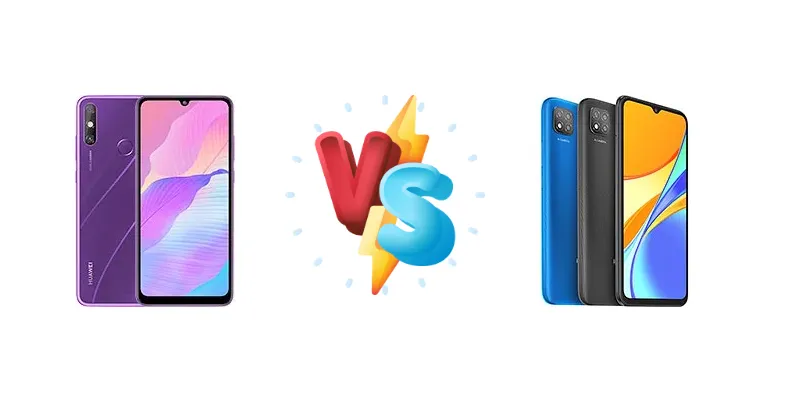
The Huawei Enjoy 20e and Xiaomi Redmi 9C NFC represent the fiercely competitive sub-$150 smartphone market. Both aim to deliver essential smartphone functionality at an accessible price point, but they take different approaches to achieving this. This comparison dissects their key specifications to determine which device offers the best overall experience for budget-conscious consumers.
🏆 Quick Verdict
For most users, the Xiaomi Redmi 9C NFC emerges as the slightly better choice. While both phones share a similar 10W charging rate, the Redmi 9C NFC’s Helio G35 chipset offers a modest, but noticeable, performance edge over the Enjoy 20e’s Helio P35, making it more responsive for daily tasks.
| Network |
|---|
| 2G bands | GSM 900 / 1800 / 1900 | GSM 850 / 900 / 1800 / 1900 |
| 3G bands | HSDPA 850 / 900 / 2100 | HSDPA 850 / 900 / 1700(AWS) / 1900 / 2100 |
| 4G bands | 1, 3, 5, 8, 34, 38, 39, 40, 41 | 1, 2, 3, 4, 5, 7, 8, 20, 38, 40 |
| Speed | HSPA, LTE | HSPA, LTE |
| Technology | GSM / HSPA / LTE | GSM / HSPA / LTE |
| Launch |
|---|
| Announced | 2021, October 28 | 2020, August 27. Released 2020, August 27 |
| Status | Available. Released 2021, November 11 | Discontinued |
| Body |
|---|
| Dimensions | 159.1 x 74.1 x 9 mm (6.26 x 2.92 x 0.35 in) | 164.9 x 77.1 x 9 mm (6.49 x 3.04 x 0.35 in) |
| SIM | Nano-SIM + Nano-SIM | Nano-SIM + Nano-SIM |
| Weight | 185 g (6.53 oz) | 196 g (6.91 oz) |
| Display |
|---|
| Resolution | 720 x 1600 pixels, 20:9 ratio (~278 ppi density) | 720 x 1600 pixels, 20:9 ratio (~269 ppi density) |
| Size | 6.3 inches, 95.8 cm2 (~81.3% screen-to-body ratio) | 6.53 inches, 102.9 cm2 (~81.0% screen-to-body ratio) |
| Type | IPS LCD | IPS LCD, 400 nits (typ) |
| Platform |
|---|
| CPU | Octa-core (4x2.35 GHz Cortex-A53 & 4x1.8 GHz Cortex-A53)Octa-core (4x2.0 GHz Cortex-A73 & 4x1.7 GHz Cortex-A53) - 128GB 6GB RAM only | Octa-core (4x2.3 GHz Cortex-A53 & 4x1.8 GHz Cortex-A53) |
| Chipset | Mediatek MT6765 Helio P35 (12 nm)Kirin 710A (14 nm) - 128GB 6GB RAM only | Mediatek MT6765G Helio G35 (12 nm) |
| GPU | PowerVR GE8320Mali-G51 MP4 - 128GB 6GB RAM only | PowerVR GE8320 |
| OS | HarmonyOS 2.0 (China), EMUI 10.1 (International), no Google Play Services | Android 10, MIUI 12 |
| Memory |
|---|
| Card slot | microSD | microSDXC (dedicated slot) |
| Internal | 64GB 4GB RAM, 128GB 4GB RAM, 128GB 6GB RAM | 32GB 2GB RAM, 32GB 3GB RAM, 64GB 2GB RAM, 64GB 3GB RAM, 128GB 3GB RAM, 128GB 4GB RAM |
| | - | eMMC 5.1 |
| Main Camera |
|---|
| Dual | 13 MP, f/1.8, 27mm (wide), PDAF
Auxiliary lens | 13 MP, f/2.2, 28mm (wide), 1.0µm, PDAF
2 MP (macro) |
| Features | LED flash, HDR, panorama | LED flash, HDR |
| Single | 8 MP, f/2.0 | - |
| Video | 1080p@30fps | 1080p@30fps |
| Selfie camera |
|---|
| Features | - | HDR |
| Single | 8 MP, f/2.0 | 5 MP, f/2.2, (wide), 1.12µm |
| Video | 1080p@30fps | 1080p@30fps |
| Sound |
|---|
| 3.5mm jack | Yes | Yes |
| 35mm jack | Yes | Yes |
| Loudspeaker | Yes | Yes |
| Comms |
|---|
| Bluetooth | 5.0, A2DP, LE | 5.0, A2DP, LE |
| NFC | No | Yes |
| Positioning | GPS, GLONASS, GALILEO, BDS | GPS, GLONASS, BDS |
| Radio | Unspecified | FM radio |
| USB | microUSB 2.0, OTG | microUSB 2.0, OTG |
| WLAN | Wi-Fi 802.11 b/g/n | Wi-Fi 802.11 b/g/n, Wi-Fi Direct |
| Features |
|---|
| Sensors | Fingerprint (rear-mounted), accelerometer, proximity | Fingerprint (rear-mounted), accelerometer, proximity |
| Battery |
|---|
| Charging | 10W wired
6W reverse wired | 10W wired |
| Type | Li-Po 5000 mAh | Li-Po 5000 mAh |
| Misc |
|---|
| Colors | Black, Green, Violet | Midnight Gray, Sunshine Yellow, Twilight Blue |
| Models | MLD-AL10 | M2006C3MNG |
| Price | About 130 EUR | About 100 EUR |
| SAR | - | 0.57 W/kg (head) 0.90 W/kg (body) |
| SAR EU | - | 0.37 W/kg (head) 1.14 W/kg (body) |
Huawei Enjoy 20e
- Potential for better performance with Kirin 710A variant
- 6W reverse wired charging
- Huawei’s software optimizations (potentially)
- Base model with Helio P35 is underpowered
- No NFC in base model
- 10W charging is slow
Xiaomi Redmi 9C NFC
- Helio G35 offers a slight performance boost over P35
- NFC support for contactless payments
- Generally more affordable
- No reverse wired charging
- 10W charging is slow
- Software experience may not be as refined as Huawei’s
Display Comparison
Neither device boasts a standout display. Both likely utilize LCD panels, typical for this price bracket. Specifics like resolution and peak brightness are not provided, but we can assume they are similar – around 720p+ and adequate for indoor use. The focus here isn’t on visual fidelity, but on basic functionality. Bezels are expected to be noticeable on both devices, contributing to a larger overall footprint.
Camera Comparison
Camera performance is likely to be similar on both devices, with neither excelling in image quality. Both will likely feature a primary camera alongside depth and macro sensors (the latter often being of limited utility). Without specific sensor size or aperture information, it’s difficult to definitively say which performs better. Image processing will play a crucial role, and Huawei’s software optimizations might provide a slight edge in certain scenarios, but don’t expect flagship-level results. The Redmi 9C NFC’s inclusion of NFC is a feature absent in the base Enjoy 20e, offering contactless payment and pairing capabilities.
Performance
The core difference lies in the chipsets. The Redmi 9C NFC features the Mediatek Helio G35, while the Enjoy 20e comes with either the Helio P35 or the Kirin 710A (only in the 128GB/6GB configuration). The Helio G35, while still an entry-level chip, benefits from a slightly higher clock speed (2.3 GHz vs 2.35 GHz on the P35) and a more modern architecture. The Kirin 710A, found in the higher-spec Enjoy 20e, represents a significant performance leap, utilizing Cortex-A73 cores for improved responsiveness. However, the base Enjoy 20e with the P35 will struggle more with demanding applications. Both phones share 6GB of RAM in their highest configurations, which is adequate for basic multitasking.
Battery Life
Both the Enjoy 20e and Redmi 9C NFC are equipped with 10W wired charging, indicating similar charging speeds. While battery capacity isn’t specified, both likely house around a 5000mAh battery, typical for this segment. Expect a full charge to take around 2-3 hours. Real-world battery life will depend heavily on usage patterns, but both should comfortably last a full day with moderate use. The Enjoy 20e also offers 6W reverse wired charging, allowing it to top up other devices, a feature absent on the Redmi 9C NFC.
Buying Guide
Buy the Huawei Enjoy 20e if you prioritize a potentially more refined software experience (depending on region and EMUI version) and the option of a more powerful Kirin 710A variant in the 128GB/6GB model. Buy the Xiaomi Redmi 9C NFC if you value a slightly more capable processor for smoother multitasking and gaming, coupled with the convenience of NFC for mobile payments and quick pairing.
Frequently Asked Questions
❓ Does the Redmi 9C NFC’s Helio G35 handle popular games like PUBG Mobile?
The Helio G35 can run PUBG Mobile, but expect to play at lower graphics settings and frame rates to maintain a smooth experience. It’s not a gaming powerhouse, but it’s capable of casual gaming.
❓ Is the NFC on the Redmi 9C NFC compatible with Google Pay and other mobile payment services?
Yes, the Redmi 9C NFC supports NFC for contactless payments with Google Pay and other compatible services, provided they are available in your region. You’ll need to set up your payment information within the respective app.
❓ What are the real-world benefits of the Huawei Enjoy 20e’s reverse wired charging?
Reverse wired charging allows you to use the Enjoy 20e as a power bank to charge other devices, like wireless earbuds or a friend’s phone, using a USB cable. It’s a convenient feature for emergencies, but the 6W output is relatively slow.
❓ Which phone is likely to receive more software updates?
Historically, Xiaomi has been more consistent with software updates for its Redmi series than Huawei, particularly given the geopolitical constraints impacting Huawei’s access to Google Mobile Services. However, update frequency can vary.