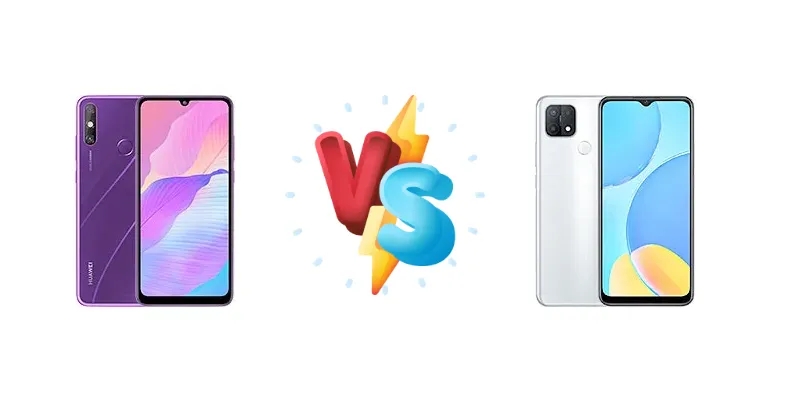
The Huawei Enjoy 20e and Oppo A15s represent the fiercely competitive entry-level smartphone market. Both aim to deliver essential smartphone functionality at an accessible price point. However, a closer look reveals key differences, particularly in chipset options for the Enjoy 20e, that could sway your decision depending on your priorities.
🏆 Quick Verdict
For the average user prioritizing consistent performance, the Huawei Enjoy 20e (specifically the Kirin 710A variant) emerges as the slightly better choice. While both phones share the same Helio P35 option, the Enjoy 20e’s Kirin 710A offers a noticeable CPU performance boost, making it more suitable for multitasking and demanding apps.
| Network |
|---|
| 2G bands | GSM 900 / 1800 / 1900 | GSM 850 / 900 / 1800 / 1900 |
| 3G bands | HSDPA 850 / 900 / 2100 | HSDPA 850 / 900 / 2100 |
| 4G bands | 1, 3, 5, 8, 34, 38, 39, 40, 41 | 1, 3, 5, 8, 38, 40, 41 |
| Speed | HSPA, LTE | HSPA, LTE |
| Technology | GSM / HSPA / LTE | GSM / HSPA / LTE |
| Launch |
|---|
| Announced | 2021, October 28 | 2020, December 18. Released 2020, December 18 |
| Status | Available. Released 2021, November 11 | Discontinued |
| Body |
|---|
| Build | - | Glass front, plastic back, plastic frame |
| Dimensions | 159.1 x 74.1 x 9 mm (6.26 x 2.92 x 0.35 in) | 164 x 75.4 x 7.9 mm (6.46 x 2.97 x 0.31 in) |
| SIM | Nano-SIM + Nano-SIM | Nano-SIM + Nano-SIM |
| Weight | 185 g (6.53 oz) | 177 g (6.24 oz) |
| Display |
|---|
| Resolution | 720 x 1600 pixels, 20:9 ratio (~278 ppi density) | 720 x 1600 pixels, 20:9 ratio (~269 ppi density) |
| Size | 6.3 inches, 95.8 cm2 (~81.3% screen-to-body ratio) | 6.52 inches, 102.6 cm2 (~83.0% screen-to-body ratio) |
| Type | IPS LCD | IPS LCD, 480 nits (typ) |
| Platform |
|---|
| CPU | Octa-core (4x2.35 GHz Cortex-A53 & 4x1.8 GHz Cortex-A53)Octa-core (4x2.0 GHz Cortex-A73 & 4x1.7 GHz Cortex-A53) - 128GB 6GB RAM only | Octa-core (4x2.35 GHz Cortex-A53 & 4x1.8 GHz Cortex-A53) |
| Chipset | Mediatek MT6765 Helio P35 (12 nm)Kirin 710A (14 nm) - 128GB 6GB RAM only | Mediatek MT6765 Helio P35 (12 nm) |
| GPU | PowerVR GE8320Mali-G51 MP4 - 128GB 6GB RAM only | PowerVR GE8320 |
| OS | HarmonyOS 2.0 (China), EMUI 10.1 (International), no Google Play Services | Android 10, ColorOS 7.2 |
| Memory |
|---|
| Card slot | microSD | microSDXC |
| Internal | 64GB 4GB RAM, 128GB 4GB RAM, 128GB 6GB RAM | 64GB 4GB RAM, 128GB 4GB RAM |
| | - | eMMC 5.1 |
| Main Camera |
|---|
| Dual | 13 MP, f/1.8, 27mm (wide), PDAF
Auxiliary lens | - |
| Features | LED flash, HDR, panorama | LED flash, HDR, panorama |
| Single | 8 MP, f/2.0 | - |
| Triple | - | 13 MP, f/2.2, (wide), 1/3.1", 1.12µm, PDAF
2 MP (macro)
Auxiliary lens |
| Video | 1080p@30fps | 1080p@30fps |
| Selfie camera |
|---|
| Features | - | HDR |
| Single | 8 MP, f/2.0 | 8 MP, f/2.0, (wide) |
| Video | 1080p@30fps | 1080p@30fps |
| Sound |
|---|
| 3.5mm jack | Yes | Yes |
| 35mm jack | Yes | Yes |
| Loudspeaker | Yes | Yes |
| Comms |
|---|
| Bluetooth | 5.0, A2DP, LE | 5.0, A2DP, LE, aptX |
| NFC | No | No |
| Positioning | GPS, GLONASS, GALILEO, BDS | GPS, GLONASS, GALILEO, BDS |
| Radio | Unspecified | FM radio |
| USB | microUSB 2.0, OTG | microUSB 2.0, OTG |
| WLAN | Wi-Fi 802.11 b/g/n | Wi-Fi 802.11 b/g/n, Wi-Fi Direct |
| Features |
|---|
| Sensors | Fingerprint (rear-mounted), accelerometer, proximity | Fingerprint (rear-mounted), accelerometer, proximity |
| Battery |
|---|
| Charging | 10W wired
6W reverse wired | 10W wired |
| Type | Li-Po 5000 mAh | Li-Po 4230 mAh |
| Misc |
|---|
| Colors | Black, Green, Violet | Dynamic Black, Fancy White |
| Models | MLD-AL10 | CPH2179 |
| Price | About 130 EUR | About 130 EUR |
Huawei Enjoy 20e
- Potential for better performance with Kirin 710A variant
- Offers 6W reverse wired charging
- More CPU core diversity with Kirin 710A
- Chipset variant confusion (Helio P35 or Kirin 710A)
- 10W charging is slow
Oppo A15s
- Consistent performance with Helio P35
- Simple and straightforward user experience
- Generally lower price point
- Helio P35 is a basic chipset
- Lacks reverse charging capability
Display Comparison
Neither Huawei nor Oppo provide detailed display specifications in the provided data. Given the price bracket, both likely utilize LCD panels with 720p+ resolution. Bezels are expected to be substantial on both devices. Color accuracy and brightness are likely to be similar, prioritizing power efficiency over visual fidelity. Without further data, a clear winner cannot be determined.
Camera Comparison
Detailed camera specifications are absent. Both phones likely feature a multi-camera setup, but the quality will heavily depend on the main sensor and image processing algorithms. The inclusion of a 2MP macro camera on either device is unlikely to significantly enhance the photography experience. Without sensor size or aperture information, a meaningful comparison is impossible. Image processing style will likely differ between Huawei and Oppo, potentially influencing color saturation and dynamic range.
Performance
The core difference lies in the chipset options. The Oppo A15s is exclusively equipped with the Mediatek MT6765 Helio P35, featuring an octa-core CPU with Cortex-A53 cores clocked up to 2.35 GHz. The Huawei Enjoy 20e offers a choice: the same Helio P35 *or* the Kirin 710A. The Kirin 710A, built on a 14nm process, boasts a more powerful CPU configuration – four Cortex-A73 cores at 2.0 GHz alongside four Cortex-A53 cores at 1.7 GHz. This architectural shift provides a significant advantage in multi-core performance, making the Kirin 710A variant of the Enjoy 20e better suited for demanding applications. Both phones share 6GB of RAM, mitigating some of the Helio P35’s limitations, but the CPU difference remains crucial.
Battery Life
Both devices offer 10W wired charging, indicating a similar charging speed. The battery capacity is not specified, but given the target market, capacities likely range between 4000mAh and 5000mAh. The Enjoy 20e also offers 6W reverse wired charging, a niche feature allowing it to charge other devices, which the Oppo A15s lacks. However, the slow charging speed limits its practicality. Without knowing the battery capacity, it's difficult to definitively say which phone offers better battery life.
Buying Guide
Buy the Huawei Enjoy 20e if you need a phone capable of handling more than basic tasks, and potentially benefit from the Kirin 710A variant's improved CPU performance. This is ideal for users who occasionally play games or use multiple apps simultaneously. Buy the Oppo A15s if you prioritize simplicity and a consistent, albeit basic, experience, and are comfortable with the limitations of the Helio P35 chipset. It's a solid choice for first-time smartphone users or those needing a reliable call and messaging device.
Frequently Asked Questions
❓ Is the Kirin 710A in the Huawei Enjoy 20e a significant upgrade over the Helio P35?
Yes, the Kirin 710A offers a noticeable performance improvement, particularly in multi-core tasks. Its Cortex-A73 cores provide a substantial boost over the Helio P35’s all-Cortex-A53 configuration, resulting in smoother multitasking and better app responsiveness.
❓ Does either phone support fast charging, and how long does it take to fully charge?
Neither phone supports fast charging. Both are limited to 10W wired charging, meaning a full charge from 0% to 100% will likely take over 2.5 hours, potentially closer to 3 hours depending on battery capacity.
❓ What kind of gaming performance can I expect from the Oppo A15s?
The Oppo A15s, with its Helio P35 chipset, is best suited for casual gaming. Demanding titles like PUBG Mobile will likely require low graphics settings and may still experience frame drops. It's adequate for less intensive games and basic entertainment.
❓ Is the reverse charging feature on the Huawei Enjoy 20e useful?
While a nice addition, the 6W reverse charging on the Enjoy 20e is quite slow. It's more of a convenience feature for emergencies than a practical way to quickly charge other devices. Expect a very slow trickle charge.