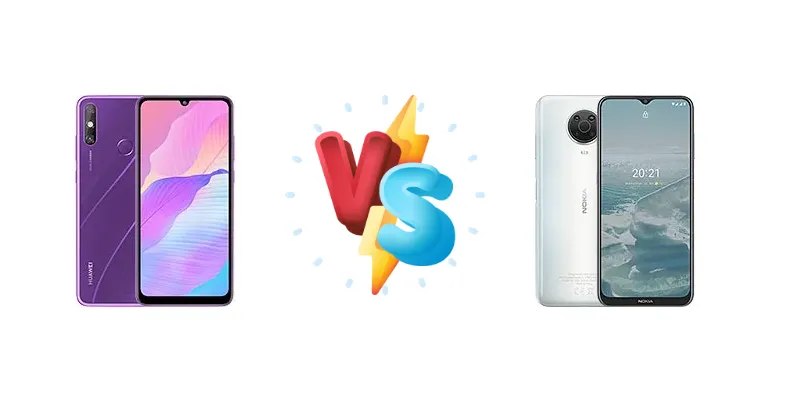
The Huawei Enjoy 20e and Nokia G20 represent compelling options in the ultra-budget smartphone segment. Both aim to deliver essential smartphone functionality at a low price point, but they take different approaches to achieving this. This comparison dissects their core specifications, focusing on performance, battery life, and overall value to determine which device best suits your needs.
🏆 Quick Verdict
For most users, the Huawei Enjoy 20e (specifically the 128GB/6GB RAM variant with the Kirin 710A) offers a slight edge in performance due to its more capable CPU architecture. However, the Nokia G20 provides a cleaner Android experience and potentially longer software support, making it a viable alternative for those prioritizing simplicity and updates.
| Network |
|---|
| 2G bands | GSM 900 / 1800 / 1900 | GSM 850 / 900 / 1800 / 1900 |
| 3G bands | HSDPA 850 / 900 / 2100 | HSDPA 850 / 900 / 1900 / 2100 - International |
| 4G bands | 1, 3, 5, 8, 34, 38, 39, 40, 41 | 1, 3, 5, 7, 8, 20, 28, 38, 40, 41 - International |
| Speed | HSPA, LTE | HSPA 42.2/5.76 Mbps, LTE Cat4 150/50 Mbps |
| Technology | GSM / HSPA / LTE | GSM / HSPA / LTE |
| | - | 1, 2, 3, 4, 5, 7, 8, 12, 17, 28, 66 - LATAM |
| Launch |
|---|
| Announced | 2021, October 28 | 2021, April 08 |
| Status | Available. Released 2021, November 11 | Available. Released 2021, May 17 |
| Body |
|---|
| Dimensions | 159.1 x 74.1 x 9 mm (6.26 x 2.92 x 0.35 in) | 164.9 x 76 x 9.2 mm (6.49 x 2.99 x 0.36 in) |
| SIM | Nano-SIM + Nano-SIM | · Nano-SIM· Nano-SIM + Nano-SIM |
| Weight | 185 g (6.53 oz) | 197 g (6.95 oz) |
| | - | Splash protection |
| Display |
|---|
| Resolution | 720 x 1600 pixels, 20:9 ratio (~278 ppi density) | 720 x 1600 pixels, 20:9 ratio (~269 ppi density) |
| Size | 6.3 inches, 95.8 cm2 (~81.3% screen-to-body ratio) | 6.52 inches, 102.6 cm2 (~81.9% screen-to-body ratio) |
| Type | IPS LCD | IPS LCD |
| Platform |
|---|
| CPU | Octa-core (4x2.35 GHz Cortex-A53 & 4x1.8 GHz Cortex-A53)Octa-core (4x2.0 GHz Cortex-A73 & 4x1.7 GHz Cortex-A53) - 128GB 6GB RAM only | Octa-core (4x2.3 GHz Cortex-A53 & 4x1.8 GHz Cortex-A53) |
| Chipset | Mediatek MT6765 Helio P35 (12 nm)Kirin 710A (14 nm) - 128GB 6GB RAM only | Mediatek MT6765G Helio G35 (12 nm) |
| GPU | PowerVR GE8320Mali-G51 MP4 - 128GB 6GB RAM only | PowerVR GE8320 |
| OS | HarmonyOS 2.0 (China), EMUI 10.1 (International), no Google Play Services | Android 11, upgradable to Android 13 |
| Memory |
|---|
| Card slot | microSD | microSDXC (dedicated slot) |
| Internal | 64GB 4GB RAM, 128GB 4GB RAM, 128GB 6GB RAM | 64GB 4GB RAM, 128GB 4GB RAM |
| Main Camera |
|---|
| Dual | 13 MP, f/1.8, 27mm (wide), PDAF
Auxiliary lens | - |
| Features | LED flash, HDR, panorama | LED flash, HDR, panorama |
| Quad | - | 48 MP, f/1.8, (wide), PDAF
5 MP, (ultrawide)
2 MP (macro)
Auxiliary lens |
| Single | 8 MP, f/2.0 | 8 MP, (wide) |
| Video | 1080p@30fps | 1080p@30fps |
| Selfie camera |
|---|
| Single | 8 MP, f/2.0 | 8 MP, (wide) |
| Video | 1080p@30fps | 1080p@30fps |
| Sound |
|---|
| 3.5mm jack | Yes | Yes |
| 35mm jack | Yes | Yes |
| Loudspeaker | Yes | Yes |
| Comms |
|---|
| Bluetooth | 5.0, A2DP, LE | 5.0, A2DP, LE |
| NFC | No | Yes (market/region dependent) |
| Positioning | GPS, GLONASS, GALILEO, BDS | GPS, GLONASS, BDS |
| Radio | Unspecified | FM radio |
| USB | microUSB 2.0, OTG | USB Type-C 2.0, OTG |
| WLAN | Wi-Fi 802.11 b/g/n | Wi-Fi 802.11 b/g/n |
| Features |
|---|
| Sensors | Fingerprint (rear-mounted), accelerometer, proximity | Fingerprint (side-mounted), accelerometer, gyro, proximity |
| Battery |
|---|
| Charging | 10W wired
6W reverse wired | 10W wired |
| Type | Li-Po 5000 mAh | Li-Po 5050 mAh |
| Misc |
|---|
| Colors | Black, Green, Violet | Glacier, Night |
| Models | MLD-AL10 | TA-1336, TA-1343, TA-1347, TA-1372, TA-1365 |
| Price | About 130 EUR | About 90 EUR |
| SAR | - | 1.01 W/kg (head) 1.02 W/kg (body) |
| SAR EU | - | 0.49 W/kg (head) 1.13 W/kg (body) |
Huawei Enjoy 20e
- Potentially better performance with Kirin 710A variant
- Larger RAM capacity (6GB)
- Reverse wired charging capability
- Huawei’s EMUI software can be polarizing
- Slower 10W charging
Nokia G20
- Clean, stock Android experience
- Guaranteed software updates from Nokia
- Simple and user-friendly interface
- Less powerful chipset (Helio G35)
- Potentially limited battery capacity
Display Comparison
Neither device boasts a standout display. Both likely utilize LCD panels, typical for this price bracket. Detailed display specs (resolution, brightness) are missing, but the focus here is on internal components. The absence of high refresh rates or advanced panel technologies like LTPO is expected, meaning users should anticipate standard 60Hz refresh rates and average viewing experiences.
Camera Comparison
Camera performance is likely to be similar on both devices, with neither excelling in this area. Detailed camera specs are unavailable, but both will likely feature a primary sensor paired with basic auxiliary lenses (depth or macro). The image processing capabilities of both phones will be limited, resulting in average image quality in good lighting conditions and poor performance in low light. The focus should be on capturing memories, not professional-grade photography.
Performance
The core difference lies in the chipsets. The Huawei Enjoy 20e offers two configurations: one with the Mediatek Helio P35 and another with the Kirin 710A. The Kirin 710A, built on a 14nm process, features a more modern CPU architecture – Cortex-A73 cores alongside A53 cores – compared to the Helio P35’s all-Cortex-A53 configuration. This translates to noticeably better multi-core performance. The Nokia G20 utilizes the Mediatek Helio G35, also based on a 12nm process, and shares the same Cortex-A53 architecture as the base Enjoy 20e. While the G35 is optimized for gaming, its overall CPU performance is comparable to the P35 and lags behind the Kirin 710A. Both phones have 6GB of RAM, which is adequate for basic multitasking, but won't handle demanding applications smoothly. Thermal management is unlikely to be a concern with these low-power chipsets.
Battery Life
Both the Huawei Enjoy 20e and Nokia G20 feature 10W wired charging, which is slow by modern standards. Expect a full charge to take over two hours. Battery capacity is not specified for the Nokia G20, but the Enjoy 20e’s battery size is also unknown. Given the low-power chipsets, both phones should offer all-day battery life with moderate usage. The Nokia G20’s software optimizations might provide a slight edge in battery efficiency, but the difference will likely be minimal.
Buying Guide
Buy the Huawei Enjoy 20e if you prioritize raw processing power for basic multitasking and light gaming, and are comfortable with Huawei’s EMUI software. This is the better choice for users who frequently switch between apps or need a bit more responsiveness. Buy the Nokia G20 if you value a stock Android experience, guaranteed software updates (a key Nokia strength), and a simple, straightforward user interface. This phone is ideal for first-time smartphone users or those who prefer a bloatware-free experience.
Frequently Asked Questions
❓ Is the Huawei Enjoy 20e’s EMUI software difficult to use?
EMUI is a heavily customized version of Android. While it offers many features, some users find it cluttered or less intuitive than stock Android. It also includes Huawei’s app ecosystem, which may not have access to all Google services depending on the region.
❓ How long will the Nokia G20 receive software updates?
Nokia is committed to providing regular software updates and security patches for its smartphones. The Nokia G20 is guaranteed to receive at least 3 years of security updates, which is a significant advantage over many other phones in this price range.
❓ Can the Huawei Enjoy 20e handle popular mobile games like PUBG Mobile?
The Kirin 710A variant can run PUBG Mobile at low to medium settings, but don't expect a smooth, high-frame-rate experience. The Helio P35 variant will struggle with demanding games.
❓ Does the Nokia G20 support NFC for contactless payments?
No, the Nokia G20 does not include NFC functionality, meaning you won't be able to use it for contactless payments or other NFC-based features.