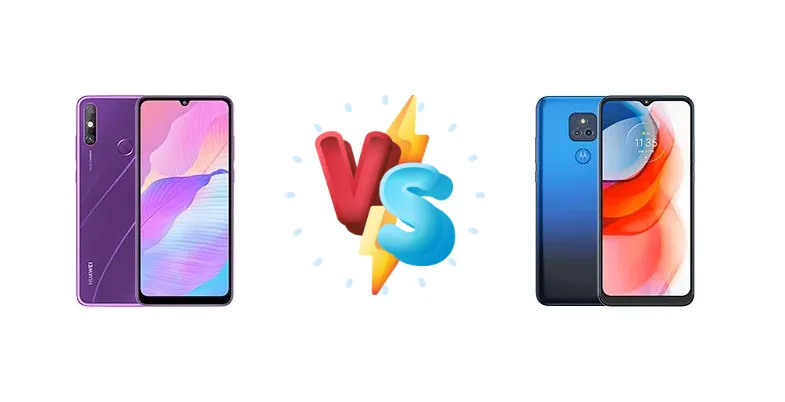
The sub-$200 smartphone market is fiercely competitive. Both the Huawei Enjoy 20e and the Motorola Moto G Play (2021) aim to deliver essential smartphone functionality at an accessible price. However, they take different approaches to achieving this, with Huawei offering a potentially more powerful chipset in some configurations, while Motorola focuses on a newer, more efficient platform. This comparison dissects the key differences to help you choose the right device.
🏆 Quick Verdict
For the average user prioritizing long-term software support and a more modern, efficient chipset, the Motorola Moto G Play (2021) is the better choice. While the Enjoy 20e’s Kirin 710A variant offers a theoretical CPU performance edge, the Snapdragon 460’s superior efficiency and Motorola’s cleaner Android experience provide a smoother, more reliable daily experience.
| Network |
|---|
| 2G bands | GSM 900 / 1800 / 1900 | GSM 850 / 900 / 1800 / 1900 |
| 3G bands | HSDPA 850 / 900 / 2100 | HSDPA 850 / 900 / 1700(AWS) / 1900 / 2100 |
| 4G bands | 1, 3, 5, 8, 34, 38, 39, 40, 41 | 1, 2, 3, 4, 5, 7, 8, 12, 13, 17, 25, 26, 38, 41, 66, 71 |
| Speed | HSPA, LTE | HSPA, LTE |
| Technology | GSM / HSPA / LTE | GSM / CDMA / HSPA / LTE |
| | - | 2, 4, 5, 12, 14, 30, 66 |
| Launch |
|---|
| Announced | 2021, October 28 | 2021, January 08 |
| Status | Available. Released 2021, November 11 | Available. Released 2021, January 14 |
| Body |
|---|
| Build | - | Plastic frame, plastic back |
| Dimensions | 159.1 x 74.1 x 9 mm (6.26 x 2.92 x 0.35 in) | 166.6 x 76 x 9.4 mm (6.56 x 2.99 x 0.37 in) |
| SIM | Nano-SIM + Nano-SIM | Nano-SIM |
| Weight | 185 g (6.53 oz) | 204 g (7.20 oz) |
| | - | Water-repellent coating |
| Display |
|---|
| Resolution | 720 x 1600 pixels, 20:9 ratio (~278 ppi density) | 720 x 1600 pixels, 20:9 ratio (~270 ppi density) |
| Size | 6.3 inches, 95.8 cm2 (~81.3% screen-to-body ratio) | 6.5 inches, 102.0 cm2 (~80.6% screen-to-body ratio) |
| Type | IPS LCD | IPS LCD |
| Platform |
|---|
| CPU | Octa-core (4x2.35 GHz Cortex-A53 & 4x1.8 GHz Cortex-A53)Octa-core (4x2.0 GHz Cortex-A73 & 4x1.7 GHz Cortex-A53) - 128GB 6GB RAM only | Octa-core (4x1.8 GHz Kryo 240 & 4x1.6 GHz Kryo 240) |
| Chipset | Mediatek MT6765 Helio P35 (12 nm)Kirin 710A (14 nm) - 128GB 6GB RAM only | Qualcomm SM4250 Snapdragon 460 (11 nm) |
| GPU | PowerVR GE8320Mali-G51 MP4 - 128GB 6GB RAM only | Adreno 610 |
| OS | HarmonyOS 2.0 (China), EMUI 10.1 (International), no Google Play Services | Android 10 |
| Memory |
|---|
| Card slot | microSD | microSDXC (dedicated slot) |
| Internal | 64GB 4GB RAM, 128GB 4GB RAM, 128GB 6GB RAM | 32GB 3GB RAM |
| | - | eMMC 5.1 |
| Main Camera |
|---|
| Dual | 13 MP, f/1.8, 27mm (wide), PDAF
Auxiliary lens | 13 MP, f/2.0, (wide), 1/3.1", 1.12µm, PDAF
Auxiliary lens |
| Features | LED flash, HDR, panorama | LED flash, HDR, panorama |
| Single | 8 MP, f/2.0 | - |
| Video | 1080p@30fps | 1080p@30/60fps |
| Selfie camera |
|---|
| Features | - | HDR |
| Single | 8 MP, f/2.0 | 5 MP, f/2.2, (wide), 1.12µm |
| Video | 1080p@30fps | 1080p@30fps |
| Sound |
|---|
| 3.5mm jack | Yes | Yes |
| 35mm jack | Yes | Yes |
| Loudspeaker | Yes | Yes |
| Comms |
|---|
| Bluetooth | 5.0, A2DP, LE | 5.0, A2DP, LE |
| NFC | No | No |
| Positioning | GPS, GLONASS, GALILEO, BDS | GPS, GLONASS, GALILEO |
| Radio | Unspecified | Unspecified |
| USB | microUSB 2.0, OTG | USB Type-C 2.0 |
| WLAN | Wi-Fi 802.11 b/g/n | Wi-Fi 802.11 a/b/g/n/ac, dual-band, Wi-Fi Direct |
| Features |
|---|
| Sensors | Fingerprint (rear-mounted), accelerometer, proximity | Fingerprint (rear-mounted), accelerometer, proximity |
| Battery |
|---|
| Charging | 10W wired
6W reverse wired | 10W wired |
| Type | Li-Po 5000 mAh | Li-Po 5000 mAh |
| Misc |
|---|
| Colors | Black, Green, Violet | Misty Blue |
| Models | MLD-AL10 | XT2093-3, XT2093-7, XT2093-DL, XT2093DL |
| Price | About 130 EUR | About 60 EUR |
Huawei Enjoy 20e
- Potentially higher CPU performance (Kirin 710A variant)
- 6W reverse wired charging
- Larger RAM option (6GB)
- Less efficient chipset (Helio P35 variant)
- Huawei’s EMUI software (potential bloatware)
- Uncertainty regarding long-term software updates
Motorola Moto G Play (2021)
- More power-efficient Snapdragon 460 chipset
- Clean Android experience
- Likely better long-term software support
- Lower peak CPU performance
- Basic camera system
- Slower charging speed
Display Comparison
Neither device boasts a standout display. Both likely feature 720p+ LCD panels, typical for this price bracket. However, detailed panel specifications like brightness (nits) and color gamut coverage are unavailable. The focus here isn't on visual fidelity, but rather basic usability. Bezels are expected to be substantial on both, contributing to a larger overall footprint. The lack of high refresh rates is standard at this price point.
Camera Comparison
Camera performance is likely to be similar on both devices, leaning towards basic functionality. Both will struggle in low-light conditions. Detailed sensor information is scarce, but both likely feature a primary sensor around 13MP. The presence of 2MP macro/depth sensors on both is largely marketing fluff. Image processing will differ – Huawei’s EMUI tends towards more saturated colors, while Motorola aims for a more natural look. The Snapdragon 460’s ISP (Image Signal Processor) is generally more refined, potentially leading to slightly better image quality in favorable conditions.
Performance
The performance disparity is the core of this comparison. The Huawei Enjoy 20e is offered with two chipsets: the older Mediatek Helio P35 and the newer Kirin 710A (only with the 128GB/6GB RAM configuration). The Helio P35, built on a 12nm process, features a Cortex-A53 cluster, while the Kirin 710A (14nm) utilizes a more modern Cortex-A73/A53 configuration. The Motorola Moto G Play (2021) employs the Qualcomm Snapdragon 460 (11nm). This process node advantage, combined with Qualcomm’s Kryo 240 cores, gives the Snapdragon 460 a significant edge in power efficiency. While the Kirin 710A may show a lead in CPU-intensive benchmarks, the Snapdragon 460’s sustained performance and smoother multitasking are more valuable in real-world usage. The Snapdragon 460’s Adreno 610 GPU also provides a more capable graphics experience.
Battery Life
Both phones feature 10W wired charging, indicating a similar charging experience – slow by modern standards. The Motorola Moto G Play (2021) benefits from the Snapdragon 460’s superior power efficiency. This translates to longer battery life on a single charge, despite potentially having a slightly smaller battery capacity (specific mAh figures are unavailable). The Enjoy 20e’s Kirin 710A, while more powerful, consumes more energy, reducing overall endurance. The 6W reverse wired charging on the Enjoy 20e is a niche feature unlikely to be heavily used.
Buying Guide
Buy the Huawei Enjoy 20e if you prioritize raw CPU performance for occasional demanding tasks and are comfortable with Huawei’s EMUI software. This is especially true for the 128GB/6GB RAM variant with the Kirin 710A. Buy the Motorola Moto G Play (2021) if you value a clean Android experience, better long-term software updates, and a more power-efficient processor for all-day battery life, even if it means sacrificing some peak CPU power.
Frequently Asked Questions
❓ Does the Huawei Enjoy 20e’s Kirin 710A chipset overheat during prolonged gaming sessions?
The Kirin 710A, while offering a performance boost over the Helio P35, is built on a 14nm process. This means it’s more prone to thermal throttling during extended gaming. While it can handle casual gaming, demanding titles may experience frame drops and reduced performance after a short period. The Motorola Moto G Play (2021)'s Snapdragon 460, with its 11nm process, manages heat more effectively.
❓ How does Huawei’s EMUI software compare to the stock Android experience on the Moto G Play (2021)?
Huawei’s EMUI is a heavily customized version of Android. It includes pre-installed apps (bloatware), a different user interface, and altered notification management. While EMUI offers some unique features, many users prefer the cleaner, more streamlined experience of the near-stock Android found on the Moto G Play (2021). Motorola also promises faster Android updates and security patches.
❓ Is the 10W charging on either phone sufficient for quick top-ups throughout the day?
No, 10W charging is quite slow by today’s standards. Expect a full charge to take over 2 hours. Neither phone is ideal for quick top-ups. The Motorola Moto G Play (2021)'s better battery efficiency mitigates this somewhat, as you may not need to charge as frequently.