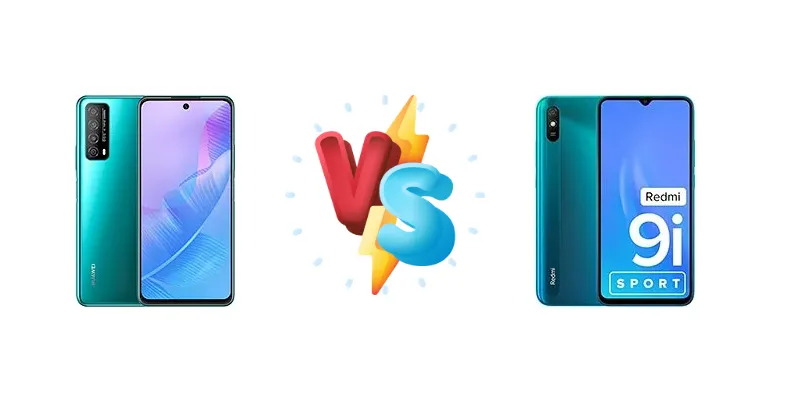
The Huawei Enjoy 20 SE and Xiaomi Redmi 9i Sport represent the fiercely competitive sub-$150 smartphone market. Both aim to deliver essential functionality at an accessible price, but they take different approaches to achieving this. The Enjoy 20 SE leverages Huawei’s in-house Kirin 710A chipset, while the Redmi 9i Sport opts for MediaTek’s Helio G25. This comparison dissects these key differences to determine which device offers the best value for budget-conscious consumers.
🏆 Quick Verdict
For most users, the Huawei Enjoy 20 SE emerges as the stronger choice. Its Kirin 710A chipset, built on a smaller 14nm process, provides a noticeable performance advantage over the Redmi 9i Sport’s Helio G25, despite both featuring similar clock speeds on their primary cores. The significantly faster 22.5W charging also makes the Enjoy 20 SE more convenient for daily use.
| Network |
|---|
| 2G bands | GSM 850 / 900 / 1800 / 1900 | GSM 850 / 900 / 1800 / 1900 |
| 3G bands | HSDPA 850 / 900 / 2100 | HSDPA 850 / 900 / 2100 |
| 4G bands | 1, 3, 5, 8, 34, 38, 39, 40, 41 | 1, 3, 5, 8, 40, 41 |
| Speed | HSPA, LTE | HSPA, LTE |
| Technology | GSM / CDMA / HSPA / EVDO / LTE | GSM / HSPA / LTE |
| Launch |
|---|
| Announced | 2020, December 23. Released 2021, January 19 | 2021, September 28 |
| Status | Discontinued | Available. Released 2021, September 28 |
| Body |
|---|
| Dimensions | 165.7 x 76.9 x 9.3 mm (6.52 x 3.03 x 0.37 in) | 164.9 x 77.1 x 9 mm (6.49 x 3.04 x 0.35 in) |
| SIM | Nano-SIM + Nano-SIM | Nano-SIM + Nano-SIM |
| Weight | 206 g (7.27 oz) | 194 g (6.84 oz) |
| | - | Water-repellent coating |
| Display |
|---|
| Resolution | 1080 x 2400 pixels, 20:9 ratio (~395 ppi density) | 720 x 1600 pixels, 20:9 ratio (~269 ppi density) |
| Size | 6.67 inches, 107.4 cm2 (~84.3% screen-to-body ratio) | 6.53 inches, 102.9 cm2 (~81.0% screen-to-body ratio) |
| Type | IPS LCD | IPS LCD, 400 nits (typ) |
| Platform |
|---|
| CPU | Octa-core (4x2.0 GHz Cortex-A73 & 4x1.7 GHz Cortex-A53) | Octa-core (4x2.0 GHz Cortex-A53 & 4x1.5 GHz Cortex-A53) |
| Chipset | Kirin 710A (14 nm) | Mediatek MT6762G Helio G25 (12 nm) |
| GPU | Mali-G51 MP4 | PowerVR GE8320 |
| OS | Android 10, EMUI 10.1, no Google Play Services | Android 10, MIUI 12 |
| Memory |
|---|
| Card slot | microSDXC (uses shared SIM slot) | microSDXC (dedicated slot) |
| Internal | 128GB 4GB RAM, 128GB 8GB RAM | 64GB 4GB RAM, 128GB 4GB RAM |
| | - | eMMC 5.1 |
| Main Camera |
|---|
| Features | LED flash, HDR, panorama | LED flash, HDR |
| Single | - | 13 MP, f/2.2, 28mm (wide), 1.0µm, PDAF |
| Triple | 13 MP, f/1.8, 26mm (wide), PDAF
8 MP, f/2.4, 120˚ (ultrawide), 1/4.0", 1.12µm
2 MP (macro) | - |
| Video | 1080p@30/60fps | 1080p@30fps |
| Selfie camera |
|---|
| Features | HDR | HDR |
| Single | 8 MP, f/2.0, (wide) | 5 MP, f/2.2, (wide), 1.12µm |
| Video | 1080p@30fps | 1080p@30fps |
| Sound |
|---|
| 3.5mm jack | Yes | Yes |
| 35mm jack | Yes | Yes |
| Loudspeaker | Yes | Yes |
| Comms |
|---|
| Bluetooth | 5.1, A2DP, LE | 5.0, A2DP, LE |
| NFC | No | No |
| Positioning | GPS, GLONASS, GALILEO, BDS | GPS, GLONASS, BDS |
| Radio | Unspecified | FM radio |
| USB | USB Type-C 2.0, OTG | microUSB 2.0, OTG |
| WLAN | Wi-Fi 802.11 b/g/n, Wi-Fi Direct | Wi-Fi 802.11 а/b/g/n, Wi-Fi Direct |
| Features |
|---|
| Sensors | Fingerprint (side-mounted), accelerometer, proximity, compass | Accelerometer, proximity, compass |
| Battery |
|---|
| Charging | 22.5W wired, 46% in 30 min | 10W wired |
| Type | Li-Po 5000 mAh | Li-Po 5000 mAh |
| Misc |
|---|
| Colors | Crush Green, Blush Gold, Midnight Black | Carbon Black, Coral Green, Metallic Blue |
| Models | PPA-AL20 | - |
| Price | About 160 EUR | About 100 EUR |
Huawei Enjoy 20 SE
- Faster Kirin 710A chipset for better performance
- Significantly faster 22.5W charging
- Potentially more refined software experience (Huawei EMUI)
- May lack full Google Mobile Services (GMS)
- Huawei ecosystem lock-in
Xiaomi Redmi 9i Sport
- Full Google Mobile Services (GMS) support
- Simpler, more open Android experience
- Potentially lower price point
- Slower Helio G25 chipset
- Slow 10W charging
- Less refined software experience (Xiaomi MIUI)
Display Comparison
Neither device boasts a standout display. Both likely feature 720p+ LCD panels, typical for this price bracket. However, detailed panel specifications (brightness, color gamut coverage) are unavailable. The focus here is on the internal hardware, as display quality is likely similar. Bezels are expected to be substantial on both, prioritizing affordability over an immersive viewing experience.
Camera Comparison
Camera performance is likely to be comparable, with both phones likely featuring a primary sensor around 13MP. Detailed sensor sizes and apertures are unknown. The Redmi 9i Sport may include a depth sensor, but these are often of limited practical use. Image processing will differ, with Huawei typically emphasizing vibrant colors and aggressive sharpening, while Xiaomi tends towards a more natural look. Without detailed specifications, it’s difficult to declare a clear winner; both will likely struggle in low-light conditions.
Performance
The core difference lies in the chipsets. The Huawei Enjoy 20 SE’s Kirin 710A, fabricated on a 14nm process, features a more sophisticated CPU architecture with Cortex-A73 cores alongside A53s. The Redmi 9i Sport’s Helio G25 utilizes only Cortex-A53 cores across all eight threads, and is built on a slightly more efficient 12nm process. While both have peak clock speeds of 2.0 GHz, the A73 cores in the Kirin 710A offer significantly better single-core performance, translating to snappier app launches and smoother multitasking. The 12nm process of the Helio G25 may offer slightly better efficiency, but the architectural advantage of the Kirin 710A is more impactful. RAM configurations are likely similar, further emphasizing the chipset as the key differentiator.
Battery Life
Both devices likely house batteries around 5000mAh, providing all-day battery life for moderate usage. However, the charging speeds are drastically different. The Huawei Enjoy 20 SE supports 22.5W wired charging, capable of reaching 46% charge in just 30 minutes. The Redmi 9i Sport is limited to a slow 10W charge, requiring significantly longer to fully replenish the battery. This difference in charging speed is a major convenience factor, favoring the Enjoy 20 SE.
Buying Guide
Buy the Huawei Enjoy 20 SE if you prioritize overall performance and faster charging speeds, even if it means potentially navigating the Huawei ecosystem. This phone is ideal for users who engage in moderate multitasking, light gaming, and appreciate quicker top-ups. Buy the Xiaomi Redmi 9i Sport if you are deeply embedded in the Google ecosystem and prefer a simpler, more straightforward Android experience, and are willing to trade performance and charging speed for a lower initial cost.
Frequently Asked Questions
❓ Does the Kirin 710A in the Enjoy 20 SE handle popular games like PUBG Mobile smoothly?
The Kirin 710A is capable of running PUBG Mobile, but likely at medium graphics settings and frame rates. While not a dedicated gaming chipset, its superior CPU performance compared to the Helio G25 will result in a more stable and enjoyable gaming experience, with fewer stutters and frame drops.
❓ Will I be able to use Google apps like YouTube and Gmail on the Huawei Enjoy 20 SE?
This is a key consideration. The Huawei Enjoy 20 SE may not come with full Google Mobile Services (GMS) pre-installed due to ongoing restrictions. Users may need to sideload apps or rely on Huawei’s AppGallery, which has a growing but still limited selection of apps. This is a significant drawback for users heavily reliant on the Google ecosystem.
❓ How long does it realistically take to fully charge the Redmi 9i Sport from 0%?
With its 10W charging, the Redmi 9i Sport will take approximately 3-4 hours to fully charge from 0% to 100%. This is a considerable amount of time compared to the Enjoy 20 SE’s 22.5W fast charging, which can significantly reduce downtime.
❓ Is the difference in CPU architecture between the Kirin 710A and Helio G25 noticeable in everyday tasks?
Yes, the difference is noticeable. The Kirin 710A’s Cortex-A73 cores provide a significant boost in single-core performance, resulting in snappier app launches, smoother scrolling, and a more responsive overall user experience compared to the Helio G25’s all-Cortex-A53 configuration.