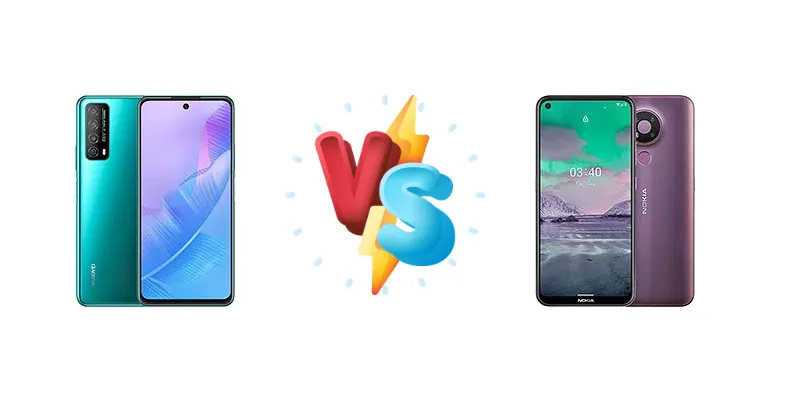
The Huawei Enjoy 20 SE and Nokia 3.4 represent compelling options in the ultra-budget smartphone space, but cater to slightly different priorities. The Enjoy 20 SE leverages Huawei’s in-house Kirin chipset and faster charging, while the Nokia 3.4 opts for Qualcomm’s Snapdragon 460 and a cleaner Android experience. This comparison dissects the key differences to determine which device delivers the best value.
🏆 Quick Verdict
For users prioritizing raw performance and faster charging, the Huawei Enjoy 20 SE is the better choice. Its Kirin 710A, despite being a 14nm chip, offers a slight edge in CPU performance. However, the Nokia 3.4’s cleaner software and Qualcomm chipset may appeal to those seeking a more streamlined Android experience.
| Network |
|---|
| 2G bands | GSM 850 / 900 / 1800 / 1900 | GSM 850 / 900 / 1800 / 1900 |
| 3G bands | HSDPA 850 / 900 / 2100 | HSDPA 850 / 900 / 1700(AWS) / 1900 / 2100 |
| 4G bands | 1, 3, 5, 8, 34, 38, 39, 40, 41 | 1, 2, 3, 4, 5, 7, 8, 12, 17, 13, 28, 66 |
| Speed | HSPA, LTE | HSPA, LTE |
| Technology | GSM / CDMA / HSPA / EVDO / LTE | GSM / HSPA / LTE |
| Launch |
|---|
| Announced | 2020, December 23. Released 2021, January 19 | 2020, September 22. Released 2020, October 26 |
| Status | Discontinued | Discontinued |
| Body |
|---|
| Dimensions | 165.7 x 76.9 x 9.3 mm (6.52 x 3.03 x 0.37 in) | 161 x 76 x 8.7 mm (6.34 x 2.99 x 0.34 in) |
| SIM | Nano-SIM + Nano-SIM | · Nano-SIM· Nano-SIM + Nano-SIM |
| Weight | 206 g (7.27 oz) | 180 g (6.35 oz) |
| Display |
|---|
| Resolution | 1080 x 2400 pixels, 20:9 ratio (~395 ppi density) | 720 x 1560 pixels, 19.5:9 ratio (~269 ppi density) |
| Size | 6.67 inches, 107.4 cm2 (~84.3% screen-to-body ratio) | 6.39 inches, 100.2 cm2 (~81.9% screen-to-body ratio) |
| Type | IPS LCD | IPS LCD, 400 nits (typ) |
| Platform |
|---|
| CPU | Octa-core (4x2.0 GHz Cortex-A73 & 4x1.7 GHz Cortex-A53) | Octa-core (4x1.8 GHz Cortex-A73 & 4x1.8 GHz Cortex-A53) |
| Chipset | Kirin 710A (14 nm) | Qualcomm SM4250 Snapdragon 460 (11 nm) |
| GPU | Mali-G51 MP4 | Adreno 610 |
| OS | Android 10, EMUI 10.1, no Google Play Services | Android 10, upgradable to Android 11 |
| Memory |
|---|
| Card slot | microSDXC (uses shared SIM slot) | microSDXC (dedicated slot) |
| Internal | 128GB 4GB RAM, 128GB 8GB RAM | 32GB 3GB RAM, 64GB 3GB RAM, 64GB 4GB RAM |
| | - | eMMC 5.1 |
| Main Camera |
|---|
| Features | LED flash, HDR, panorama | LED flash, HDR, panorama |
| Triple | 13 MP, f/1.8, 26mm (wide), PDAF
8 MP, f/2.4, 120˚ (ultrawide), 1/4.0", 1.12µm
2 MP (macro) | 13 MP, (wide), PDAF
5 MP, (ultrawide)
Auxiliary lens |
| Video | 1080p@30/60fps | 1080p@30fps |
| Selfie camera |
|---|
| Features | HDR | - |
| Single | 8 MP, f/2.0, (wide) | 8 MP, (wide) |
| Video | 1080p@30fps | 1080p@30fps |
| Sound |
|---|
| 3.5mm jack | Yes | Yes |
| 35mm jack | Yes | Yes |
| Loudspeaker | Yes | Yes |
| Comms |
|---|
| Bluetooth | 5.1, A2DP, LE | 4.2, A2DP, aptX |
| NFC | No | Yes (market/region dependent) |
| Positioning | GPS, GLONASS, GALILEO, BDS | GPS, GLONASS, GALILEO, BDS |
| Radio | Unspecified | FM radio |
| USB | USB Type-C 2.0, OTG | USB Type-C 2.0 |
| WLAN | Wi-Fi 802.11 b/g/n, Wi-Fi Direct | Wi-Fi 802.11 b/g/n |
| Features |
|---|
| Sensors | Fingerprint (side-mounted), accelerometer, proximity, compass | Fingerprint (rear-mounted), accelerometer, gyro, proximity |
| Battery |
|---|
| Charging | 22.5W wired, 46% in 30 min | 10W wired |
| Type | Li-Po 5000 mAh | Li-Po 4000 mAh |
| Misc |
|---|
| Colors | Crush Green, Blush Gold, Midnight Black | Fjord, Dusk, Charcoal |
| Models | PPA-AL20 | TA-1288, TA-1285, TA-1283 |
| Price | About 160 EUR | About 100 EUR |
| SAR | - | 0.83 W/kg (head) 1.05 W/kg (body) |
| SAR EU | - | 0.36 W/kg (head) 1.56 W/kg (body) |
Huawei Enjoy 20 SE
- Faster 22.5W charging significantly reduces downtime.
- Kirin 710A offers a slight performance edge in CPU-intensive tasks.
- Potentially more aggressive CPU scheduling for smoother multitasking.
- 14nm process may result in higher power consumption under sustained load.
- Huawei’s software ecosystem and potential lack of Google Mobile Services (GMS) may be a drawback for some users.
Nokia 3.4
- Clean, stock Android experience with guaranteed updates.
- Qualcomm Snapdragon 460’s 11nm process offers better power efficiency.
- Wider availability of Google Mobile Services (GMS).
- Significantly slower 10W charging.
- Snapdragon 460 may offer slightly lower peak performance compared to the Kirin 710A.
Display Comparison
Neither device boasts a standout display. Details regarding panel type, resolution, and brightness are absent from the provided data, suggesting both likely utilize standard LCD panels common in this price bracket. Bezels are expected to be noticeable on both. Color accuracy will likely be adequate for everyday use but not suitable for color-critical work. The lack of specific display specs makes a direct comparison impossible, but both will likely offer a similar viewing experience.
Camera Comparison
Without sensor size or aperture information, a detailed camera comparison is limited. Both phones likely feature a multi-camera setup with a primary sensor and supporting lenses (potentially including a depth or macro sensor). Given the price point, image quality will be heavily reliant on software processing. Huawei’s image processing tends to be more saturated and contrast-rich, while Nokia aims for a more natural look. The absence of OIS on either device suggests low-light performance will be a weakness.
Performance
The core difference lies in the chipsets. The Huawei Enjoy 20 SE’s Kirin 710A (14nm) features a CPU with 4x2.0 GHz Cortex-A73 cores and 4x1.7 GHz Cortex-A53 cores. The Nokia 3.4’s Qualcomm Snapdragon 460 (11nm) has 4x1.8 GHz Cortex-A73 cores and 4x1.8 GHz Cortex-A53 cores. While the Snapdragon 460’s cores are clocked slightly higher, the Kirin 710A’s architecture and potentially more aggressive core scheduling could translate to comparable real-world performance. Crucially, the Snapdragon 460’s 11nm process should offer better power efficiency, potentially leading to longer battery life under sustained load. However, the Enjoy 20 SE likely has a performance advantage in burst tasks.
Battery Life
Battery capacity is not specified, but the charging speeds are a significant differentiator. The Huawei Enjoy 20 SE supports 22.5W wired charging, capable of adding 46% charge in 30 minutes. The Nokia 3.4 is limited to 10W charging, meaning a full charge will take considerably longer. Even with a slightly larger battery on the Nokia 3.4, the Enjoy 20 SE’s faster charging provides a more convenient user experience, especially for those who frequently need to top up their battery.
Buying Guide
Buy the Huawei Enjoy 20 SE if you need a phone capable of handling moderately demanding tasks and appreciate significantly faster 22.5W charging. This phone is ideal for users who frequently consume media or play casual games. Buy the Nokia 3.4 if you prefer a stock Android experience with guaranteed updates and value long-term software support over peak performance. It’s a solid choice for essential smartphone functions and those prioritizing simplicity.
Frequently Asked Questions
❓ Does the Huawei Enjoy 20 SE support Google Mobile Services (GMS)?
This is a critical consideration. Due to ongoing restrictions, the Enjoy 20 SE likely ships without GMS, meaning no pre-installed Google apps like the Play Store. Users will need to rely on Huawei’s AppGallery and potentially sideload apps, which may not be ideal for all users.
❓ How does the Snapdragon 460 in the Nokia 3.4 handle multitasking compared to the Kirin 710A?
While the Kirin 710A may have a slight edge in single-core performance, the Snapdragon 460’s efficient architecture and potentially better RAM management could provide a smoother multitasking experience, especially with multiple apps open simultaneously. The difference is unlikely to be dramatic, but noticeable for power users.
❓ Is the 10W charging on the Nokia 3.4 a significant drawback in daily use?
Yes, 10W charging is considerably slower than the Enjoy 20 SE’s 22.5W. Expect a full charge to take over two hours, which can be inconvenient if you frequently need to quickly top up your battery. This is a major trade-off for choosing the Nokia 3.4.