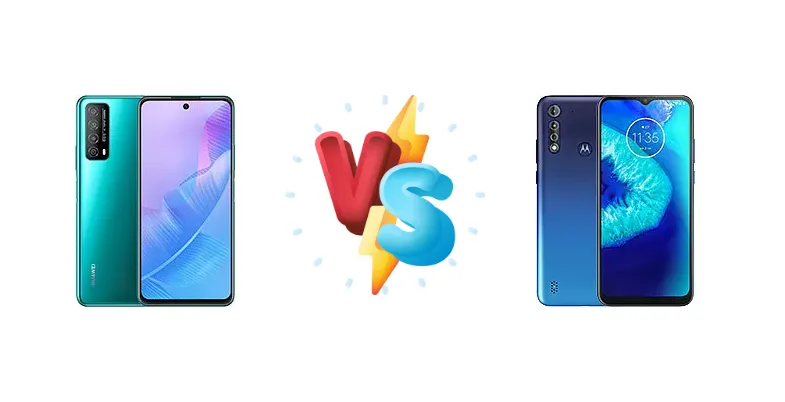
The Huawei Enjoy 20 SE and Motorola Moto G8 Power Lite represent two distinct approaches to the budget smartphone market. The Enjoy 20 SE aims for a balance of performance and convenience with its faster charging, while the Moto G8 Power Lite focuses on maximizing battery life through a more efficient chipset. This comparison dissects their key differences to determine which device best suits your needs.
🏆 Quick Verdict
For the average user prioritizing quick top-ups and slightly smoother performance, the Huawei Enjoy 20 SE is the better choice. Its Kirin 710A chipset and 22.5W charging offer a noticeable advantage. However, users who value extended battery life and are less concerned with peak performance will find the Moto G8 Power Lite a compelling option.
| Network |
|---|
| 2G bands | GSM 850 / 900 / 1800 / 1900 | GSM 850 / 900 / 1800 / 1900 |
| 3G bands | HSDPA 850 / 900 / 2100 | HSDPA 850 / 900 / 1900 / 2100 |
| 4G bands | 1, 3, 5, 8, 34, 38, 39, 40, 41 | LTE |
| Speed | HSPA, LTE | HSPA, LTE |
| Technology | GSM / CDMA / HSPA / EVDO / LTE | GSM / HSPA / LTE |
| Launch |
|---|
| Announced | 2020, December 23. Released 2021, January 19 | 2020, April 03. Released 2020, April 03 |
| Status | Discontinued | Discontinued |
| Body |
|---|
| Build | - | Glass front, plastic back, plastic frame |
| Dimensions | 165.7 x 76.9 x 9.3 mm (6.52 x 3.03 x 0.37 in) | 164.9 x 75.8 x 9.2 mm (6.49 x 2.98 x 0.36 in) |
| SIM | Nano-SIM + Nano-SIM | · Nano-SIM· Nano-SIM + Nano-SIM |
| Weight | 206 g (7.27 oz) | 200 g (7.05 oz) |
| | - | Water-repellent coating |
| Display |
|---|
| Resolution | 1080 x 2400 pixels, 20:9 ratio (~395 ppi density) | 720 x 1600 pixels, 20:9 ratio (~269 ppi density) |
| Size | 6.67 inches, 107.4 cm2 (~84.3% screen-to-body ratio) | 6.5 inches, 102.8 cm2 (~82.2% screen-to-body ratio) |
| Type | IPS LCD | IPS LCD |
| Platform |
|---|
| CPU | Octa-core (4x2.0 GHz Cortex-A73 & 4x1.7 GHz Cortex-A53) | Octa-core (4x2.3 GHz Cortex-A53 & 4x1.8 GHz Cortex-A53) |
| Chipset | Kirin 710A (14 nm) | Mediatek MT6765 Helio P35 (12 nm) |
| GPU | Mali-G51 MP4 | PowerVR GE8320 |
| OS | Android 10, EMUI 10.1, no Google Play Services | Android 9.0 (Pie) |
| Memory |
|---|
| Card slot | microSDXC (uses shared SIM slot) | microSDXC (dedicated slot) |
| Internal | 128GB 4GB RAM, 128GB 8GB RAM | 64GB 4GB RAM |
| | - | eMMC 5.1 |
| Main Camera |
|---|
| Features | LED flash, HDR, panorama | LED flash, HDR, panorama |
| Triple | 13 MP, f/1.8, 26mm (wide), PDAF
8 MP, f/2.4, 120˚ (ultrawide), 1/4.0", 1.12µm
2 MP (macro) | 16 MP, f/2.0, (wide), 1.0µm, PDAF
2 MP (macro)
Auxiliary lens |
| Video | 1080p@30/60fps | 1080p@30fps |
| Selfie camera |
|---|
| Features | HDR | HDR |
| Single | 8 MP, f/2.0, (wide) | 8 MP, f/2.0, (wide), 1.12µm |
| Video | 1080p@30fps | 1080p@30fps |
| Sound |
|---|
| 3.5mm jack | Yes | Yes |
| 35mm jack | Yes | Yes |
| Loudspeaker | Yes | Yes |
| Comms |
|---|
| Bluetooth | 5.1, A2DP, LE | 4.2, A2DP, LE |
| NFC | No | No |
| Positioning | GPS, GLONASS, GALILEO, BDS | GPS, GLONASS, GALILEO |
| Radio | Unspecified | FM radio |
| USB | USB Type-C 2.0, OTG | microUSB 2.0 |
| WLAN | Wi-Fi 802.11 b/g/n, Wi-Fi Direct | Wi-Fi 802.11 b/g/n, Wi-Fi Direct |
| Features |
|---|
| Sensors | Fingerprint (side-mounted), accelerometer, proximity, compass | Fingerprint (rear-mounted), accelerometer, gyro, proximity |
| Battery |
|---|
| Charging | 22.5W wired, 46% in 30 min | 10W wired |
| Type | Li-Po 5000 mAh | Li-Po 5000 mAh |
| Misc |
|---|
| Colors | Crush Green, Blush Gold, Midnight Black | Arctic Blue, Royal Blue |
| Models | PPA-AL20 | XT2055-2 |
| Price | About 160 EUR | About 160 EUR |
Huawei Enjoy 20 SE
- Faster 22.5W charging significantly reduces downtime.
- Kirin 710A offers better CPU performance for smoother multitasking.
- More capable chipset for handling demanding apps.
- Likely lower battery life compared to the Moto G8 Power Lite.
- 14nm process is less power efficient than the Helio P35's 12nm.
Motorola Moto G8 Power Lite
- Excellent battery life thanks to the efficient Helio P35 chipset.
- 12nm process contributes to lower power consumption.
- Potentially longer standby time.
- Significantly slower 10W charging.
- Helio P35 offers less processing power for demanding tasks.
Display Comparison
Neither device boasts a particularly impressive display. Details regarding panel type, resolution, and color accuracy are absent from the provided data, suggesting both likely utilize standard LCD panels common in this price bracket. The focus here isn't on visual fidelity. Bezels are likely comparable, given the market segment. The absence of high refresh rate support on either device is expected.
Camera Comparison
Without detailed camera specifications, a direct comparison is limited. However, it’s safe to assume both phones feature basic camera setups geared towards casual photography. The absence of information regarding sensor size or optical image stabilization (OIS) suggests neither device excels in low-light conditions. The focus is likely on providing adequate image quality in well-lit environments. Any additional cameras (often 2MP macro lenses) are likely of limited practical use.
Performance
The core difference lies in the chipsets. Huawei’s Kirin 710A, built on a 14nm process, features a more sophisticated CPU architecture with Cortex-A73 cores (2.0 GHz) alongside Cortex-A53 cores (1.7 GHz). This contrasts with the Motorola’s MediaTek Helio P35 (12nm) which relies solely on Cortex-A53 cores clocked at 2.3 GHz and 1.8 GHz. While the Helio P35 has a higher peak clock speed, the Kirin 710A’s A73 cores offer significantly better single-core performance, translating to snappier app launches and smoother multitasking. The 12nm process of the Helio P35 is more efficient, but the architectural advantage of the Kirin 710A likely provides a better overall user experience. The Kirin 710A will handle graphically intensive tasks with more ease.
Battery Life
The Moto G8 Power Lite’s strength lies in its chipset efficiency. The 12nm Helio P35 consumes less power than the 14nm Kirin 710A, resulting in longer battery life. However, the Enjoy 20 SE compensates with significantly faster 22.5W wired charging, capable of adding 46% charge in just 30 minutes. The G8 Power Lite’s 10W charging is considerably slower. This trade-off means the G8 Power Lite offers longer runtimes between charges, while the Enjoy 20 SE minimizes downtime with its rapid charging capability.
Buying Guide
Buy the Huawei Enjoy 20 SE if you need faster charging speeds and a chipset capable of handling moderately demanding tasks with greater fluidity. This phone is ideal for users who frequently find themselves needing to quickly replenish their battery throughout the day. Buy the Motorola Moto G8 Power Lite if you prioritize maximizing battery life above all else, and prefer a device that can comfortably last a full day – or even longer – on a single charge, even with moderate usage. This is the phone for those who dislike the hassle of frequent charging.
Frequently Asked Questions
❓ Will the Kirin 710A in the Enjoy 20 SE struggle with modern mobile games?
While the Kirin 710A isn't a gaming powerhouse, it's capable of running many popular mobile games at medium settings. Expect some frame drops in graphically intensive titles, but it's a significant step up from the Helio P35 for gaming performance.
❓ How long does it *actually* take to fully charge the Motorola Moto G8 Power Lite with its 10W charging?
With its 10W charging, the Moto G8 Power Lite will likely take over 3 hours to fully charge from 0% to 100%. This is a significant drawback compared to the Enjoy 20 SE's rapid charging capabilities.
❓ Is the difference in CPU architecture between the Kirin 710A and Helio P35 noticeable in everyday use?
Yes, the Kirin 710A's Cortex-A73 cores provide a noticeable improvement in responsiveness when launching apps, switching between tasks, and general navigation. The Helio P35, while adequate for basic tasks, can feel sluggish in comparison.