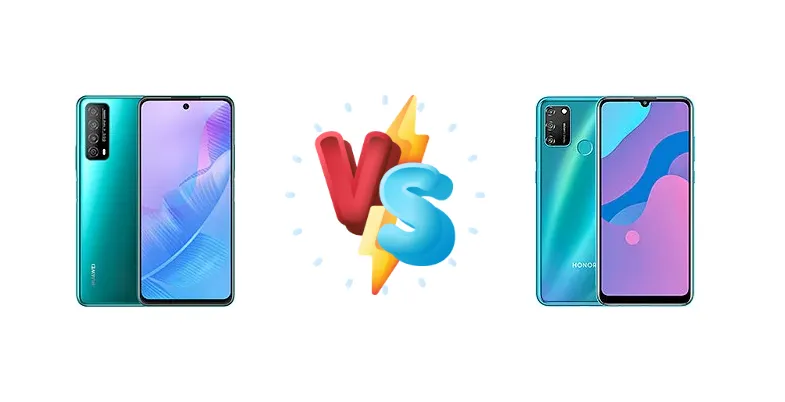
Both the Huawei Enjoy 20 SE and Honor 9A target the ultra-budget smartphone market, but they take different approaches to achieving affordability. The Enjoy 20 SE leverages Huawei’s in-house Kirin 710A chipset, while the Honor 9A opts for MediaTek’s Helio P22. This comparison dissects these key differences to determine which device offers the best experience for users prioritizing value.
🏆 Quick Verdict
For most users, the Huawei Enjoy 20 SE emerges as the better choice. Its Kirin 710A chipset, built on a smaller 14nm process, provides a noticeable performance advantage over the Honor 9A’s Helio P22, translating to smoother multitasking and a more responsive user experience. While the Honor 9A boasts a brighter display, the performance trade-off isn't worth it for the average user.
| Network |
|---|
| 2G bands | GSM 850 / 900 / 1800 / 1900 | GSM 850 / 900 / 1800 / 1900 |
| 3G bands | HSDPA 850 / 900 / 2100 | HSDPA 850 / 900 / 1900 / 2100 |
| 4G bands | 1, 3, 5, 8, 34, 38, 39, 40, 41 | 1, 2, 3, 4, 5, 7, 8, 20, 28, 34, 38, 39, 40, 41 |
| Speed | HSPA, LTE | HSPA 42.2/5.76 Mbps, LTE Cat4 150/50 Mbps |
| Technology | GSM / CDMA / HSPA / EVDO / LTE | GSM / HSPA / LTE |
| Launch |
|---|
| Announced | 2020, December 23. Released 2021, January 19 | 2020, April 29. Released 2020, May 04 |
| Status | Discontinued | Discontinued |
| Body |
|---|
| Build | - | Glass front, plastic back, plastic frame |
| Dimensions | 165.7 x 76.9 x 9.3 mm (6.52 x 3.03 x 0.37 in) | 159.1 x 74.1 x 9 mm (6.26 x 2.92 x 0.35 in) |
| SIM | Nano-SIM + Nano-SIM | Nano-SIM + Nano-SIM |
| Weight | 206 g (7.27 oz) | 185 g (6.53 oz) |
| Display |
|---|
| Resolution | 1080 x 2400 pixels, 20:9 ratio (~395 ppi density) | 720 x 1600 pixels, 20:9 ratio (~278 ppi density) |
| Size | 6.67 inches, 107.4 cm2 (~84.3% screen-to-body ratio) | 6.3 inches, 95.8 cm2 (~81.3% screen-to-body ratio) |
| Type | IPS LCD | IPS LCD |
| Platform |
|---|
| CPU | Octa-core (4x2.0 GHz Cortex-A73 & 4x1.7 GHz Cortex-A53) | Octa-core (4x2.0 GHz Cortex-A53 & 4x1.5 GHz Cortex-A53) |
| Chipset | Kirin 710A (14 nm) | Mediatek MT6762R Helio P22 (12 nm) |
| GPU | Mali-G51 MP4 | PowerVR GE8320 |
| OS | Android 10, EMUI 10.1, no Google Play Services | Android 10, Magic UI 3.1, no Google Play Services |
| Memory |
|---|
| Card slot | microSDXC (uses shared SIM slot) | microSDXC (dedicated slot) |
| Internal | 128GB 4GB RAM, 128GB 8GB RAM | 64GB 3GB RAM |
| | - | eMMC 5.1 |
| Main Camera |
|---|
| Features | LED flash, HDR, panorama | LED flash, HDR, panorama |
| Triple | 13 MP, f/1.8, 26mm (wide), PDAF
8 MP, f/2.4, 120˚ (ultrawide), 1/4.0", 1.12µm
2 MP (macro) | 13 MP, f/1.8, (wide), PDAF
5 MP, f/2.2, (ultrawide)
Auxiliary lens |
| Video | 1080p@30/60fps | 1080p@30fps |
| Selfie camera |
|---|
| Features | HDR | HDR |
| Single | 8 MP, f/2.0, (wide) | 8 MP, f/2.0, (wide) |
| Video | 1080p@30fps | 1080p@30fps |
| Sound |
|---|
| 3.5mm jack | Yes | Yes |
| 35mm jack | Yes | Yes |
| Loudspeaker | Yes | Yes |
| Comms |
|---|
| Bluetooth | 5.1, A2DP, LE | 5.0, A2DP, LE |
| NFC | No | Yes (market/region dependent) |
| Positioning | GPS, GLONASS, GALILEO, BDS | GPS, GLONASS, BDS |
| Radio | Unspecified | FM radio; built-in antenna |
| USB | USB Type-C 2.0, OTG | microUSB 2.0, OTG |
| WLAN | Wi-Fi 802.11 b/g/n, Wi-Fi Direct | Wi-Fi 802.11 b/g/n, Wi-Fi Direct |
| Features |
|---|
| Sensors | Fingerprint (side-mounted), accelerometer, proximity, compass | Fingerprint (rear-mounted), accelerometer, proximity |
| Battery |
|---|
| Charging | 22.5W wired, 46% in 30 min | - |
| Type | Li-Po 5000 mAh | Li-Po 5000 mAh |
| Misc |
|---|
| Colors | Crush Green, Blush Gold, Midnight Black | Black, Blue, Green |
| Models | PPA-AL20 | MOA-LX9N |
| Price | About 160 EUR | About 150 EUR |
| Tests |
|---|
| Loudspeaker | - |
-26.2 LUFS (Good)
|
Huawei Enjoy 20 SE
- More powerful Kirin 710A chipset
- Faster 22.5W charging
- Potentially better long-term performance
- Display specifications are unknown
- Camera performance likely basic
Honor 9A
- Brighter display (546 nits)
- Higher contrast ratio (1583:1)
- Potentially better outdoor visibility
- Less powerful Helio P22 chipset
- Slower performance overall
- Unknown charging speed
Display Comparison
The Honor 9A distinguishes itself with a measured peak brightness of 546 nits and a 1583:1 contrast ratio. This suggests a more vibrant and visible display, particularly outdoors. However, the Huawei Enjoy 20 SE’s display specifications are not provided, so we can only assume it offers a standard experience for this price point. The Honor 9A’s higher brightness will benefit users who frequently view content in direct sunlight, while the Enjoy 20 SE likely prioritizes cost savings in this area.
Camera Comparison
Neither device is expected to excel in photography. Without detailed camera specifications beyond the presence of cameras, it’s difficult to make a definitive judgment. However, given the price point, both likely feature basic sensors and image processing. The absence of information regarding sensor size or optical image stabilization suggests that image quality will be heavily reliant on software algorithms, and likely limited in low-light conditions. Focusing on the core processors, the Enjoy 20 SE's superior processing power may allow for slightly faster image processing and potentially better noise reduction.
Performance
The core difference lies in the chipsets. The Huawei Enjoy 20 SE’s Kirin 710A (14nm) features an octa-core configuration with a mix of Cortex-A73 and A53 cores, offering a more powerful and efficient architecture. The Honor 9A’s MediaTek Helio P22 (12nm) utilizes only Cortex-A53 cores across all eight cores. While the Helio P22’s 12nm process is technically more efficient, the architectural advantage of the Kirin 710A’s A73 cores provides a significant performance boost in CPU-intensive tasks. This translates to faster app loading times and smoother multitasking on the Enjoy 20 SE. The Kirin 710A will also handle graphically demanding apps and games with greater ease.
Battery Life
Battery capacity isn’t specified for either device, making a direct comparison challenging. However, the Huawei Enjoy 20 SE supports 22.5W wired charging, capable of delivering 46% charge in 30 minutes. The Honor 9A’s charging speed is unknown. The faster charging on the Enjoy 20 SE is a significant advantage for users who need to quickly top up their battery. Even with a similar battery capacity, the Enjoy 20 SE’s faster charging will provide more usable uptime throughout the day.
Buying Guide
Buy the Huawei Enjoy 20 SE if you need a phone capable of handling everyday tasks and light gaming with relative ease. Its chipset offers a more future-proof experience. Buy the Honor 9A if display brightness is your absolute top priority, and you primarily use your phone for static content consumption like videos and browsing, and are willing to accept slower performance.
Frequently Asked Questions
❓ Will the Huawei Enjoy 20 SE handle popular games like PUBG Mobile?
The Kirin 710A is capable of running PUBG Mobile, but likely at medium settings to maintain a stable frame rate. Don't expect a flagship gaming experience, but it's significantly better than the Helio P22 in the Honor 9A.
❓ Is the Honor 9A’s display brightness enough for comfortable outdoor use in sunny conditions?
Yes, the measured 546 nits peak brightness is sufficient for comfortable viewing in most outdoor scenarios. This is the Honor 9A’s primary advantage over the Enjoy 20 SE.
❓ Does the Huawei Enjoy 20 SE support Google Mobile Services (GMS)?
Given Huawei's situation, it's highly unlikely the Enjoy 20 SE ships with GMS. It will likely use Huawei Mobile Services (HMS) and the AppGallery. Users should be aware of potential app compatibility issues.
❓ How does the 12nm process of the Helio P22 compare to the 14nm process of the Kirin 710A in terms of battery life?
While 12nm is generally more efficient, the architectural differences between the chipsets are more impactful. The Kirin 710A’s Cortex-A73 cores are more powerful, but also consume more power. However, the overall system optimization and software on the Enjoy 20 SE could offset this, resulting in comparable real-world battery life.