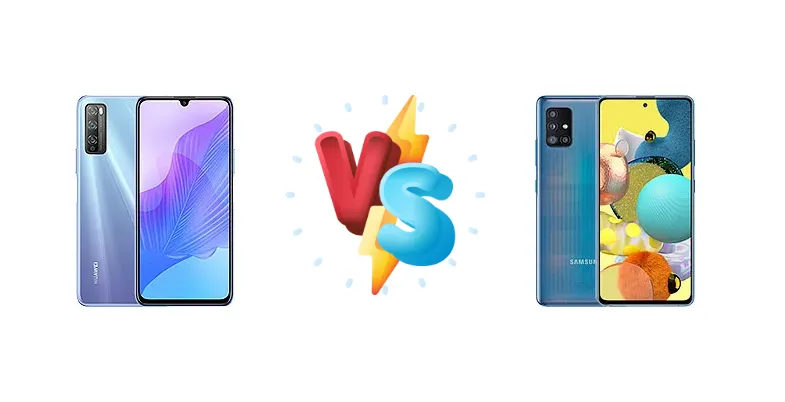
Both the Huawei Enjoy 20 Pro and the Samsung Galaxy A51 5G UW represent attempts to bring 5G connectivity to a more accessible price point. However, they achieve this with different approaches to chipset selection and feature prioritization. This comparison dissects the core differences between the Mediatek Dimensity 800-powered Huawei and the Qualcomm Snapdragon 765G-equipped Samsung, helping you determine which device best suits your needs.
🏆 Quick Verdict
For the average user prioritizing raw processing power and potentially longer software support, the Samsung Galaxy A51 5G UW is the better choice. While the Huawei Enjoy 20 Pro boasts faster 22.5W charging, the Snapdragon 765G’s CPU architecture provides a noticeable performance edge in demanding tasks.
| Network |
|---|
| 2G bands | GSM 900 / 1800 / 1900 | GSM 850 / 900 / 1800 / 1900 |
| 3G bands | HSDPA 850 / 900 / 1700(AWS) / 1900 / 2100 | HSDPA 850 / 900 / 1900 / 2100 |
| 4G bands | LTE | 2, 4, 5, 13, 66 |
| 5G bands | 1, 38, 41, 77, 78, 79 SA/NSA | 260, 261 mmWave |
| Speed | HSPA, LTE, 5G | HSPA, LTE, 5G |
| Technology | GSM / HSPA / LTE / 5G | GSM / HSPA / LTE / 5G |
| Launch |
|---|
| Announced | 2020, June 19. Released 2020, June 24 | 2020, August 14 |
| Status | Discontinued | Available. Released 2020, August 14 |
| Body |
|---|
| Build | - | Glass front (Gorilla Glass 3), plastic back, aluminum frame |
| Dimensions | 160 x 75.3 x 8.4 mm (6.30 x 2.96 x 0.33 in) | 158.8 x 73.4 x 8.6 mm (6.25 x 2.89 x 0.34 in) |
| SIM | Nano-SIM + Nano-SIM | Nano-SIM (pre-installed) |
| Weight | 192 g (6.77 oz) | 188.8 g (6.67 oz) |
| Display |
|---|
| Protection | - | Corning Gorilla Glass 3 |
| Resolution | 1080 x 2400 pixels, 20:9 ratio (~405 ppi density) | 1080 x 2400 pixels, 20:9 ratio (~405 ppi density) |
| Size | 6.5 inches, 102.0 cm2 (~84.7% screen-to-body ratio) | 6.5 inches, 102.0 cm2 (~87.5% screen-to-body ratio) |
| Type | IPS LCD, 90Hz | Super AMOLED |
| Platform |
|---|
| CPU | Octa-core (4x2.0 GHz Cortex-A76 & 4x2.0 GHz Cortex-A55) | Octa-core (1x2.4 GHz Kryo 475 Prime & 1x2.2 GHz Kryo 475 Gold & 6x1.8 GHz Kryo 475 Silver) |
| Chipset | Mediatek Dimensity 800 (7 nm) | Qualcomm SM7250 Snapdragon 765G 5G (7 nm) |
| GPU | Mali-G57MP4 | Adreno 620 |
| OS | Android 10, EMUI 10.1, no Google Play Services | Android 10, One UI 2 |
| Memory |
|---|
| Card slot | Nano Memory (uses shared SIM slot) | microSDXC (uses shared SIM slot) |
| Internal | 128GB 6GB RAM, 128GB 8GB RAM | 128GB 6GB RAM |
| | UFS 2.1 | UFS 2.1 |
| Main Camera |
|---|
| Features | LED flash, HDR, panorama | LED flash, panorama, HDR |
| Quad | - | 48 MP, f/2.0, 26mm (wide), 1/2.0", 0.8µm, PDAF
12 MP, f/2.2, 123˚ (ultrawide)
5 MP (macro)
Auxiliary lens |
| Single | - | 5 MP, AF |
| Triple | 48 MP, f/1.8, 26mm (wide), 1/2.0", 0.8µm, PDAF
8 MP, f/2.4, 120˚ (ultrawide)
2 MP (macro) | - |
| Video | 4K@30fps, 1080p@30fps | 4K@30fps, 1080p@30/120fps; gyro-EIS |
| Selfie camera |
|---|
| Features | HDR | HDR |
| Single | 16 MP, f/2.0 | 32 MP, f/2.2, 26mm (wide), 1/2.8", 0.8µm |
| Video | 1080p@30fps | 4K@30fps, 1080p@30fps |
| Sound |
|---|
| 3.5mm jack | Yes | Yes |
| 35mm jack | Yes | Yes |
| Loudspeaker | Yes | Yes |
| Comms |
|---|
| Bluetooth | 5.1, A2DP, LE | 5.0, A2DP, LE |
| NFC | No | Yes |
| Positioning | GPS, GLONASS, BDS | GPS, GLONASS, GALILEO, BDS |
| Radio | No | FM radio, RDS, recording |
| USB | USB Type-C 2.0, OTG | USB Type-C 2.0, OTG |
| WLAN | Wi-Fi 802.11 a/b/g/n/ac, dual-band, Wi-Fi Direct | Wi-Fi 802.11 a/b/g/n/ac, dual-band, Wi-Fi Direct |
| Features |
|---|
| Sensors | Fingerprint (side-mounted), accelerometer, gyro, proximity, compass | Fingerprint (under display, optical), accelerometer, gyro, proximity, compass |
| | - | ANT+ |
| Battery |
|---|
| Charging | 22.5W wired | 15W wired |
| Stand-by | - | Up to 672 h |
| Talk time | - | Up to 5 h |
| Type | Li-Po 4000 mAh | Li-Po 4500 mAh |
| Misc |
|---|
| Colors | Magic Night Black, Dark Blue, Galaxy Silver | Prism Bricks Blue |
| Models | DVC-AN20 | SM-A516V |
| Price | About 250 EUR | About 470 EUR |
| SAR | - | 0.70 W/kg (head) 1.25 W/kg (body) |
| SAR EU | - | 0.59 W/kg (head) 1.32 W/kg (body) |
Huawei Enjoy 20 Pro
- Faster 22.5W wired charging
- Potentially better thermal management due to Dimensity 800's efficiency
- Competitive 5G performance for the price
- Potential limitations with Google Mobile Services
- Less established Android ecosystem
Samsung Galaxy A51 5G UW
- More powerful Snapdragon 765G CPU
- Wider app compatibility and established Android experience
- Qualcomm Adreno GPU for better gaming performance
- Slower 15W wired charging
- Potentially more throttling under sustained load
Display Comparison
Neither device is known for a standout display. Given the context data lacks display specifics, we can infer both likely utilize LCD panels common in this price bracket. The focus here isn't on visual fidelity, but rather on functional usability. Bezels are likely comparable, and color accuracy will be standard for mid-range phones. The absence of high refresh rate technology on either device suggests a focus on battery life over a smoother visual experience.
Camera Comparison
Without detailed camera specs, a direct comparison is difficult. However, given the market positioning, both phones likely prioritize versatility over outright image quality. We can assume both feature multi-camera setups, but the quality will heavily depend on sensor size and image processing. The absence of information regarding OIS suggests neither phone will excel in low-light photography. The focus is likely on providing a range of shooting options rather than delivering flagship-level image quality. The inclusion of a 2MP macro lens on either device is likely a marketing gimmick with limited practical value.
Performance
The core difference lies in the chipsets. The Huawei Enjoy 20 Pro’s Mediatek Dimensity 800 (7nm) utilizes a Cortex-A76 based CPU, offering strong performance, but the Samsung Galaxy A51 5G UW’s Qualcomm Snapdragon 765G (7nm) features a more refined Kryo architecture. Specifically, the Snapdragon 765G’s prime core clocked at 2.4 GHz provides a performance advantage over the Dimensity 800’s 2.0 GHz Cortex-A76 cores. This translates to snappier app launches and smoother multitasking. While both use 7nm fabrication, Qualcomm’s architectural optimizations generally lead to better sustained performance. The Snapdragon 765G also benefits from Qualcomm’s Adreno GPU, which typically outperforms the Mali-G52 MC2 found in the Dimensity 800, making it a better choice for mobile gaming.
Battery Life
The Huawei Enjoy 20 Pro’s 22.5W wired charging is a clear advantage over the Samsung Galaxy A51 5G UW’s 15W charging. This means significantly faster top-up times, a crucial benefit for users who frequently find themselves needing a quick power boost. While battery capacity isn’t specified, the faster charging speed of the Huawei suggests a focus on minimizing downtime. The Snapdragon 765G’s efficiency might partially offset the slower charging, but the Enjoy 20 Pro will still likely offer a quicker return to full power.
Buying Guide
Buy the Huawei Enjoy 20 Pro if you need faster wired charging and are comfortable with the Huawei ecosystem, potentially facing limitations with Google Mobile Services. Buy the Samsung Galaxy A51 5G UW if you prefer a more established Android experience with wider app compatibility, and value a slightly more powerful CPU for multitasking and gaming, even if it means slower charging speeds.
Frequently Asked Questions
❓ Does the Mediatek Dimensity 800 in the Huawei Enjoy 20 Pro struggle with graphically intensive games like PUBG or Call of Duty?
While the Dimensity 800 is capable, the Snapdragon 765G’s Adreno GPU generally provides a smoother gaming experience, especially at higher settings. The Enjoy 20 Pro will likely require lower graphics settings to maintain consistent frame rates in demanding titles.
❓ How does the lack of Google Mobile Services (GMS) on the Huawei Enjoy 20 Pro affect app availability?
The Huawei Enjoy 20 Pro relies on Huawei Mobile Services (HMS) and the AppGallery. While many popular apps are available, some Google-dependent apps may require workarounds or won't be directly accessible. This can be a significant inconvenience for users heavily reliant on the Google ecosystem.
❓ Will the Samsung Galaxy A51 5G UW receive long-term software updates and security patches?
Samsung generally provides a reasonable level of software support for its A-series devices. While not on par with flagship models, the A51 5G UW is likely to receive at least two major Android updates and several years of security patches, offering better long-term security than the Huawei.