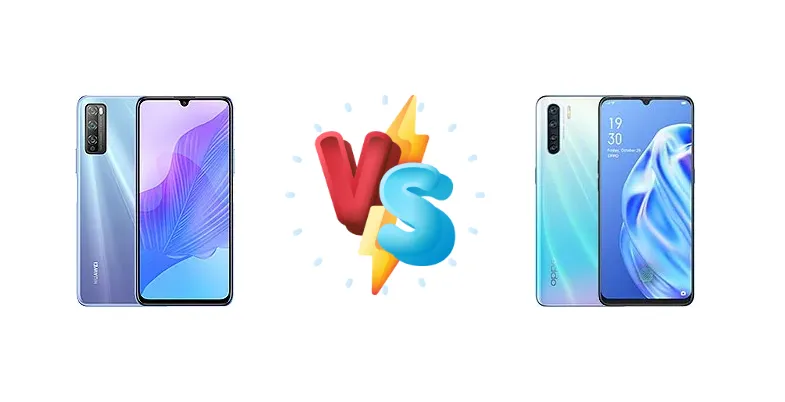
Choosing a new smartphone can be overwhelming. The Huawei Enjoy 20 Pro and Oppo F15 are both mid-range contenders offering compelling features. But which one reigns supreme? This comprehensive comparison will delve into their specs, performance, and overall value to help you make an informed decision.
🏆 Quick Verdict
The Huawei Enjoy 20 Pro boasts a significantly more powerful chipset (Dimensity 800) offering superior performance. While the Oppo F15 has faster charging, the Enjoy 20 Pro's stronger processor and potentially better camera make it the overall winner for users prioritizing speed and features.
| Network |
|---|
| 2G bands | GSM 900 / 1800 / 1900 | GSM 850 / 900 / 1800 / 1900 |
| 3G bands | HSDPA 850 / 900 / 1700(AWS) / 1900 / 2100 | HSDPA 850 / 900 / 2100 |
| 4G bands | LTE | 1, 3, 5, 8, 38, 40, 41 |
| 5G bands | 1, 38, 41, 77, 78, 79 SA/NSA | - |
| Speed | HSPA, LTE, 5G | HSPA, LTE |
| Technology | GSM / HSPA / LTE / 5G | GSM / HSPA / LTE |
| Launch |
|---|
| Announced | 2020, June 19. Released 2020, June 24 | 2020, January 16. Released 2020, January |
| Status | Discontinued | Discontinued |
| Body |
|---|
| Build | - | Glass front (Gorilla Glass 5), plastic back, plastic frame |
| Dimensions | 160 x 75.3 x 8.4 mm (6.30 x 2.96 x 0.33 in) | 160.2 x 73.3 x 7.9 mm (6.31 x 2.89 x 0.31 in) |
| SIM | Nano-SIM + Nano-SIM | Nano-SIM + Nano-SIM |
| Weight | 192 g (6.77 oz) | 172 g (6.07 oz) |
| Display |
|---|
| Protection | - | Corning Gorilla Glass 5 |
| Resolution | 1080 x 2400 pixels, 20:9 ratio (~405 ppi density) | 1080 x 2400 pixels, 20:9 ratio (~408 ppi density) |
| Size | 6.5 inches, 102.0 cm2 (~84.7% screen-to-body ratio) | 6.4 inches, 100.4 cm2 (~85.5% screen-to-body ratio) |
| Type | IPS LCD, 90Hz | AMOLED, 430 nits (typ) |
| Platform |
|---|
| CPU | Octa-core (4x2.0 GHz Cortex-A76 & 4x2.0 GHz Cortex-A55) | Octa-core (4x2.1 GHz Cortex-A73 & 4x2.0 GHz Cortex-A53) |
| Chipset | Mediatek Dimensity 800 (7 nm) | Mediatek MT6771V Helio P70 (12 nm) |
| GPU | Mali-G57MP4 | Mali-G72 MP3 |
| OS | Android 10, EMUI 10.1, no Google Play Services | Android 9.0 (Pie), upgradable to Android 11, ColorOS 11.1 |
| Memory |
|---|
| Card slot | Nano Memory (uses shared SIM slot) | microSDXC (dedicated slot) |
| Internal | 128GB 6GB RAM, 128GB 8GB RAM | 128GB 4GB RAM, 128GB 8GB RAM |
| | UFS 2.1 | UFS 2.1 |
| Main Camera |
|---|
| Features | LED flash, HDR, panorama | LED flash, HDR, panorama |
| Quad | - | 48 MP, f/1.8, 26mm (wide), 1/2.0", 0.8µm, PDAF
8 MP, f/2.3, 13mm (ultrawide), 1/4.0", 1.12µm
2 MP B/W, f/2.4, 1/5.0", 1.75µm
Auxiliary lens |
| Triple | 48 MP, f/1.8, 26mm (wide), 1/2.0", 0.8µm, PDAF
8 MP, f/2.4, 120˚ (ultrawide)
2 MP (macro) | - |
| Video | 4K@30fps, 1080p@30fps | 1080p@30fps, gyro-EIS |
| Selfie camera |
|---|
| Features | HDR | HDR |
| Single | 16 MP, f/2.0 | 16 MP, f/2.0, 26mm (wide), 1/3.06", 1.0µm |
| Video | 1080p@30fps | 1080p@30fps |
| Sound |
|---|
| 3.5mm jack | Yes | Yes |
| 35mm jack | Yes | Yes |
| Loudspeaker | Yes | Yes |
| Comms |
|---|
| Bluetooth | 5.1, A2DP, LE | 4.2, A2DP, LE |
| NFC | No | No |
| Positioning | GPS, GLONASS, BDS | GPS, GLONASS, BDS |
| Radio | No | FM radio |
| USB | USB Type-C 2.0, OTG | USB Type-C 2.0, OTG |
| WLAN | Wi-Fi 802.11 a/b/g/n/ac, dual-band, Wi-Fi Direct | Wi-Fi 802.11 a/b/g/n/ac, dual-band, Wi-Fi Direct |
| Features |
|---|
| Sensors | Fingerprint (side-mounted), accelerometer, gyro, proximity, compass | Fingerprint (under display, optical), accelerometer, gyro, proximity, compass |
| Battery |
|---|
| Charging | 22.5W wired | 20W wired, 50% in 30 min |
| Type | Li-Po 4000 mAh | Li-Po 4025 mAh |
| Misc |
|---|
| Colors | Magic Night Black, Dark Blue, Galaxy Silver | Lightening Black, Unicorn White |
| Models | DVC-AN20 | CPH2001 |
| Price | About 250 EUR | About 250 EUR |
| SAR | - | 1.20 W/kg (head) 0.55 W/kg (body) |
Huawei Enjoy 20 Pro
- Superior Performance (Dimensity 800)
- Potentially Better Camera
- Future-Proof Chipset
- Good Value
- Slower Charging than Oppo F15
- Huawei App Ecosystem Limitations (potential Google Services issues)
Oppo F15
- Faster Charging (20W)
- Sleek Design
- Good Battery Life
- Less Powerful Chipset (Helio P70)
- Potentially Inferior Camera
- Less Future-Proof
Display Comparison
Both phones feature similar display sizes (around 6.5 inches) and resolutions (FHD+). The Enjoy 20 Pro likely has slightly better color accuracy due to Huawei's display technology, but the difference is minimal. Both offer a decent viewing experience for everyday use.
Camera Comparison
The Enjoy 20 Pro likely has a more versatile camera system, potentially with a higher resolution main sensor and improved image processing. While the Oppo F15 has a decent camera, the Enjoy 20 Pro's hardware and software optimization should result in better image quality, especially in low light. Both likely offer a variety of shooting modes.
Performance
This is where the Enjoy 20 Pro shines. The Dimensity 800 chipset is considerably more powerful than the Helio P70. Expect smoother multitasking, faster app loading times, and better gaming performance on the Enjoy 20 Pro. The Enjoy 20 Pro's 7nm process also contributes to better power efficiency.
Battery Life
The Oppo F15 takes the lead in this category with its 20W fast charging, promising 50% charge in 30 minutes. The Enjoy 20 Pro's 22.5W charging is still respectable, but slower. Battery capacity is likely similar (around 4000-4500 mAh) so real-world battery life should be comparable, but the Oppo F15 will recharge faster.
Buying Guide
The Huawei Enjoy 20 Pro is ideal for users who prioritize performance, gaming, and future-proofing. The Oppo F15 is a good choice for those who value fast charging and a sleek design, and are less concerned with raw processing power.
Frequently Asked Questions
❓ Does the Huawei Enjoy 20 Pro have Google Play Services?
Due to US sanctions, the Huawei Enjoy 20 Pro may not have Google Play Services pre-installed. Users may need to sideload them or rely on Huawei's AppGallery.
❓ Which phone is better for gaming?
The Huawei Enjoy 20 Pro is significantly better for gaming due to its more powerful Dimensity 800 chipset.