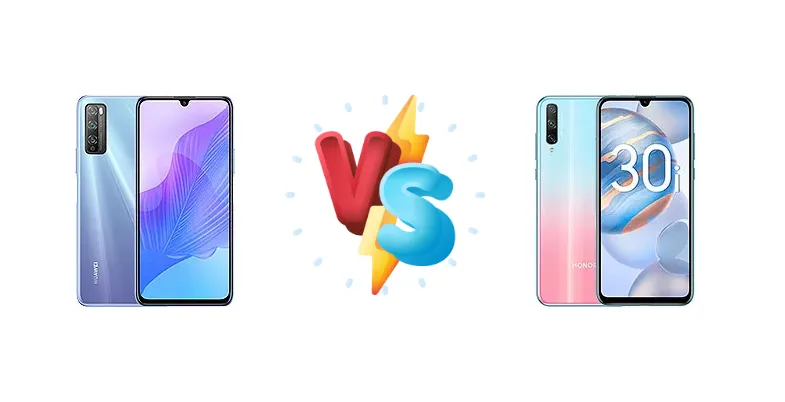
The Huawei Enjoy 20 Pro and Honor 30i represent compelling options in the increasingly competitive budget 5G smartphone market. While both aim to deliver connectivity at an accessible price, they diverge significantly in their core hardware, particularly in their chipsets. This comparison dissects these differences to determine which device offers the best overall experience for the money.
🏆 Quick Verdict
For the average user prioritizing performance and future-proofing, the Huawei Enjoy 20 Pro is the clear winner. Its Mediatek Dimensity 800 chipset provides a substantial performance advantage over the Honor 30i’s Kirin 710F, making it better suited for demanding tasks and gaming. However, the Honor 30i remains a viable option for users with very basic needs.
| Network |
|---|
| 2G bands | GSM 900 / 1800 / 1900 | GSM 900 / 1800 / 1900 |
| 3G bands | HSDPA 850 / 900 / 1700(AWS) / 1900 / 2100 | HSDPA 850 / 900 / 1900 / 2100 |
| 4G bands | LTE | 1, 2, 3, 4, 5, 7, 8, 19, 20, 26, 28, 34, 38, 39, 40, 41 |
| 5G bands | 1, 38, 41, 77, 78, 79 SA/NSA | - |
| Speed | HSPA, LTE, 5G | HSPA, LTE |
| Technology | GSM / HSPA / LTE / 5G | GSM / CDMA / HSPA / LTE |
| | - | CDMA 800 & TD-SCDMA |
| Launch |
|---|
| Announced | 2020, June 19. Released 2020, June 24 | 2020, September 11. Released 2020, September 12 |
| Status | Discontinued | Discontinued |
| Body |
|---|
| Dimensions | 160 x 75.3 x 8.4 mm (6.30 x 2.96 x 0.33 in) | 157.2 x 73.2 x 7.7 mm (6.19 x 2.88 x 0.30 in) |
| SIM | Nano-SIM + Nano-SIM | Nano-SIM + Nano-SIM |
| Weight | 192 g (6.77 oz) | 171.5 g (6.07 oz) |
| Display |
|---|
| Resolution | 1080 x 2400 pixels, 20:9 ratio (~405 ppi density) | 1080 x 2400 pixels, 20:9 ratio (~418 ppi density) |
| Size | 6.5 inches, 102.0 cm2 (~84.7% screen-to-body ratio) | 6.3 inches, 95.8 cm2 (~83.3% screen-to-body ratio) |
| Type | IPS LCD, 90Hz | AMOLED, 600 nits (typ) |
| Platform |
|---|
| CPU | Octa-core (4x2.0 GHz Cortex-A76 & 4x2.0 GHz Cortex-A55) | Octa-core (4x2.2 GHz Cortex-A73 & 4x1.7 GHz Cortex-A53) |
| Chipset | Mediatek Dimensity 800 (7 nm) | Kirin 710F (12 nm) |
| GPU | Mali-G57MP4 | Mali-G51 MP4 |
| OS | Android 10, EMUI 10.1, no Google Play Services | Android 10, Magic UI 2.1 |
| Memory |
|---|
| Card slot | Nano Memory (uses shared SIM slot) | Nano Memory (uses shared SIM slot) |
| Internal | 128GB 6GB RAM, 128GB 8GB RAM | 128GB 4GB RAM |
| | UFS 2.1 | - |
| Main Camera |
|---|
| Features | LED flash, HDR, panorama | LED flash, HDR, panorama |
| Triple | 48 MP, f/1.8, 26mm (wide), 1/2.0", 0.8µm, PDAF
8 MP, f/2.4, 120˚ (ultrawide)
2 MP (macro) | 48 MP, f/1.8, 28mm (wide), 1/2.0", 0.8µm, PDAF
8 MP, f/2.4, 120˚ (ultrawide)
Auxiliary lens |
| Video | 4K@30fps, 1080p@30fps | 1080p@30fps |
| Selfie camera |
|---|
| Features | HDR | HDR |
| Single | 16 MP, f/2.0 | 16 MP, f/2.0, 26mm (wide), 1/3.06", 1.0µm |
| Video | 1080p@30fps | 1080p@30fps |
| Sound |
|---|
| 3.5mm jack | Yes | Yes |
| 35mm jack | Yes | Yes |
| Loudspeaker | Yes | Yes |
| Comms |
|---|
| Bluetooth | 5.1, A2DP, LE | 5.1, A2DP, LE |
| NFC | No | Yes |
| Positioning | GPS, GLONASS, BDS | GPS, GLONASS, BDS |
| Radio | No | FM radio |
| USB | USB Type-C 2.0, OTG | USB Type-C 2.0, OTG |
| WLAN | Wi-Fi 802.11 a/b/g/n/ac, dual-band, Wi-Fi Direct | Wi-Fi 802.11 a/b/g/n/ac, dual-band, Wi-Fi Direct |
| Features |
|---|
| Sensors | Fingerprint (side-mounted), accelerometer, gyro, proximity, compass | Fingerprint (under display, optical), accelerometer, gyro, proximity, compass |
| Battery |
|---|
| Charging | 22.5W wired | 10W wired |
| Type | Li-Po 4000 mAh | Li-Po 4000 mAh |
| Misc |
|---|
| Colors | Magic Night Black, Dark Blue, Galaxy Silver | Ultraviolet Sunset, Turquoise, Midnight Black |
| Models | DVC-AN20 | LRA-LX1 |
| Price | About 250 EUR | About 200 EUR |
Huawei Enjoy 20 Pro
- Significantly faster processor (Dimensity 800)
- Faster 22.5W charging
- Potentially better camera image processing
- May be slightly more expensive
- Software experience (Huawei's EMUI)
Honor 30i
- Lower price point
- Simpler user experience
- Lightweight and potentially more compact
- Slower processor (Kirin 710F)
- Slow 10W charging
- Inferior gaming performance
Display Comparison
Neither Huawei nor Honor provided display specs beyond the device names. Assuming typical LCD panels for this price bracket, the display experience will likely be similar. However, the chipset difference impacts the ability to drive higher refresh rates smoothly. The Dimensity 800 in the Enjoy 20 Pro has the headroom to potentially support a 90Hz panel, while the Kirin 710F would struggle to maintain consistent performance at that refresh rate.
Camera Comparison
Without detailed camera specifications, a direct comparison is difficult. However, the chipset’s image signal processor (ISP) plays a crucial role. The Dimensity 800’s ISP is more advanced, enabling better image processing, noise reduction, and dynamic range. While both phones likely feature similar sensor configurations (a primary sensor and potentially depth/macro lenses), the Enjoy 20 Pro will likely produce superior image quality, especially in challenging lighting conditions. The Honor 30i’s camera will likely be adequate for casual snapshots, but will struggle with detail and clarity in low light.
Performance
The core difference lies in the chipsets. The Huawei Enjoy 20 Pro’s Mediatek Dimensity 800, built on a 7nm process, significantly outperforms the Honor 30i’s Kirin 710F (12nm). The Dimensity 800’s Cortex-A76 cores, clocked at 2.0 GHz, offer a substantial architectural advantage over the Kirin 710F’s Cortex-A73 cores at 2.2 GHz. While the Kirin 710F has a slightly higher clock speed, the more modern architecture and smaller process node of the Dimensity 800 translate to superior sustained performance and efficiency. This means smoother app launches, faster multitasking, and a better gaming experience on the Enjoy 20 Pro. The 7nm process also contributes to better thermal management, reducing the likelihood of throttling during extended use.
Battery Life
The Huawei Enjoy 20 Pro’s 22.5W wired charging is a significant advantage over the Honor 30i’s 10W charging. This translates to considerably faster charging times, allowing users to quickly top up their battery. While battery capacity isn’t specified, the Dimensity 800’s improved power efficiency means the Enjoy 20 Pro will likely offer comparable or even better battery life despite potentially having a similar capacity to the Honor 30i. The faster charging speed mitigates any potential battery capacity differences.
Buying Guide
Buy the Huawei Enjoy 20 Pro if you need a phone capable of handling modern games, multitasking efficiently, and benefiting from faster 5G speeds. It’s ideal for users who want a device that won’t feel outdated quickly. Buy the Honor 30i if you prioritize simplicity and are primarily focused on basic communication tasks like calls, texts, and light social media browsing, and are on a very tight budget.
Frequently Asked Questions
❓ Will the Huawei Enjoy 20 Pro handle demanding games like PUBG or Call of Duty?
Yes, the Mediatek Dimensity 800 chipset in the Enjoy 20 Pro is capable of running PUBG and Call of Duty at medium to high settings with playable frame rates. While it won't match flagship performance, it offers a significantly better gaming experience than the Honor 30i.
❓ Is the 10W charging on the Honor 30i a dealbreaker?
For users who don't mind waiting several hours for a full charge, 10W charging isn't necessarily a dealbreaker. However, if you frequently need to quickly top up your battery, the Honor 30i's slow charging will be frustrating. The Enjoy 20 Pro's 22.5W charging is a substantial improvement.
❓ How does the Dimensity 800's 5G performance compare to the Kirin 710F's 5G?
The Dimensity 800 generally offers faster and more reliable 5G connectivity due to its more advanced modem and carrier aggregation capabilities. While both support 5G, the Enjoy 20 Pro will likely achieve higher download and upload speeds in areas with good 5G coverage.