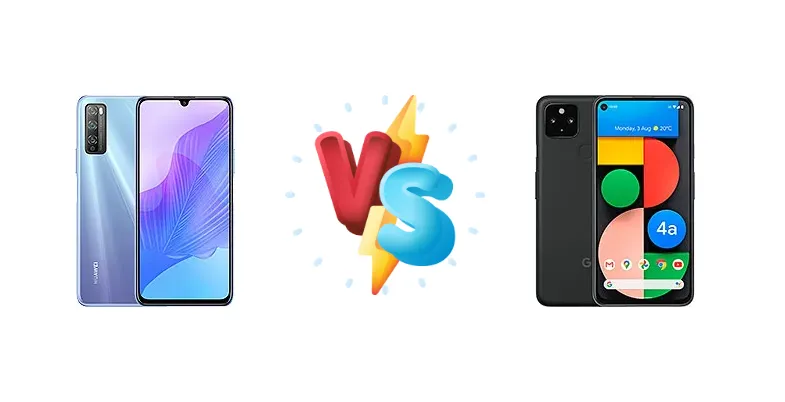
The Huawei Enjoy 20 Pro and Google Pixel 4a 5G represent compelling options in the increasingly crowded mid-range 5G smartphone market. While both aim to deliver 5G connectivity at a reasonable price, they take distinctly different approaches to achieving this, primarily through chipset choice and software experience. This comparison dives deep into the hardware and potential user experience to determine which device offers the best value.
🏆 Quick Verdict
For the average user prioritizing a clean software experience and strong camera performance, the Google Pixel 4a 5G is the better choice. However, the Huawei Enjoy 20 Pro offers a performance edge in raw processing power thanks to the Dimensity 800, making it suitable for demanding users on a tighter budget.
| Network |
|---|
| 2G bands | GSM 900 / 1800 / 1900 | GSM 850 / 900 / 1800 / 1900 |
| 3G bands | HSDPA 850 / 900 / 1700(AWS) / 1900 / 2100 | HSDPA 850 / 900 / 1700(AWS) / 1900 / 2100 |
| 4G bands | LTE | 1, 2, 3, 4, 5, 7, 8, 12, 13, 14, 17, 18, 19, 20, 25, 26, 28, 29, 30, 32, 38, 39, 40, 41, 42, 46, 48, 66, 71 |
| 5G bands | 1, 38, 41, 77, 78, 79 SA/NSA | 1, 2, 3, 5, 7, 8, 12, 28, 41, 66, 71, 77, 78 Sub6, mmWave (market dependant) |
| Speed | HSPA, LTE, 5G | HSPA, LTE, 5G |
| Technology | GSM / HSPA / LTE / 5G | GSM / HSPA / LTE / 5G |
| Launch |
|---|
| Announced | 2020, June 19. Released 2020, June 24 | 2020, September 30 |
| Status | Discontinued | Available. Released 2020, November 05 |
| Body |
|---|
| Build | - | Glass front (Gorilla Glass 3), plastic back, plastic frame |
| Dimensions | 160 x 75.3 x 8.4 mm (6.30 x 2.96 x 0.33 in) | 153.9 x 74 x 8.2 mm (Sub-6) or 8.5 mm (Sub-6 and mmWave) |
| SIM | Nano-SIM + Nano-SIM | Nano-SIM + eSIM |
| Weight | 192 g (6.77 oz) | 168 g (5G Sub-6); 171 g ( 5G Sub-6 and mmWave) (5.93 oz) |
| Display |
|---|
| Protection | - | Corning Gorilla Glass 3 |
| Resolution | 1080 x 2400 pixels, 20:9 ratio (~405 ppi density) | 1080 x 2340 pixels, 19.5:9 ratio (~413 ppi density) |
| Size | 6.5 inches, 102.0 cm2 (~84.7% screen-to-body ratio) | 6.2 inches, 95.7 cm2 (~84.1% screen-to-body ratio) |
| Type | IPS LCD, 90Hz | OLED, HDR |
| | - | Always-on display |
| Platform |
|---|
| CPU | Octa-core (4x2.0 GHz Cortex-A76 & 4x2.0 GHz Cortex-A55) | Octa-core (1x2.4 GHz Kryo 475 Prime & 1x2.2 GHz Kryo 475 Gold & 6x1.8 GHz Kryo 475 Silver) |
| Chipset | Mediatek Dimensity 800 (7 nm) | Qualcomm SM7250 Snapdragon 765G 5G (7 nm) |
| GPU | Mali-G57MP4 | Adreno 620 |
| OS | Android 10, EMUI 10.1, no Google Play Services | Android 11, upgradable to Android 14 |
| Memory |
|---|
| Card slot | Nano Memory (uses shared SIM slot) | No |
| Internal | 128GB 6GB RAM, 128GB 8GB RAM | 128GB 6GB RAM |
| | UFS 2.1 | UFS 2.1 |
| Main Camera |
|---|
| Dual | - | 12.2 MP, f/1.7, 27mm (wide), 1/2.55", 1.4µm, dual pixel PDAF, OIS
16 MP, f/2.2, 107˚ (ultrawide), 1.0µm |
| Features | LED flash, HDR, panorama | LED flash, Pixel Shift, Auto-HDR, panorama |
| Triple | 48 MP, f/1.8, 26mm (wide), 1/2.0", 0.8µm, PDAF
8 MP, f/2.4, 120˚ (ultrawide)
2 MP (macro) | - |
| Video | 4K@30fps, 1080p@30fps | 4K@30/60fps, 1080p@30/60/120/240fps; gyro-EIS |
| Selfie camera |
|---|
| Features | HDR | HDR |
| Single | 16 MP, f/2.0 | 8 MP, f/2.0, 24mm (wide), 1/4.0", 1.12µm |
| Video | 1080p@30fps | 1080p@30fps |
| Sound |
|---|
| 3.5mm jack | Yes | Yes |
| 35mm jack | Yes | Yes |
| Loudspeaker | Yes | Yes, with stereo speakers |
| Comms |
|---|
| Bluetooth | 5.1, A2DP, LE | 5.0, A2DP, LE, aptX HD |
| NFC | No | Yes |
| Positioning | GPS, GLONASS, BDS | GPS, GLONASS, GALILEO, QZSS, BDS |
| Radio | No | No |
| USB | USB Type-C 2.0, OTG | USB Type-C 3.1 |
| WLAN | Wi-Fi 802.11 a/b/g/n/ac, dual-band, Wi-Fi Direct | Wi-Fi 802.11 a/b/g/n/ac, dual-band, Wi-Fi Direct |
| Features |
|---|
| Sensors | Fingerprint (side-mounted), accelerometer, gyro, proximity, compass | Fingerprint (rear-mounted), accelerometer, gyro, proximity, compass, barometer |
| Battery |
|---|
| Charging | 22.5W wired | 18W wired, PD2.0 |
| Type | Li-Po 4000 mAh | Li-Po 3885 mAh |
| Misc |
|---|
| Colors | Magic Night Black, Dark Blue, Galaxy Silver | Just Black, Clearly White |
| Models | DVC-AN20 | GD1YQ, G025I, G025E, G025H, G6QU3 |
| Price | About 250 EUR | About 140 EUR |
Huawei Enjoy 20 Pro
- Faster charging at 22.5W
- Potentially stronger multi-core performance with Dimensity 800
- Likely larger battery capacity
- EMUI software may not appeal to all users
- Camera performance likely trails the Pixel 4a 5G
Google Pixel 4a 5G
- Clean Android experience with guaranteed updates
- Exceptional camera quality and computational photography
- OLED display for vibrant colors and contrast
- Slower 18W charging
- Potentially less raw processing power for demanding tasks
Display Comparison
Neither device boasts a particularly standout display. While specific panel details (like OLED vs LCD) are missing for the Enjoy 20 Pro, its market positioning suggests an LCD panel. The Pixel 4a 5G features a 6.7-inch OLED display. The key difference lies in processing power; the Dimensity 800 in the Enjoy 20 Pro may handle graphically intensive tasks on the display more smoothly, but the Pixel 4a 5G’s OLED panel will offer superior contrast and color accuracy. Bezels are likely comparable given the price points, and neither is expected to feature high refresh rates.
Camera Comparison
Google’s Pixel phones are renowned for their computational photography, and the Pixel 4a 5G is no exception. While sensor size isn’t specified, Google’s image processing algorithms are likely to extract more detail and dynamic range from a smaller sensor than Huawei’s. The Enjoy 20 Pro likely features a higher megapixel count, but megapixel count isn’t everything. The Pixel 4a 5G’s focus on software optimization and consistent image quality gives it an edge. The Enjoy 20 Pro may offer more versatility with additional lenses, but the Pixel’s single lens setup is often sufficient for most users. We can expect the Pixel 4a 5G to excel in low-light conditions.
Performance
The core of the difference lies in the chipsets. The Huawei Enjoy 20 Pro’s Mediatek Dimensity 800 (7nm) utilizes a Cortex-A76 based CPU, offering strong single-core performance. The Google Pixel 4a 5G’s Qualcomm Snapdragon 765G (7nm) employs Kryo cores with a more tiered approach – a prime core for peak tasks, gold cores for sustained performance, and silver cores for efficiency. While the Snapdragon 765G’s prime core clocks higher at 2.4GHz versus the Dimensity 800’s 2.0GHz, the Dimensity 800’s architecture often translates to better multi-core performance. This means the Enjoy 20 Pro may excel in tasks that can fully utilize all cores, like video editing or complex calculations. Thermal management is a question mark without testing, but the 7nm process on both should keep temperatures in check. RAM speeds are not specified, but both likely utilize LPDDR4X to balance performance and cost.
Battery Life
The battery capacity isn’t specified for the Enjoy 20 Pro, but given its size and market segment, it’s likely around 4000-4500mAh. The Pixel 4a 5G has a 3885mAh battery. The Enjoy 20 Pro’s 22.5W wired charging is faster than the Pixel 4a 5G’s 18W charging with PD2.0. This means the Enjoy 20 Pro will likely charge from 0-100% faster, potentially in under 90 minutes, while the Pixel 4a 5G will take closer to 2 hours. However, the Pixel 4a 5G’s more efficient chipset and software optimization may result in comparable real-world battery life despite the smaller capacity.
Buying Guide
Buy the Huawei Enjoy 20 Pro if you need maximum processing power for gaming or multitasking and are comfortable with Huawei’s EMUI software. This phone is ideal for users who prioritize performance over camera features and software simplicity. Buy the Google Pixel 4a 5G if you prefer a streamlined Android experience, exceptional camera quality, and guaranteed software updates. This phone is best for users who value ease of use, photography, and long-term support.
Frequently Asked Questions
❓ Does the Dimensity 800 in the Huawei Enjoy 20 Pro get hot during extended gaming sessions?
While the Dimensity 800 is a 7nm chip and generally efficient, sustained gaming can generate heat. Huawei’s thermal management implementation will be crucial. Without specific testing data, it’s difficult to say definitively, but the Enjoy 20 Pro’s larger size may allow for better heat dissipation compared to more compact phones.
❓ How does the Pixel 4a 5G’s camera perform in very low-light conditions compared to the Enjoy 20 Pro?
The Pixel 4a 5G is expected to significantly outperform the Enjoy 20 Pro in low-light photography. Google’s Night Sight mode is renowned for its ability to capture bright, detailed images in near-darkness, leveraging computational photography to overcome sensor limitations. The Enjoy 20 Pro will likely struggle in similar conditions.
❓ Will the Huawei Enjoy 20 Pro receive long-term software updates and security patches?
Huawei’s software update track record is less consistent than Google’s. While the Enjoy 20 Pro will likely receive some updates, they may not be as frequent or long-lasting as those offered for the Pixel 4a 5G, which is guaranteed to receive updates directly from Google.