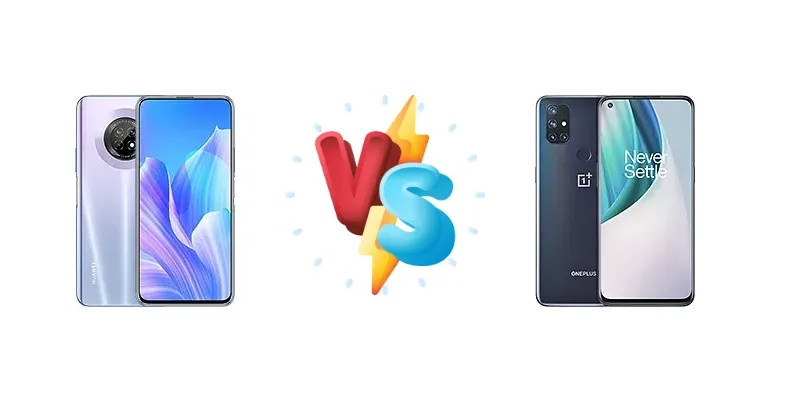
The Huawei Enjoy 20 Plus 5G and OnePlus Nord N10 5G represent compelling options in the increasingly crowded budget 5G smartphone market. Both aim to deliver 5G connectivity without breaking the bank, but they achieve this with different chipsets and design philosophies. This comparison dissects their key differences to determine which device offers the best value.
🏆 Quick Verdict
For the average user prioritizing consistent performance and a slightly brighter display, the OnePlus Nord N10 5G emerges as the better choice. While both boast a 99-hour endurance rating, the Snapdragon 690's 8nm process offers a slight edge in efficiency, and the measured 440 nits brightness is preferable.
| Network |
|---|
| 2G bands | GSM 900 / 1800 / 1900 | GSM 850 / 900 / 1800 / 1900 |
| 3G bands | HSDPA 850 / 900 / 1700(AWS) / 1900 / 2100 | HSDPA 850 / 900 / 1700(AWS) / 1900 / 2100 |
| 4G bands | LTE | 1, 2, 3, 4, 5, 7, 8, 12, 17, 20, 28, 38, 39, 40, 41, 66 - International |
| 5G bands | 1, 3, 38, 41, 77, 78, 79 SA/NSA | 1, 3, 7, 28, 41, 66, 78 SA/NSA - International |
| Speed | HSPA, LTE, 5G | HSPA 42.2/5.76 Mbps, LTE Cat18 1024/150 Mbps, 5G |
| Technology | GSM / HSPA / LTE / 5G | GSM / CDMA / HSPA / LTE / 5G |
| | - | 2, 5, 25, 41, 66, 71 SA/NSA - USA |
| Launch |
|---|
| Announced | 2020, September 03. Released 2020, September 10 | 2020, October 26 |
| Status | Discontinued | Available. Released 2020, November 21 |
| Body |
|---|
| Build | - | Glass front (Gorilla Glass 3), plastic back, plastic frame |
| Dimensions | 163.5 x 76.5 x 9 mm (6.44 x 3.01 x 0.35 in) | 163 x 74.7 x 9 mm (6.42 x 2.94 x 0.35 in) |
| SIM | Nano-SIM + Nano-SIM | Nano-SIM + Nano-SIM |
| Weight | 197 g (6.95 oz) | 190 g (6.70 oz) |
| Display |
|---|
| Protection | - | Corning Gorilla Glass 3 |
| Resolution | 1080 x 2400 pixels, 20:9 ratio (~397 ppi density) | 1080 x 2400 pixels, 20:9 ratio (~406 ppi density) |
| Size | 6.63 inches, 106.1 cm2 (~84.8% screen-to-body ratio) | 6.49 inches, 101.7 cm2 (~83.5% screen-to-body ratio) |
| Type | IPS LCD, 90Hz | IPS LCD, 90Hz |
| Platform |
|---|
| CPU | Octa-core (2x2.0 GHz Cortex-A76 & 6x2.0 GHz Cortex-A55) | Octa-core (2x2.0 GHz Kryo 560 Gold & 6x1.7 GHz Kryo 560 Silver) |
| Chipset | Mediatek Dimensity 720 (7 nm) | Qualcomm SM6350 Snapdragon 690 5G (8 nm) |
| GPU | Mali-G57 MC2 | Adreno 619L |
| OS | Android 10, EMUI 10.1, no Google Play Services | Android 10, OxygenOS 10.5 |
| Memory |
|---|
| Card slot | Nano Memory (uses shared SIM slot) | microSDXC |
| Internal | 128GB 6GB RAM, 128GB 8GB RAM | 128GB 6GB RAM |
| | UFS 2.1 | UFS 2.1 |
| Main Camera |
|---|
| Features | LED flash, HDR, panorama | LED flash, HDR, panorama |
| Quad | - | 64 MP, f/1.8, (wide), 1/1.72", 0.8µm, PDAF
8 MP, f/2.3, 119˚ (ultrawide)
2 MP (macro)
Auxiliary lens |
| Triple | 48 MP, f/1.8, 26mm (wide), 1/2.0", 0.8µm, PDAF
8 MP, f/2.4, 120˚ (ultrawide)
2 MP (macro) | - |
| Video | 4K@30fps, 1080p@30fps | 4K@30fps, 1080p@30/60/120fps; gyro-EIS |
| Selfie camera |
|---|
| Features | HDR | HDR |
| Single | Motorized pop-up 16 MP, f/2.2, (wide), 1/3.1", 1.0µm | 16 MP, f/2.1 |
| Video | 1080p@30fps | 1080p@30/60fps, gyro-EIS |
| Sound |
|---|
| 3.5mm jack | Yes | Yes |
| 35mm jack | Yes | Yes |
| Loudspeaker | Yes | Yes, with dual speakers |
| Comms |
|---|
| Bluetooth | 5.1, A2DP, LE | 5.1, A2DP, LE |
| NFC | No | Yes |
| Positioning | GPS, GLONASS, BDS | GPS (L1+L5), GLONASS, GALILEO, BDS |
| Radio | No | No |
| USB | USB Type-C 2.0, OTG | USB Type-C 2.0, OTG |
| WLAN | Wi-Fi 802.11 a/b/g/n/ac, dual-band, Wi-Fi Direct | Wi-Fi 802.11 a/b/g/n/ac, dual-band, Wi-Fi Direct |
| Features |
|---|
| Sensors | Fingerprint (side-mounted), accelerometer, gyro, proximity, compass | Fingerprint (rear-mounted), accelerometer, gyro, proximity, compass |
| Battery |
|---|
| Charging | 40W wired | 30W wired |
| Type | Li-Po 4200 mAh | Li-Po 4300 mAh |
| Misc |
|---|
| Colors | Black, Blue, Green, Pink | Midnight Ice |
| Models | FRL-AN00a | BE2029, BE2025, BE2026, BE2028 |
| Price | About 280 EUR | About 250 EUR |
| Tests |
|---|
| Battery life | - |
Endurance rating 99h
|
| Camera | - |
Photo / Video |
| Loudspeaker | - |
-25.8 LUFS (Very good)
|
| Performance | - |
AnTuTu: 279579 (v8)
GeekBench: 1848 (v5.1)
GFXBench: 13fps (ES 3.1 onscreen) |
Huawei Enjoy 20 Plus 5G
- Faster 40W wired charging
- Potentially better battery optimization (due to chipset)
- Competitive 5G performance
- Lack of detailed display specifications
- Limited camera information
OnePlus Nord N10 5G
- Brighter 440 nits display
- Slightly more efficient 8nm Snapdragon 690
- Generally smoother software experience
- Slower 30W wired charging
- Similar overall performance to Enjoy 20 Plus 5G
Display Comparison
The OnePlus Nord N10 5G features a display measured at 440 nits of peak brightness and a 1447:1 contrast ratio. While the Enjoy 20 Plus 5G’s display specifications aren’t provided, the Nord N10’s brightness is a tangible benefit for outdoor visibility. The contrast ratio on the Nord N10 suggests a decent viewing experience, though it lacks advanced features like LTPO found in higher-end devices. The absence of detailed display specs for the Enjoy 20 Plus makes a direct comparison difficult, but the Nord N10’s measured performance gives it a clear advantage.
Camera Comparison
Both devices are listed as having Photo/Video capabilities, but detailed camera specifications are lacking. Without sensor size, aperture, or image processing details, a meaningful comparison is impossible. The presence of a 2MP macro camera on either device is unlikely to significantly impact image quality, and should be considered a marketing feature rather than a core strength. The absence of OIS on either device suggests reliance on software stabilization.
Performance
At the heart of the Enjoy 20 Plus 5G lies the Mediatek Dimensity 720 (7nm), while the Nord N10 5G utilizes the Qualcomm Snapdragon 690 5G (8nm). Both CPUs feature an octa-core configuration with a similar performance tier – 2x2.0 GHz Cortex-A76/Kryo 560 Gold and 6x2.0 GHz/1.7 GHz Cortex-A55/Kryo 560 Silver. However, the Snapdragon 690’s 8nm process offers a potential edge in thermal efficiency, potentially leading to less throttling during sustained workloads. While both are capable of handling everyday tasks, the Snapdragon 690 is generally considered to have a slight advantage in GPU performance, benefiting light gaming.
Battery Life
Both the Huawei Enjoy 20 Plus 5G and the OnePlus Nord N10 5G achieve an impressive endurance rating of 99 hours. However, they differ in charging speeds. The Enjoy 20 Plus 5G supports 40W wired charging, while the Nord N10 5G is limited to 30W. This means the Enjoy 20 Plus 5G will likely charge significantly faster, potentially reaching 100% in under an hour, while the Nord N10 5G will take longer. The similar endurance ratings suggest comparable battery optimization despite the differing charging speeds.
Buying Guide
Buy the Huawei Enjoy 20 Plus 5G if you prioritize fast charging – its 40W wired charging is a significant advantage over the Nord N10’s 30W. Buy the OnePlus Nord N10 5G if you value a brighter, more visible display in outdoor conditions and a slightly more refined software experience, despite the similar overall performance.
Frequently Asked Questions
❓ Does the Dimensity 720 in the Enjoy 20 Plus 5G struggle with graphically intensive games like PUBG?
The Dimensity 720 is capable of running PUBG, but you may need to lower graphics settings for a consistently smooth experience. The Snapdragon 690 in the Nord N10 5G has a slight GPU advantage, potentially allowing for higher settings, but both chips are mid-range and will require some compromise.
❓ Given both phones have 99-hour endurance ratings, why does charging speed matter?
While endurance is the same, charging speed impacts convenience. The Enjoy 20 Plus 5G’s 40W charging means you can quickly top up the battery during short breaks, whereas the Nord N10 5G’s 30W charging will take considerably longer to reach a full charge.
❓ Is the lack of detailed camera specs a dealbreaker for photography enthusiasts?
Yes, if camera quality is a priority, the lack of information on sensor size, aperture, and image processing makes it difficult to assess the capabilities of either phone. Both are likely to perform adequately in good lighting conditions, but will struggle in low light.