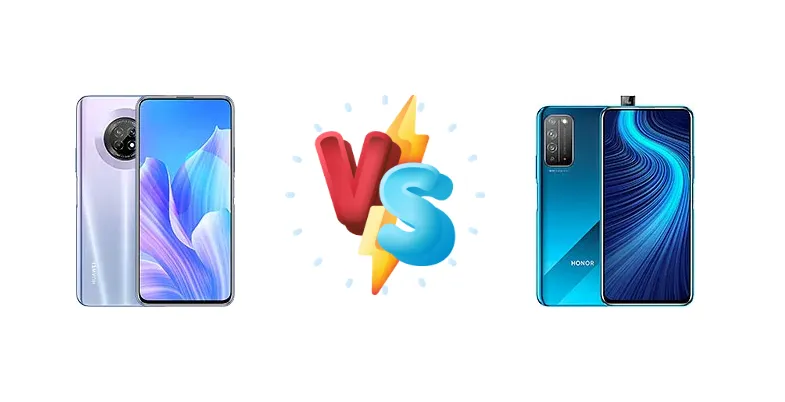
Both the Huawei Enjoy 20 Plus 5G and the Honor X10 5G target the increasingly competitive mid-range 5G market. However, they approach this segment with different chipsets and priorities. The Enjoy 20 Plus focuses on value, while the X10 5G aims for a more balanced experience with a more powerful processor. This comparison will dissect their key differences to determine which device delivers the best overall package.
🏆 Quick Verdict
For the average user prioritizing raw performance and future-proofing, the Honor X10 5G is the better choice. Its Kirin 820 chipset offers a significant performance uplift over the Enjoy 20 Plus’s Dimensity 720, justifying the slightly higher price and slower charging. However, the Enjoy 20 Plus remains a compelling option for budget-conscious buyers.
| Network |
|---|
| 2G bands | GSM 900 / 1800 / 1900 | GSM 850 / 900 / 1800 / 1900 |
| 3G bands | HSDPA 850 / 900 / 1700(AWS) / 1900 / 2100 | HSDPA 800 / 850 / 900 / 1700(AWS) / 1900 / 2100 |
| 4G bands | LTE | 1, 2, 3, 4, 5, 8, 18, 19, 26, 34, 38, 39, 40, 41 |
| 5G bands | 1, 3, 38, 41, 77, 78, 79 SA/NSA | 1, 3, 38, 41, 77, 78, 79, 80, 84 SA/NSA |
| Speed | HSPA, LTE, 5G | HSPA 42.2/5.76 Mbps, LTE (4CA) Cat12 600/50 Mbps, 5G 2.3 Gbps DL |
| Technology | GSM / HSPA / LTE / 5G | GSM / CDMA / HSPA / EVDO / LTE / 5G |
| | - | CDMA2000 1xEV-DO |
| Launch |
|---|
| Announced | 2020, September 03. Released 2020, September 10 | 2020, May 20. Released 2020, May 26 |
| Status | Discontinued | Discontinued |
| Body |
|---|
| Build | - | Glass front (Aluminosilicate glass) |
| Dimensions | 163.5 x 76.5 x 9 mm (6.44 x 3.01 x 0.35 in) | 163.7 x 76.5 x 8.8 mm (6.44 x 3.01 x 0.35 in) |
| SIM | Nano-SIM + Nano-SIM | Nano-SIM + Nano-SIM |
| Weight | 197 g (6.95 oz) | 203 g (7.16 oz) |
| Display |
|---|
| Protection | - | Aluminosilicate glass |
| Resolution | 1080 x 2400 pixels, 20:9 ratio (~397 ppi density) | 1080 x 2400 pixels, 20:9 ratio (~397 ppi density) |
| Size | 6.63 inches, 106.1 cm2 (~84.8% screen-to-body ratio) | 6.63 inches, 106.1 cm2 (~84.7% screen-to-body ratio) |
| Type | IPS LCD, 90Hz | IPS LCD, 90Hz |
| Platform |
|---|
| CPU | Octa-core (2x2.0 GHz Cortex-A76 & 6x2.0 GHz Cortex-A55) | Octa-core (1x2.36 GHz Cortex-A76 & 3x2.22 GHz Cortex-A76 & 4x1.84 GHz Cortex-A55) |
| Chipset | Mediatek Dimensity 720 (7 nm) | Kirin 820 5G (7 nm) |
| GPU | Mali-G57 MC2 | Mali-G57 (6-core) |
| OS | Android 10, EMUI 10.1, no Google Play Services | Android 10, Magic UI 3.1, no Google Play Services |
| Memory |
|---|
| Card slot | Nano Memory (uses shared SIM slot) | Nano Memory (uses shared SIM slot) |
| Internal | 128GB 6GB RAM, 128GB 8GB RAM | 64GB 6GB RAM, 128GB 6GB RAM, 128GB 8GB RAM |
| | UFS 2.1 | - |
| Main Camera |
|---|
| Features | LED flash, HDR, panorama | LED flash, panorama, HDR |
| Triple | 48 MP, f/1.8, 26mm (wide), 1/2.0", 0.8µm, PDAF
8 MP, f/2.4, 120˚ (ultrawide)
2 MP (macro) | 40 MP, f/1.8, 26mm (wide), 1/1.7", PDAF
8 MP, f/2.4, 17mm, 120˚ (ultrawide)
Auxiliary lens |
| Video | 4K@30fps, 1080p@30fps | 4K@30fps, 1080p@30fps, 720p@960fps, gyro-EIS |
| Selfie camera |
|---|
| Features | HDR | HDR |
| Single | Motorized pop-up 16 MP, f/2.2, (wide), 1/3.1", 1.0µm | Motorized pop-up 16 MP, f/2.2, 24mm (wide), 1/3.06", 1.0µm |
| Video | 1080p@30fps | 1080p@30fps |
| Sound |
|---|
| 3.5mm jack | Yes | Yes |
| 35mm jack | Yes | Yes |
| Loudspeaker | Yes | Yes |
| Comms |
|---|
| Bluetooth | 5.1, A2DP, LE | 5.1, A2DP, LE |
| NFC | No | No |
| Positioning | GPS, GLONASS, BDS | GPS, GLONASS, BDS |
| Radio | No | No |
| USB | USB Type-C 2.0, OTG | USB Type-C 2.0, OTG |
| WLAN | Wi-Fi 802.11 a/b/g/n/ac, dual-band, Wi-Fi Direct | Wi-Fi 802.11 a/b/g/n/ac, dual-band, Wi-Fi Direct |
| Features |
|---|
| Sensors | Fingerprint (side-mounted), accelerometer, gyro, proximity, compass | Fingerprint (side-mounted), accelerometer, gyro, proximity, compass |
| Battery |
|---|
| Charging | 40W wired | 22.5W wired
5W reverse wired |
| Type | Li-Po 4200 mAh | Li-Po 4300 mAh |
| Misc |
|---|
| Colors | Black, Blue, Green, Pink | Blue, Orange, Black, Silver |
| Models | FRL-AN00a | TEL-AN00, TEL-TN00, TEL-AN00a, TEL-AN10 |
| Price | About 280 EUR | About 250 EUR |
Huawei Enjoy 20 Plus 5G
- Faster 40W wired charging
- More affordable price point
- Potentially longer battery life due to efficient chipset
- Less powerful processor (Dimensity 720)
- Likely inferior camera performance
- May struggle with demanding games
Honor X10 5G
- More powerful processor (Kirin 820)
- Superior gaming performance
- Better camera image processing
- Slower 22.5W wired charging
- Higher price tag
- Potentially shorter battery life under heavy load
Display Comparison
Neither device boasts a standout display. While specific panel details (like OLED vs. LCD) are missing, both likely utilize LCD panels common in this price bracket. The core difference lies in the processing power driving them. The Honor X10 5G’s Kirin 820 has a more capable GPU, potentially leading to smoother animations and better graphics rendering, even if the panel itself is similar. Bezels are likely comparable, and without specific color accuracy data, it’s difficult to declare a clear winner in image quality.
Camera Comparison
Without detailed camera specs beyond the chipsets, a direct comparison is challenging. However, the Kirin 820’s integrated ISP (Image Signal Processor) is generally more advanced than the one found in the Dimensity 720. This suggests the Honor X10 5G will likely produce images with better dynamic range, noise reduction, and overall detail, particularly in challenging lighting conditions. The Enjoy 20 Plus will still capture usable photos, but the X10 5G has the potential for superior image quality. We can assume both phones will include standard features like HDR and portrait modes.
Performance
The Kirin 820 5G in the Honor X10 5G is the clear performance champion. Its octa-core configuration, featuring a prime Cortex-A76 core clocked at 2.36 GHz, alongside three additional Cortex-A76 cores at 2.22 GHz, provides a substantial advantage over the Enjoy 20 Plus’s Dimensity 720. The Dimensity 720, with its 2x2.0 GHz Cortex-A76 and 6x2.0 GHz Cortex-A55 setup, is still capable, but the Kirin 820’s more powerful cores and potentially more efficient architecture translate to faster app loading times, smoother multitasking, and better gaming performance. The Honor X10 5G will handle graphically intensive games with higher frame rates and fewer stutters.
Battery Life
The Huawei Enjoy 20 Plus 5G’s 40W wired charging is a significant advantage over the Honor X10 5G’s 22.5W charging. This translates to considerably faster charging times, allowing you to top up the battery more quickly. While battery capacity isn’t specified, the faster charging of the Enjoy 20 Plus mitigates any potential disadvantage from a slightly smaller battery. The Honor X10 5G also offers 5W reverse wired charging, a convenient feature for topping up accessories, but this is unlikely to be a deciding factor for most users.
Buying Guide
Buy the Huawei Enjoy 20 Plus 5G if you need a highly affordable 5G phone and prioritize battery life over peak performance. It’s ideal for everyday tasks, social media, and light gaming. Buy the Honor X10 5G if you prefer a smoother, more responsive experience for demanding apps, gaming, and multitasking, and are willing to trade some battery life for the extra processing power.
Frequently Asked Questions
❓ Will the Honor X10 5G handle demanding games like PUBG Mobile at high settings?
Yes, the Kirin 820 chipset in the Honor X10 5G is capable of running PUBG Mobile at high settings with stable frame rates. The more powerful GPU and CPU provide the necessary horsepower for a smooth gaming experience, although sustained performance may be affected by thermal throttling.
❓ How long will it take to fully charge the Huawei Enjoy 20 Plus 5G from 0% to 100%?
With its 40W wired charging, the Huawei Enjoy 20 Plus 5G should fully charge from 0% to 100% in approximately 60-75 minutes, making it significantly faster than the Honor X10 5G.
❓ Does the Honor X10 5G's reverse charging feature work with all devices?
The Honor X10 5G's 5W reverse wired charging is compatible with most devices that charge via USB-C, but charging speeds will be slow. It's best suited for accessories like wireless earbuds or smartwatches, rather than fully charging a smartphone.
❓ Is the Dimensity 720 in the Enjoy 20 Plus 5G sufficient for everyday tasks like browsing and social media?
Absolutely. The Dimensity 720 is more than capable of handling everyday tasks such as web browsing, social media, and video streaming without any noticeable lag or slowdown. It's a solid performer for general use.