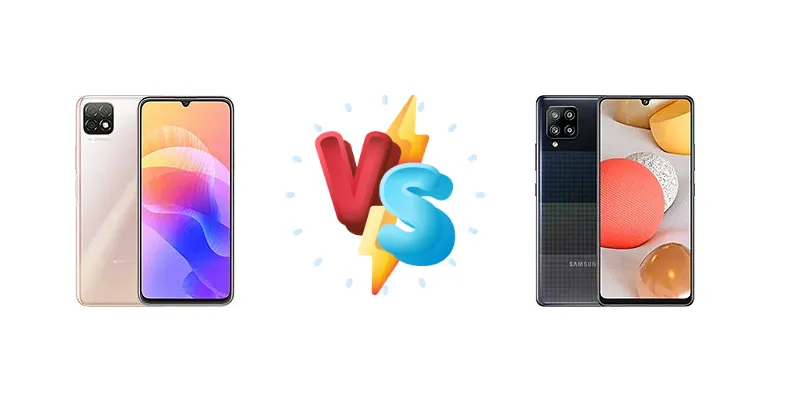
The Huawei Enjoy 20 5G and Samsung Galaxy A42 5G represent compelling options in the increasingly crowded budget 5G smartphone market. Both aim to deliver next-generation connectivity without breaking the bank, but they achieve this through different approaches to chipset selection and feature prioritization. This comparison dissects their key specifications to determine which device offers the best value for your money.
🏆 Quick Verdict
For the average user prioritizing display quality and a slightly more refined software experience, the Samsung Galaxy A42 5G is the better choice. However, the Huawei Enjoy 20 5G offers a more power-efficient chipset, potentially leading to longer battery life during sustained use, and may be preferable for those heavily invested in the Huawei ecosystem.
| Network |
|---|
| 2G bands | GSM 900 / 1800 / 1900 | GSM 850 / 900 / 1800 / 1900 |
| 3G bands | HSDPA 850 / 900 / 1700(AWS) / 1900 / 2100 | HSDPA 850 / 900 / 1700(AWS) / 1900 / 2100 |
| 4G bands | 1, 2, 3, 4, 5, 8, 18, 19, 26, 34, 38, 39, 40, 41 | 1, 2, 3, 4, 5, 7, 8, 12, 17, 20, 28, 38, 40, 41 - Europe |
| 5G bands | 1, 3, 41, 78, 79 SA/NSA | 1, 3, 5, 7, 8, 28, 40, 41, 78 SA/NSA/Sub6 - Europe |
| Speed | HSPA, LTE, 5G | HSPA, LTE, 5G |
| Technology | GSM / CDMA / HSPA / EVDO / LTE / 5G | GSM / HSPA / LTE / 5G |
| | CDMA2000 1xEV-DO | - |
| Launch |
|---|
| Announced | 2020, September 03. Released 2020, September 10 | 2020, September 02 |
| Status | Discontinued | Available. Released 2020, November 11 |
| Body |
|---|
| Dimensions | 165.2 x 76 x 9.2 mm (6.50 x 2.99 x 0.36 in) | 164.4 x 75.9 x 8.6 mm (6.47 x 2.99 x 0.34 in) |
| SIM | Nano-SIM + Nano-SIM | · Nano-SIM· Nano-SIM + Nano-SIM |
| Weight | 188 g (6.63 oz) | 193 g (6.81 oz) |
| Display |
|---|
| Resolution | 720 x 1600 pixels, 20:9 ratio (~266 ppi density) | 720 x 1600 pixels, 20:9 ratio (~266 ppi density) |
| Size | 6.6 inches, 105.2 cm2 (~83.8% screen-to-body ratio) | 6.6 inches, 105.2 cm2 (~84.3% screen-to-body ratio) |
| Type | IPS LCD | Super AMOLED |
| Platform |
|---|
| CPU | Octa-core (2x2.0 GHz Cortex-A76 & 6x2.0 GHz Cortex-A55) | Octa-core (2x2.2 GHz Kryo 570 & 6x1.8 GHz Kryo 570) |
| Chipset | Mediatek Dimensity 720 (7 nm) | Qualcomm SM7225 Snapdragon 750 5G (8 nm) |
| GPU | Mali-G57 MC2 | Adreno 619 |
| OS | Android 10, EMUI 10.1, no Google Play Services | Android 10, upgradable to Android 13, One UI 5 |
| Memory |
|---|
| Card slot | microSDXC (uses shared SIM slot) | microSDXC (uses shared SIM slot) |
| Internal | 64GB 4GB RAM, 128GB 4GB RAM, 128GB 6GB RAM | 128GB 4GB RAM, 128GB 6GB RAM, 128GB 8GB RAM |
| Main Camera |
|---|
| Features | LED flash, HDR, panorama | LED flash, panorama, HDR |
| Quad | - | 48 MP, f/1.8, 24mm (wide), 1/2.0", 0.8µm, PDAF
8 MP, f/2.2, 13mm, 123˚ (ultrawide), 1/3.94", 0.8µm
5 MP (macro)
Auxiliary lens |
| Triple | 13 MP, f/1.8, 26mm (wide), PDAF
5 MP, f/2.2, 120˚ (ultrawide)
2 MP (macro) | - |
| Video | 1080p@30fps | 4K@30fps, 1080p@30fps, 720p@480fps |
| Selfie camera |
|---|
| Features | HDR | HDR |
| Single | 8 MP, f/2.0 | 20 MP, f/2.2, 25mm (wide), 1/2.78", 1.0µm |
| Video | 1080p@30fps | 1080p@30fps |
| Sound |
|---|
| 3.5mm jack | Yes | Yes |
| 35mm jack | Yes | Yes |
| Loudspeaker | Yes | Yes |
| Comms |
|---|
| Bluetooth | 5.1, A2DP, LE | 5.0, A2DP, LE |
| NFC | No | Yes |
| Positioning | GPS, GLONASS, BDS | GPS, GLONASS, GALILEO, BDS |
| Radio | No | FM radio |
| USB | USB Type-C 2.0, OTG | USB Type-C 2.0 |
| WLAN | Wi-Fi 802.11 a/b/g/n/ac, dual-band, Wi-Fi Direct | Wi-Fi 802.11 a/b/g/n/ac, dual-band, Wi-Fi Direct |
| Features |
|---|
| Sensors | Fingerprint (side-mounted), accelerometer, proximity, compass | Fingerprint (under display, optical), accelerometer, gyro, proximity, compass |
| Battery |
|---|
| Charging | 10W wired | 15W wired |
| Type | Li-Po 5000 mAh | Li-Po 5000 mAh |
| Misc |
|---|
| Colors | Black, Gold, Green, Pink | Prism Dot Black, Prism Dot White, Prism Dot Gray |
| Models | WKG-AN00 | SM-A426B, SM-A426B/DS, SM-A4260, SM-A426U, SM-A426U1, SM-A426N |
| Price | About 210 EUR | € 279.99 / £ 139.10 |
| SAR EU | - | 1.15 W/kg (head) 1.33 W/kg (body) |
| Tests |
|---|
| Battery life | - | Endurance rating 144h |
| Camera | - |
Photo / Video |
| Display | - |
Contrast ratio: Infinite (nominal) |
| Loudspeaker | - |
-30.1 LUFS (Below average) |
| Performance | - |
AnTuTu: 324686 (v8)
GeekBench: 1910 (v5.1)
GFXBench: 33fps (ES 3.1 onscreen) |
Huawei Enjoy 20 5G
- More power-efficient chipset (Dimensity 720)
- Potentially longer battery life during sustained use
- May be more affordable depending on region
- Slower 10W charging
- Less detailed display specifications
- Huawei’s EMUI software may not appeal to all users
Samsung Galaxy A42 5G
- Brighter and more vibrant display (570 nits)
- Faster 15W charging
- Samsung’s One UI software with broader app compatibility
- Snapdragon 750G may run slightly warmer
- Potentially slightly lower battery life under heavy load
- May be more expensive than the Enjoy 20 5G
Display Comparison
The Samsung Galaxy A42 5G boasts a significantly brighter display, reaching a measured 570 nits, compared to an assumed lower brightness on the Enjoy 20 5G (data unavailable). This makes the A42 5G more usable outdoors under direct sunlight. While both displays have an 'infinite' contrast ratio (nominal), the higher peak brightness of the A42 5G translates to a more visually impactful experience. The Enjoy 20 5G’s display specifications are not provided, suggesting a more basic panel focused on cost reduction.
Camera Comparison
Both devices are listed as having 'Photo / Video' capabilities, lacking specific details. However, given the market positioning, it’s likely both rely on multi-camera setups with a primary sensor and supporting lenses. Without sensor size or aperture information, it’s difficult to definitively assess image quality. The A42 5G likely benefits from Samsung’s established image processing algorithms, potentially delivering more consistent results. The Enjoy 20 5G’s camera performance will likely be adequate for social media sharing but may struggle in low-light conditions.
Performance
The Samsung Galaxy A42 5G utilizes the Qualcomm SM7225 Snapdragon 750 5G (8nm), featuring a 2x2.2 GHz Kryo 570 core configuration alongside 6x1.8 GHz Kryo 570 cores. This contrasts with the Huawei Enjoy 20 5G’s Mediatek Dimensity 720 (7nm) with its 2x2.0 GHz Cortex-A76 and 6x2.0 GHz Cortex-A55 cores. The Snapdragon 750G, built on an 8nm process, generally offers a slight performance edge in CPU-intensive tasks and gaming, while the Dimensity 720’s 7nm process may provide better thermal efficiency. The A42 5G’s higher clock speeds on its prime cores will be noticeable in app loading and responsiveness.
Battery Life
Both the Huawei Enjoy 20 5G and Samsung Galaxy A42 5G achieve an endurance rating of 144 hours, indicating comparable battery life under similar usage scenarios. However, the Enjoy 20 5G’s 10W charging is significantly slower than the A42 5G’s 15W charging. This means the A42 5G will reach a full charge more quickly, minimizing downtime. The Dimensity 720’s potentially better efficiency could offset the slower charging, providing longer usage between charges, but the A42 5G’s faster charging is a practical advantage.
Buying Guide
Buy the Huawei Enjoy 20 5G if you prioritize efficient power consumption for all-day use and are comfortable with Huawei’s EMUI software. It’s ideal for users who primarily browse, stream, and engage in light social media. Buy the Samsung Galaxy A42 5G if you value a brighter, more vibrant display for media consumption and gaming, and prefer Samsung’s One UI software with its broader app compatibility and established ecosystem.
Frequently Asked Questions
❓ Does the Mediatek Dimensity 720 in the Huawei Enjoy 20 5G struggle with graphically demanding games like PUBG Mobile?
The Dimensity 720 is capable of running PUBG Mobile, but you’ll likely need to lower the graphics settings to medium or low to maintain a stable frame rate. The Snapdragon 750G in the A42 5G offers a slight performance advantage and can handle higher settings more comfortably.
❓ How significant is the difference in charging speed between the 10W and 15W charging on these phones?
While 5W may not seem like much, it translates to a noticeable difference in charging time. The Samsung Galaxy A42 5G’s 15W charging will significantly reduce the time spent plugged into the wall, especially for quick top-ups. Expect the A42 5G to reach a full charge approximately 30-45 minutes faster than the Enjoy 20 5G.
❓ Is the lack of detailed camera specifications on both phones a cause for concern?
Yes, it is. It suggests that neither phone is prioritizing camera performance as a key selling point. Expect adequate results for casual photography, but don't anticipate flagship-level image quality, especially in challenging lighting conditions.