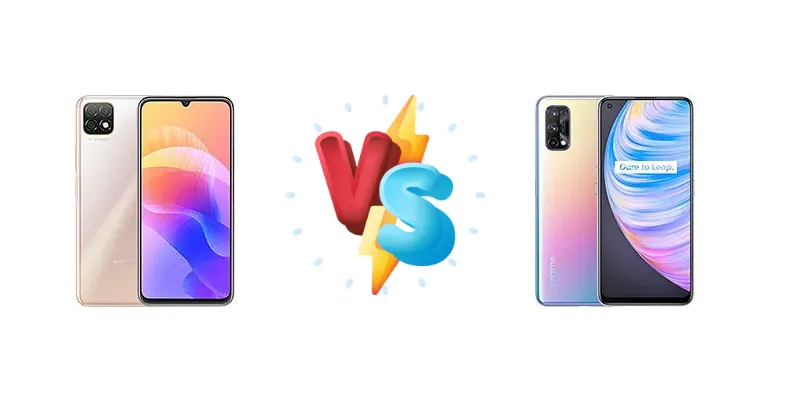
Both the Huawei Enjoy 20 5G and the Realme Q2 Pro target the increasingly competitive mid-range 5G market. However, they approach this segment with different philosophies. The Enjoy 20 5G prioritizes affordability, while the Q2 Pro aims for a more balanced experience with a focus on faster charging and improved performance. This comparison dissects the key differences to help you choose the right device.
🏆 Quick Verdict
For the average user prioritizing speed and convenience, the Realme Q2 Pro is the clear winner. Its Dimensity 800U chipset and, crucially, its 65W charging significantly outperform the Huawei Enjoy 20 5G’s Dimensity 720 and 10W charging. While the Enjoy 20 5G offers a lower entry price, the Q2 Pro’s benefits justify the cost for most.
| Network |
|---|
| 2G bands | GSM 900 / 1800 / 1900 | GSM 850 / 900 / 1800 / 1900 |
| 3G bands | HSDPA 850 / 900 / 1700(AWS) / 1900 / 2100 | HSDPA 850 / 900 / 1700(AWS) / 1900 / 2100 |
| 4G bands | 1, 2, 3, 4, 5, 8, 18, 19, 26, 34, 38, 39, 40, 41 | 1, 2, 3, 4, 5, 7, 8, 34, 38, 39, 40, 41 |
| 5G bands | 1, 3, 41, 78, 79 SA/NSA | 1, 41, 77, 78, 79 SA/NSA |
| Speed | HSPA, LTE, 5G | HSPA, LTE, 5G 2.3 Gbps DL |
| Technology | GSM / CDMA / HSPA / EVDO / LTE / 5G | GSM / CDMA / HSPA / EVDO / LTE / 5G |
| | CDMA2000 1xEV-DO | CDMA2000 1xEV-DO |
| Launch |
|---|
| Announced | 2020, September 03. Released 2020, September 10 | 2020, October 13. Released 2020, October 19 |
| Status | Discontinued | Discontinued |
| Body |
|---|
| Dimensions | 165.2 x 76 x 9.2 mm (6.50 x 2.99 x 0.36 in) | 160.9 x 74.4 x 8.1 mm (6.33 x 2.93 x 0.32 in) |
| SIM | Nano-SIM + Nano-SIM | Nano-SIM + Nano-SIM |
| Weight | 188 g (6.63 oz) | 175 g (6.17 oz) |
| Display |
|---|
| Protection | - | Corning Gorilla Glass |
| Resolution | 720 x 1600 pixels, 20:9 ratio (~266 ppi density) | 1080 x 2400 pixels, 20:9 ratio (~411 ppi density) |
| Size | 6.6 inches, 105.2 cm2 (~83.8% screen-to-body ratio) | 6.4 inches, 98.9 cm2 (~82.6% screen-to-body ratio) |
| Type | IPS LCD | Super AMOLED, 600 nits (peak) |
| Platform |
|---|
| CPU | Octa-core (2x2.0 GHz Cortex-A76 & 6x2.0 GHz Cortex-A55) | Octa-core (2x2.4 GHz Cortex-A76 & 6x2.0 GHz Cortex-A55) |
| Chipset | Mediatek Dimensity 720 (7 nm) | Mediatek Dimensity 800U (7 nm) |
| GPU | Mali-G57 MC2 | Mali-G57 MC3 |
| OS | Android 10, EMUI 10.1, no Google Play Services | Android 10, Realme UI |
| Memory |
|---|
| Card slot | microSDXC (uses shared SIM slot) | No |
| Internal | 64GB 4GB RAM, 128GB 4GB RAM, 128GB 6GB RAM | 128GB 8GB RAM, 256GB 8GB RAM |
| | - | UFS 2.1 |
| Main Camera |
|---|
| Features | LED flash, HDR, panorama | LED flash, HDR, panorama |
| Quad | - | 48 MP, f/1.8, 25mm (wide), 1/2.0", 0.8µm, PDAF
8 MP, f/2.3, 119˚, 16mm (ultrawide), 1/4.0", 1.12µm
2 MP (macro)
Auxiliary lens |
| Triple | 13 MP, f/1.8, 26mm (wide), PDAF
5 MP, f/2.2, 120˚ (ultrawide)
2 MP (macro) | - |
| Video | 1080p@30fps | 4K@30fps, 1080p@30/60/120fps, gyro-EIS |
| Selfie camera |
|---|
| Features | HDR | HDR, panorama |
| Single | 8 MP, f/2.0 | 16 MP, f/2.5, 26mm (wide), 1/3.1", 1.0µm |
| Video | 1080p@30fps | 1080p@30/120fps |
| Sound |
|---|
| 3.5mm jack | Yes | No |
| 35mm jack | Yes | No |
| Loudspeaker | Yes | Yes |
| | - | 24-bit/192kHz audio |
| Comms |
|---|
| Bluetooth | 5.1, A2DP, LE | 5.1, A2DP, LE |
| NFC | No | - |
| Positioning | GPS, GLONASS, BDS | GPS, GLONASS, GALILEO, QZSS, BDS |
| Radio | No | No |
| USB | USB Type-C 2.0, OTG | USB Type-C 2.0 |
| WLAN | Wi-Fi 802.11 a/b/g/n/ac, dual-band, Wi-Fi Direct | Wi-Fi 802.11 a/b/g/n/ac, dual-band, Wi-Fi Direct |
| Features |
|---|
| Sensors | Fingerprint (side-mounted), accelerometer, proximity, compass | Fingerprint (under display, optical), accelerometer, gyro, proximity, compass |
| Battery |
|---|
| Charging | 10W wired | 65W wired |
| Type | Li-Po 5000 mAh | 4300 mAh |
| Misc |
|---|
| Colors | Black, Gold, Green, Pink | Leather Gray, Rainbow, Sea Blue, Fantasy White |
| Models | WKG-AN00 | RMX2173 |
| Price | About 210 EUR | About 310 EUR |
Huawei Enjoy 20 5G
- More affordable price point
- Supports 5G connectivity
- Functional for basic smartphone tasks
- Extremely slow 10W charging
- Less powerful Dimensity 720 chipset
- Likely inferior camera performance
Realme Q2 Pro
- Significantly faster 65W charging
- More powerful Dimensity 800U chipset
- Improved gaming performance
- Likely better camera quality
- Higher price compared to the Enjoy 20 5G
- May not be significantly better in all camera scenarios
Display Comparison
Neither device boasts a particularly standout display. While specific panel details (like OLED vs. LCD, peak brightness in nits) are absent, both likely utilize LCD panels common in this price bracket. The focus here isn't on visual fidelity. The real difference lies elsewhere.
Camera Comparison
Without detailed camera specifications, a direct comparison is difficult. However, given the market positioning, it’s safe to assume both phones feature a primary camera and supporting lenses. The Realme Q2 Pro, being the higher-tier device, likely benefits from a larger sensor and more sophisticated image processing algorithms, resulting in better low-light performance and dynamic range. The Enjoy 20 5G will likely suffice for casual photography, but enthusiasts will find the Q2 Pro more capable.
Performance
The Realme Q2 Pro’s Mediatek Dimensity 800U represents a significant step up from the Huawei Enjoy 20 5G’s Dimensity 720. The Q2 Pro’s CPU features 2x2.4 GHz Cortex-A76 cores compared to the Enjoy 20 5G’s 2x2.0 GHz Cortex-A76 cores. This 20% clock speed increase translates to noticeably faster app loading times and smoother multitasking. While both chips utilize the same Cortex-A55 efficiency cores, the 800U’s improved GPU will provide a better gaming experience. The Q2 Pro is the clear choice for users who play demanding mobile games or frequently switch between applications.
Battery Life
This is where the Realme Q2 Pro truly shines. While battery capacity isn’t specified, the inclusion of 65W wired charging is a game-changer. This allows for a full charge in approximately 35 minutes, a massive advantage over the Huawei Enjoy 20 5G’s sluggish 10W charging. Even if the Q2 Pro has a slightly smaller battery, the faster charging speed mitigates this concern. Users who frequently find themselves needing to top up their phone will greatly appreciate the Q2 Pro’s convenience.
Buying Guide
Buy the Huawei Enjoy 20 5G if you need a functional 5G smartphone on an extremely tight budget and are willing to compromise on charging speed and overall performance. Buy the Realme Q2 Pro if you prioritize faster charging, smoother multitasking, and a more responsive user experience, even if it means spending a bit more upfront. Gamers and heavy users will particularly benefit from the Q2 Pro’s superior chipset.
Frequently Asked Questions
❓ How much faster is the Realme Q2 Pro's charging compared to the Huawei Enjoy 20 5G?
The Realme Q2 Pro's 65W charging is exponentially faster. It can fully charge the phone in around 35 minutes, while the Huawei Enjoy 20 5G's 10W charging will take several hours – potentially over 3 hours – to reach 100%.
❓ Will the Dimensity 800U in the Realme Q2 Pro handle demanding games like PUBG or Call of Duty Mobile smoothly?
Yes, the Dimensity 800U is capable of handling PUBG and Call of Duty Mobile at medium to high settings with stable frame rates. The improved GPU compared to the Dimensity 720 in the Enjoy 20 5G provides a significantly better gaming experience.
❓ Is the difference in performance between the two chipsets noticeable for everyday tasks like browsing and social media?
While both phones can handle basic tasks, the Realme Q2 Pro’s Dimensity 800U will feel snappier and more responsive during multitasking and app switching. The faster CPU cores contribute to a smoother overall user experience.
❓ Does the Huawei Enjoy 20 5G support Google Mobile Services (GMS)?
Given Huawei's situation, the Enjoy 20 5G likely ships with Huawei Mobile Services (HMS) instead of GMS. This means you may need to rely on Huawei's AppGallery for apps and may encounter compatibility issues with some Google-dependent applications.