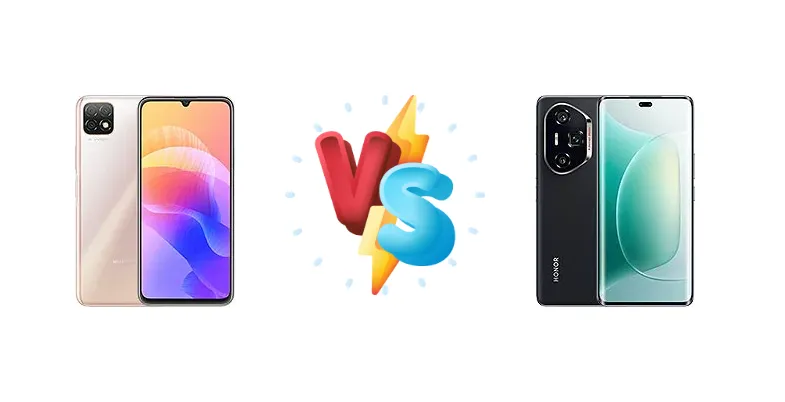
The smartphone landscape offers a wide spectrum of choices, from budget-friendly options like the Huawei Enjoy 20 5G to premium flagships like the Honor 300 Ultra. This comparison dissects these two devices, highlighting the significant performance gap and examining whether the Honor 300 Ultra’s advanced features justify its higher price tag for the average user.
🏆 Quick Verdict
For most users, the Honor 300 Ultra is the clear winner. Its Snapdragon 8 Gen 3 chipset delivers significantly superior performance, and the 100W charging is a game-changer. However, the Huawei Enjoy 20 5G remains a viable option for those prioritizing affordability and basic 5G connectivity.
| Network |
|---|
| 2G bands | GSM 900 / 1800 / 1900 | GSM 850 / 900 / 1800 / 1900 |
| 3G bands | HSDPA 850 / 900 / 1700(AWS) / 1900 / 2100 | HSDPA 800 / 850 / 900 / 1700(AWS) / 1900 / 2100 |
| 4G bands | 1, 2, 3, 4, 5, 8, 18, 19, 26, 34, 38, 39, 40, 41 | LTE |
| 5G bands | 1, 3, 41, 78, 79 SA/NSA | SA/NSA |
| Speed | HSPA, LTE, 5G | HSPA, LTE, 5G |
| Technology | GSM / CDMA / HSPA / EVDO / LTE / 5G | GSM / HSPA / LTE / 5G |
| | CDMA2000 1xEV-DO | - |
| Launch |
|---|
| Announced | 2020, September 03. Released 2020, September 10 | 2024, December 02 |
| Status | Discontinued | Available. Released 2024, December 07 |
| Body |
|---|
| Build | - | Glass front, glass back or silicone polymer back (eco leather) |
| Dimensions | 165.2 x 76 x 9.2 mm (6.50 x 2.99 x 0.36 in) | 163.8 x 75.3 x 8.2 mm (6.45 x 2.96 x 0.32 in) |
| SIM | Nano-SIM + Nano-SIM | Nano-SIM + Nano-SIM |
| Weight | 188 g (6.63 oz) | 198 g (6.98 oz) |
| Display |
|---|
| Protection | - | Giant rhino glass |
| Resolution | 720 x 1600 pixels, 20:9 ratio (~266 ppi density) | 1224 x 2700 pixels (~437 ppi density) |
| Size | 6.6 inches, 105.2 cm2 (~83.8% screen-to-body ratio) | 6.78 inches, 111.5 cm2 (~90.4% screen-to-body ratio) |
| Type | IPS LCD | AMOLED, 1B colors, 120Hz, HDR, 1200 nits (HBM), 4000 nits (peak) |
| Platform |
|---|
| CPU | Octa-core (2x2.0 GHz Cortex-A76 & 6x2.0 GHz Cortex-A55) | Octa-core (1x3.0 GHz Cortex-X4 & 5x2.95 GHz Cortex-A720 & 2x2.0 GHz Cortex-A520) |
| Chipset | Mediatek Dimensity 720 (7 nm) | Qualcomm SM8650-AB Snapdragon 8 Gen 3 (4 nm) |
| GPU | Mali-G57 MC2 | Adreno 750 |
| OS | Android 10, EMUI 10.1, no Google Play Services | Android 15, MagicOS 9 |
| Memory |
|---|
| Card slot | microSDXC (uses shared SIM slot) | No |
| Internal | 64GB 4GB RAM, 128GB 4GB RAM, 128GB 6GB RAM | 512GB 12GB RAM, 1TB 16GB RAM |
| Main Camera |
|---|
| Features | LED flash, HDR, panorama | LED flash, HDR, panorama |
| Triple | 13 MP, f/1.8, 26mm (wide), PDAF
5 MP, f/2.2, 120˚ (ultrawide)
2 MP (macro) | 50 MP, f/2.0, (wide), 1/1.56", 1.0µm, PDAF, OIS
50 MP, f/3.0, (periscope telephoto), 1/2.51", 0.7µm, PDAF, OIS, 3.8x optical zoom
12 MP, f/2.2, 112˚ (ultrawide), AF |
| Video | 1080p@30fps | 4K, 1080p, gyro-EIS, OIS |
| Selfie camera |
|---|
| Dual | - | 50 MP, f/2.1, (wide)
2 MP, f/2.4, (depth) |
| Features | HDR | HDR |
| Single | 8 MP, f/2.0 | - |
| Video | 1080p@30fps | 4K, 1080p, gyro-EIS |
| Sound |
|---|
| 3.5mm jack | Yes | - |
| 35mm jack | Yes | No |
| Loudspeaker | Yes | Yes, with stereo speakers |
| Comms |
|---|
| Bluetooth | 5.1, A2DP, LE | 5.3, A2DP, LE, aptX HD |
| Infrared port | - | Yes |
| NFC | No | Yes |
| Positioning | GPS, GLONASS, BDS | GPS, GALILEO, GLONASS, QZSS, BDS (B1I+B1c) |
| Radio | No | No |
| USB | USB Type-C 2.0, OTG | USB Type-C 2.0, OTG |
| WLAN | Wi-Fi 802.11 a/b/g/n/ac, dual-band, Wi-Fi Direct | Wi-Fi 802.11 a/b/g/n/ac/6/7, dual-band, Wi-Fi Direct |
| Features |
|---|
| Sensors | Fingerprint (side-mounted), accelerometer, proximity, compass | Fingerprint (under display, ultrasonic), accelerometer, gyro, compass, ultrasound proximity |
| Battery |
|---|
| Charging | 10W wired | 100W wired, 59% in 15 min
80W wireless, 39% in 15 min
5W reverse wired
Reverse wireless |
| Type | Li-Po 5000 mAh | Si/C Li-Ion 5300 mAh |
| Misc |
|---|
| Colors | Black, Gold, Green, Pink | Black, White |
| Models | WKG-AN00 | - |
| Price | About 210 EUR | About 550 EUR |
Huawei Enjoy 20 5G
- Significantly more affordable
- Supports 5G connectivity
- Functional for basic smartphone tasks
- Slow 10W charging
- Outdated chipset performance
- Likely lower-quality display
Honor 300 Ultra
- Exceptional performance with Snapdragon 8 Gen 3
- Ultra-fast 100W wired and 80W wireless charging
- Likely superior camera system and display quality
- Considerably more expensive
- May be overkill for basic users
- Potential for higher heat output under sustained load
Display Comparison
While display specifications are absent for the Enjoy 20 5G, we can infer it utilizes a standard LCD panel given its price point. The Honor 300 Ultra, positioned as a flagship, likely features an OLED display with a high refresh rate. The key differentiator is the chipset's ability to drive a higher resolution and refresh rate smoothly. The Snapdragon 8 Gen 3’s Adreno 750 GPU will handle graphically intensive displays with ease, while the Dimensity 720 may struggle with higher resolutions or refresh rates, resulting in a less fluid visual experience.
Camera Comparison
Without detailed camera specs for either device, it’s difficult to make precise comparisons. However, the Honor 300 Ultra, as a flagship, is expected to feature a more sophisticated camera system with a larger sensor and advanced image processing capabilities. The Snapdragon 8 Gen 3’s ISP (Image Signal Processor) is significantly more powerful than the Dimensity 720’s, enabling features like faster autofocus, better low-light performance, and more detailed image capture. The Enjoy 20 5G likely relies on software processing to compensate for a less capable sensor, potentially resulting in less natural-looking images.
Performance
The performance disparity is stark. The Honor 300 Ultra’s Qualcomm Snapdragon 8 Gen 3 (4nm) is a generational leap ahead of the Huawei Enjoy 20 5G’s MediaTek Dimensity 720 (7nm). The Snapdragon 8 Gen 3’s Cortex-X4 prime core, clocked at 3.0 GHz, provides significantly higher single-core performance, crucial for responsive app launches and UI navigation. The 4nm process node also translates to improved thermal efficiency, meaning the Honor 300 Ultra will sustain peak performance for longer periods without throttling. The Dimensity 720, while capable for everyday tasks, will show its limitations in demanding games and multitasking scenarios. The Honor 300 Ultra’s LPDDR5x RAM further enhances performance, offering faster data transfer speeds compared to the likely LPDDR4X RAM in the Enjoy 20 5G.
Battery Life
The Huawei Enjoy 20 5G’s 10W charging is painfully slow by modern standards, requiring several hours for a full charge. The Honor 300 Ultra, with its 100W wired charging, can reach 59% charge in just 15 minutes, and a full charge will take under 30 minutes. Furthermore, the 80W wireless charging capability is a significant convenience feature absent in the Enjoy 20 5G. While battery capacity isn’t specified, the Honor 300 Ultra’s efficient Snapdragon 8 Gen 3 chipset and fast charging mitigate the impact of a potentially smaller battery size.
Buying Guide
Buy the Huawei Enjoy 20 5G if you need a functional 5G smartphone for essential tasks like calling, texting, and light social media browsing, and your budget is extremely limited. Buy the Honor 300 Ultra if you prioritize a smooth, responsive experience for demanding applications, gaming, and content creation, and you value incredibly fast charging speeds.
Frequently Asked Questions
❓ Will the Snapdragon 8 Gen 3 in the Honor 300 Ultra get uncomfortably hot during extended gaming sessions?
While the Snapdragon 8 Gen 3 is a powerful chip, Qualcomm has focused on thermal efficiency with the 4nm process. The Honor 300 Ultra likely incorporates advanced cooling solutions to mitigate heat buildup. However, some heat is inevitable during prolonged, demanding gaming. Expect some performance throttling after extended play, but it should be less pronounced than with older generation chips.
❓ Is the 10W charging on the Huawei Enjoy 20 5G realistically usable in 2024?
10W charging is extremely slow by today's standards. It's suitable for overnight charging, but topping up the battery during the day will be inconvenient. Expect a full charge to take several hours, making it a significant drawback for users accustomed to faster charging technologies.
❓ Does the Honor 300 Ultra support reverse wireless charging for accessories like earbuds?
Yes, the Honor 300 Ultra includes both reverse wired and wireless charging capabilities. This allows you to use the phone as a power bank to charge other devices, offering added convenience for users with compatible accessories.