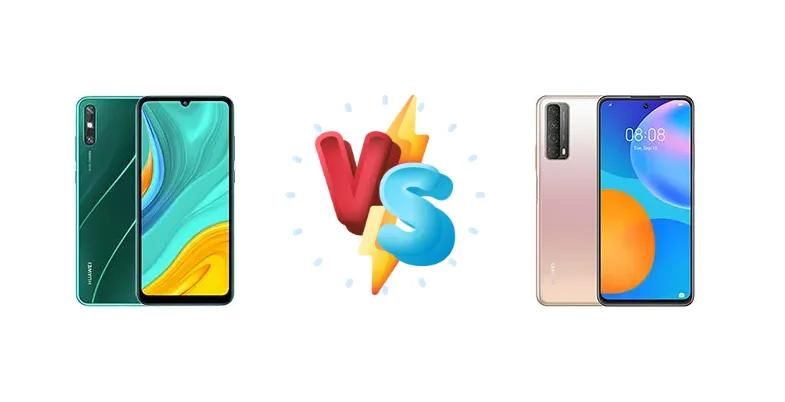
Huawei's Enjoy and Y series represent their entry-level and budget-focused offerings. The Enjoy 10e and Y7a, while both aiming for affordability, take different approaches to delivering value. The Enjoy 10e prioritizes a lower entry price, while the Y7a attempts to offer a more refined experience with faster charging and a more modern chipset. This comparison dissects the key differences to help you determine which device best suits your needs.
🏆 Quick Verdict
For the average user prioritizing responsiveness and future-proofing, the Huawei Y7a is the better choice. Its Kirin 710A chipset offers a noticeable performance uplift over the Enjoy 10e’s Helio P35, and the 22.5W fast charging significantly reduces downtime. While the Enjoy 10e is cheaper, the Y7a’s improvements justify the price difference.
| Network |
|---|
| 2G bands | GSM 900 / 1800 / 1900 | GSM 900 / 1800 / 1900 |
| 3G bands | HSDPA 850 / 900 / 2100 | HSDPA 850 / 900 / 1900 / 2100 |
| 4G bands | 1, 3, 5, 8, 38, 40, 41 | 1, 3, 5, 7, 8, 20, 28, 38, 40, 41 |
| Speed | HSPA, LTE | HSPA, LTE |
| Technology | GSM / HSPA / LTE | GSM / HSPA / LTE |
| Launch |
|---|
| Announced | 2020, March 01. Released 2020, March | 2020, October 21. Released 2020, October 30 |
| Status | Discontinued | Discontinued |
| Body |
|---|
| Dimensions | 159.1 x 74.1 x 9 mm (6.26 x 2.92 x 0.35 in) | 165.7 x 76.9 x 9.3 mm (6.52 x 3.03 x 0.37 in) |
| Keyboard | - | QWERTY |
| SIM | Nano-SIM + Nano-SIM | Nano-SIM + Nano-SIM |
| Weight | 185 g (6.53 oz) | 206 g (7.27 oz) |
| Display |
|---|
| Resolution | 720 x 1600 pixels, 20:9 ratio (~278 ppi density) | 1080 x 2400 pixels, 20:9 ratio (~395 ppi density) |
| Size | 6.3 inches, 95.8 cm2 (~81.3% screen-to-body ratio) | 6.67 inches, 107.4 cm2 (~84.3% screen-to-body ratio) |
| Type | IPS LCD | IPS LCD |
| Platform |
|---|
| CPU | Octa-core (4x2.35 GHz Cortex-A53 & 4x1.8 GHz Cortex-A53) | Octa-core (4x2.0 GHz Cortex-A73 & 4x1.7 GHz Cortex-A53) |
| Chipset | Mediatek MT6765 Helio P35 (12 nm) | Kirin 710A (14 nm) |
| GPU | PowerVR GE8320 | Mali-G51 MP4 |
| OS | Android 10, EMUI 10, no Google Play Services | Android 10, EMUI 10.1, no Google Play Services |
| Memory |
|---|
| Card slot | microSD | microSDXC (dedicated slot) |
| Internal | 64GB 4GB RAM, 128GB 4GB RAM | 64GB 4GB RAM, 128GB 4GB RAM |
| Main Camera |
|---|
| Dual | 13 MP, f/1.8, 27mm (wide), PDAF
Auxiliary lens | - |
| Features | LED flash, HDR, panorama | LED flash, HDR, panorama |
| Quad | - | 48 MP, f/1.8, 26mm (wide), 1/2.0", 0.8µm, PDAF
8 MP, f/2.4, 120˚ (ultrawide), 1/4.0", 1.12µm
2 MP (macro)
Auxiliary lens |
| Single | 8 MP, f/2.0 | 5 MP, AF |
| Video | 1080p@30fps | 1080p@30/60fps |
| Selfie camera |
|---|
| Features | - | HDR |
| Single | 8 MP, f/2.0 | 8 MP, f/2.0, (wide) |
| Video | 1080p@30fps | 1080p@30fps |
| Sound |
|---|
| 3.5mm jack | Yes | Yes |
| 35mm jack | Yes | Yes |
| Loudspeaker | Yes | Yes |
| Comms |
|---|
| Bluetooth | 5.0, A2DP, LE | 5.1, A2DP, LE |
| NFC | No | No |
| Positioning | GPS, GLONASS, BDS | GPS, GLONASS, BDS |
| Radio | Unspecified | FM radio |
| USB | microUSB 2.0, OTG | USB Type-C 2.0, OTG |
| WLAN | Wi-Fi 802.11 b/g/n | Wi-Fi 802.11 b/g/n, Wi-Fi Direct |
| Features |
|---|
| Sensors | Accelerometer, proximity | Fingerprint (side-mounted), accelerometer, proximity |
| Battery |
|---|
| Charging | 10W wired | 22.5W wired, 46% in 30 min |
| Stand-by | - | Up to 144 h (3G) |
| Talk time | - | Up to 15 h (3G) |
| Type | Li-Po 5000 mAh | Li-Po 5000 mAh |
| Misc |
|---|
| Colors | Pearl White, Emerald Green, Midnight Black | Crush Green, Blush Gold, Midnight Black |
| Models | MED-AL00, MED-AL20, MED-TL00 | PPA-LX3 |
| Price | About 120 EUR | About 160 EUR |
| SAR | - | 0.37 W/kg (head) 0.90 W/kg (body) |
Huawei Enjoy 10e
- Lowest possible price point
- Functional for basic tasks
- Potentially longer battery life (depending on usage)
- Significantly slower performance
- Slow 10W charging
- Outdated chipset architecture
Huawei Y7a
- Faster and more responsive performance
- 22.5W fast charging
- More modern chipset (Kirin 710A)
- Slightly higher price
- May not have a significantly larger battery capacity
- Still a budget device with limitations
Display Comparison
Neither device boasts a standout display. Both are likely to feature 720p+ LCD panels, typical for this price bracket. However, detailed panel specifications (brightness, color gamut coverage) are unavailable. The focus here is on the internal hardware, as display quality is unlikely to be a major differentiator. Bezels are expected to be relatively substantial on both models, reflecting their budget positioning.
Camera Comparison
Without detailed camera sensor information, a direct comparison is difficult. However, it’s safe to assume both phones feature a primary camera alongside depth and potentially macro sensors. Given the market segment, image processing will likely prioritize scene recognition and basic enhancements over advanced features like computational photography. The Y7a’s more powerful ISP (Image Signal Processor) within the Kirin 710A *could* result in slightly better image quality, particularly in low-light conditions, but this is speculative without sample images. The presence of a 2MP macro camera on either device is largely a marketing tactic and unlikely to deliver significant photographic value.
Performance
The core difference lies in the chipsets. The Huawei Y7a’s Kirin 710A, fabricated on a 14nm process, utilizes a more modern CPU architecture with 4x Cortex-A73 cores clocked at 2.0 GHz alongside 4x Cortex-A53 cores at 1.7 GHz. This contrasts with the Enjoy 10e’s Mediatek Helio P35, built on a 12nm process, which relies solely on 4x Cortex-A53 cores at 2.35 GHz and another 4x at 1.8 GHz. While the P35’s higher clock speed *appears* advantageous, the A73 cores in the 710A offer significantly better single-core performance, translating to snappier app launches and smoother multitasking. The 710A also benefits from a more capable integrated GPU, making it the better choice for casual gaming.
Battery Life
Both devices likely house batteries in the 4000-5000 mAh range, a common capacity for budget smartphones. However, the Y7a’s 22.5W wired charging is a significant advantage. Huawei claims a 46% charge in 30 minutes, drastically reducing charging times compared to the Enjoy 10e’s slow 10W charging. This faster charging capability is a major convenience factor, especially for users who rely heavily on their phones throughout the day. While a larger battery capacity on the Enjoy 10e *could* theoretically offer longer runtime, the Y7a’s more efficient chipset and faster charging likely offset any capacity difference in real-world usage.
Buying Guide
Buy the Huawei Enjoy 10e if you need the absolute lowest possible price and your usage is limited to basic tasks like calls, texts, and light social media. It’s a functional device for first-time smartphone users or those on a very tight budget. Buy the Huawei Y7a if you prefer a smoother, more responsive experience, faster charging, and the potential for light gaming or more demanding apps. It’s a better long-term investment for most users.
Frequently Asked Questions
❓ Will the Kirin 710A in the Y7a handle popular games like PUBG Mobile?
The Kirin 710A is capable of running PUBG Mobile, but you’ll likely need to stick to medium graphics settings for a smooth experience. It’s not a gaming powerhouse, but it’s a significant step up from the Helio P35 in the Enjoy 10e, which would struggle with consistent frame rates.
❓ How much faster is the 22.5W charging on the Y7a compared to the 10W charging on the Enjoy 10e?
The difference is substantial. Huawei claims the Y7a can reach 46% charge in 30 minutes. The Enjoy 10e, with its 10W charging, would likely only achieve around 15-20% in the same timeframe. This means you can get a significant top-up in a short amount of time with the Y7a.
❓ Is the Enjoy 10e a good option for someone upgrading from a very old feature phone?
Yes, the Enjoy 10e is a perfectly adequate first smartphone for someone upgrading from a feature phone. It covers the basics – calls, texts, internet browsing – and is very affordable. However, be aware of its performance limitations if you plan to use demanding apps.
❓ Does the Y7a support Google Mobile Services (GMS)?
This is a crucial point. Both devices launched without native GMS support due to the US trade restrictions. They utilize Huawei Mobile Services (HMS) and the AppGallery. While the AppGallery is growing, access to popular apps like Google Maps and YouTube requires workarounds.