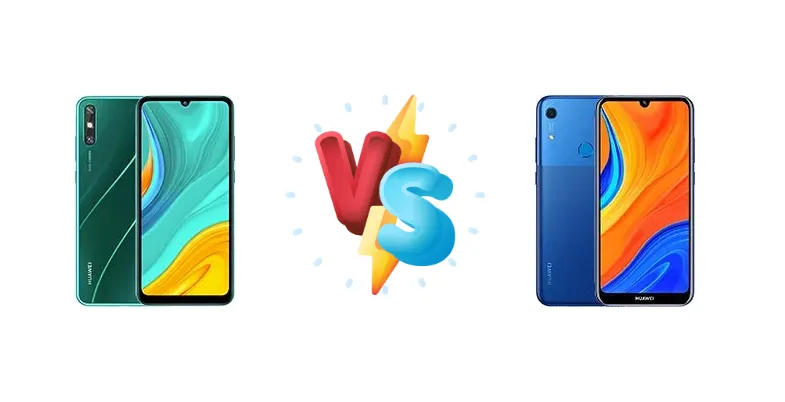
The Huawei Enjoy 10e and Y6s (2019) represent Huawei’s commitment to the entry-level smartphone market. Both devices are powered by the same Mediatek Helio P35 chipset, making this a comparison of incremental differences rather than revolutionary leaps. This review dissects those nuances to determine which phone offers the best value for budget-conscious consumers.
🏆 Quick Verdict
For the average user, the Huawei Enjoy 10e is the slightly better choice. While the difference is minimal, its marginally higher CPU clock speed (2.35 GHz vs 2.3 GHz) translates to a subtly smoother experience in everyday tasks and potentially slightly better multitasking performance. However, the Y6s remains a viable option if found at a significantly lower price.
| Network |
|---|
| 2G bands | GSM 900 / 1800 / 1900 | GSM 850 / 900 / 1800 / 1900 |
| 3G bands | HSDPA 850 / 900 / 2100 | HSDPA 850 / 900 / 1900 / 2100 - JAT-L29, JAT-LX1, JAT-LX1 NFC |
| 4G bands | 1, 3, 5, 8, 38, 40, 41 | 1, 3, 5, 7, 8, 20, 38, 40, 41 - JAT-L29 |
| Speed | HSPA, LTE | HSPA, LTE |
| Technology | GSM / HSPA / LTE | GSM / HSPA / LTE |
| | - | 1, 2, 3, 4, 5, 7, 8, 28, 38, 41 - JAT-LX3 |
| Launch |
|---|
| Announced | 2020, March 01. Released 2020, March | 2020, January 30. Released 2020, May |
| Status | Discontinued | Discontinued |
| Body |
|---|
| Build | - | Glass front, plastic back, plastic frame |
| Dimensions | 159.1 x 74.1 x 9 mm (6.26 x 2.92 x 0.35 in) | 156.3 x 73.5 x 8 mm (6.15 x 2.89 x 0.31 in) |
| SIM | Nano-SIM + Nano-SIM | Nano-SIM + Nano-SIM |
| Weight | 185 g (6.53 oz) | 150 g (5.29 oz) |
| Display |
|---|
| Resolution | 720 x 1600 pixels, 20:9 ratio (~278 ppi density) | 720 x 1560 pixels, 19.5:9 ratio (~282 ppi density) |
| Size | 6.3 inches, 95.8 cm2 (~81.3% screen-to-body ratio) | 6.09 inches, 91.0 cm2 (~79.2% screen-to-body ratio) |
| Type | IPS LCD | IPS LCD |
| Platform |
|---|
| CPU | Octa-core (4x2.35 GHz Cortex-A53 & 4x1.8 GHz Cortex-A53) | Octa-core (4x2.3 GHz Cortex-A53 & 4x1.8 GHz Cortex-A53) |
| Chipset | Mediatek MT6765 Helio P35 (12 nm) | Mediatek MT6765 Helio P35 (12 nm) |
| GPU | PowerVR GE8320 | PowerVR GE8320 |
| OS | Android 10, EMUI 10, no Google Play Services | Android 9.0 (Pie), EMUI 9.1 |
| Memory |
|---|
| Card slot | microSD | microSDXC (dedicated slot) |
| Internal | 64GB 4GB RAM, 128GB 4GB RAM | 32GB 3GB RAM, 64GB 3GB RAM |
| | - | eMMC 5.1 |
| Main Camera |
|---|
| Dual | 13 MP, f/1.8, 27mm (wide), PDAF
Auxiliary lens | - |
| Features | LED flash, HDR, panorama | LED flash, HDR, panorama |
| Single | 8 MP, f/2.0 | 13 MP, f/1.8, PDAF |
| Video | 1080p@30fps | 1080p@30fps |
| Selfie camera |
|---|
| Single | 8 MP, f/2.0 | 8 MP, f/2.0 |
| Video | 1080p@30fps | 1080p@30fps |
| Sound |
|---|
| 3.5mm jack | Yes | Yes |
| 35mm jack | Yes | Yes |
| Loudspeaker | Yes | Yes |
| Comms |
|---|
| Bluetooth | 5.0, A2DP, LE | 4.2, A2DP, LE |
| NFC | No | Yes (JAT-LX1 NFC only) |
| Positioning | GPS, GLONASS, BDS | GPS, GLONASS, BDS |
| Radio | Unspecified | FM Radio, built-in antenna |
| USB | microUSB 2.0, OTG | microUSB 2.0 |
| WLAN | Wi-Fi 802.11 b/g/n | Wi-Fi 802.11 b/g/n, Wi-Fi Direct |
| Features |
|---|
| Sensors | Accelerometer, proximity | Fingerprint (rear-mounted), accelerometer, proximity |
| Battery |
|---|
| Charging | 10W wired | - |
| Type | Li-Po 5000 mAh | Li-Po 3020 mAh |
| Misc |
|---|
| Colors | Pearl White, Emerald Green, Midnight Black | Orchid Blue, Starry Black |
| Models | MED-AL00, MED-AL20, MED-TL00 | JAT-LX3, JAT-L29, JAT-LX1, JAT-L41 |
| Price | About 120 EUR | About 160 EUR |
Huawei Enjoy 10e
- Slightly faster CPU clock speed for improved responsiveness.
- Potential for marginally better multitasking performance.
- Reputable brand with established software support (EMUI).
- Slow 10W charging.
- Likely limited RAM and storage options.
- Camera performance likely average at best.
Huawei Y6s (2019)
- Extremely affordable price point.
- Functional for basic communication tasks.
- Reputable brand with established software support (EMUI).
- Slightly slower CPU clock speed.
- Slow 10W charging.
- Camera performance likely average at best.
Display Comparison
Neither Huawei provides display specifications beyond resolution in their marketing materials. Given their market positioning, both likely utilize IPS LCD panels with similar color accuracy and viewing angles. The absence of high refresh rates or advanced features like HDR is expected. The real-world difference in display quality will likely be negligible, making this a non-factor in the purchasing decision.
Camera Comparison
Detailed camera specifications are unavailable for either device. Given their price point, both likely feature a primary camera paired with a depth sensor. The image processing algorithms employed by Huawei will be the primary determinant of image quality, and are likely to be similar across both models. Expect acceptable results in well-lit conditions, but poor performance in low light. The absence of Optical Image Stabilization (OIS) is a given, and the inclusion of low-resolution auxiliary cameras (often 2MP) adds little practical value.
Performance
Both the Enjoy 10e and Y6s are equipped with the Mediatek MT6765 Helio P35 (12 nm). The core difference lies in the CPU clock speed: the Enjoy 10e boasts a 2.35 GHz clock speed for its four Cortex-A53 cores, while the Y6s operates at 2.3 GHz. This 0.05 GHz difference, while seemingly insignificant, can lead to a small performance advantage for the Enjoy 10e in CPU-bound tasks. The GPU remains identical in both devices, meaning gaming performance will be virtually indistinguishable. Both phones will struggle with demanding titles, but are adequate for casual gaming. RAM configurations are not specified, but are likely to be similar, further minimizing performance gaps.
Battery Life
Battery capacity is not specified for either device. However, both are equipped with 10W wired charging. This slow charging speed means a full charge will take a considerable amount of time – likely exceeding 2.5 hours. Real-world battery life will depend heavily on usage patterns, but the Helio P35’s efficiency suggests both phones should comfortably last a full day with moderate use. The lack of fast charging is a significant drawback for users accustomed to quicker top-ups.
Buying Guide
Buy the Huawei Enjoy 10e if you prioritize a slightly more responsive user experience and anticipate moderate multitasking. It’s ideal for users who frequently switch between apps or engage in light social media browsing. Buy the Huawei Y6s (2019) if you are on an extremely tight budget and primarily need a phone for basic communication – calls, texts, and occasional light web browsing. The Y6s offers a functional experience at the lowest possible price point.
Frequently Asked Questions
❓ Will the Enjoy 10e handle popular apps like WhatsApp and Facebook smoothly?
Yes, the Mediatek Helio P35 chipset is sufficient for running common social media applications like WhatsApp and Facebook without significant lag. However, expect slower loading times compared to phones with more powerful processors.
❓ Can I play PUBG Mobile on either the Enjoy 10e or Y6s?
While technically possible, playing PUBG Mobile on either device will likely be a frustrating experience. The Helio P35 struggles with demanding games, and you'll need to use the lowest graphics settings and accept significant frame rate drops. It's not recommended for serious gaming.
❓ How long will it take to fully charge either phone from 0%?
With only 10W charging support, expect a full charge to take over 2.5 hours, potentially even longer depending on usage during charging. These phones are not designed for quick top-ups.