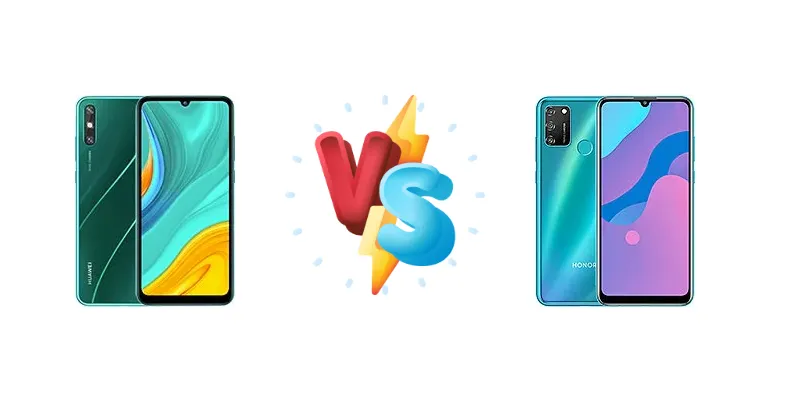
Both the Huawei Enjoy 10e and Honor 9A occupy the ultra-budget smartphone segment, aiming to deliver essential functionality at the lowest possible price. However, despite their similar positioning, key differences in their chipsets and display characteristics create distinct user experiences. This comparison dives deep into these differences to help you determine which device best suits your needs.
🏆 Quick Verdict
For the average user prioritizing responsiveness and smoother multitasking, the Huawei Enjoy 10e is the better choice. Its Mediatek Helio P35 chipset, with higher clock speeds, provides a noticeable performance advantage over the Honor 9A’s Helio P22. While the Honor 9A boasts a brighter display, the performance trade-off is significant.
| Network |
|---|
| 2G bands | GSM 900 / 1800 / 1900 | GSM 850 / 900 / 1800 / 1900 |
| 3G bands | HSDPA 850 / 900 / 2100 | HSDPA 850 / 900 / 1900 / 2100 |
| 4G bands | 1, 3, 5, 8, 38, 40, 41 | 1, 2, 3, 4, 5, 7, 8, 20, 28, 34, 38, 39, 40, 41 |
| Speed | HSPA, LTE | HSPA 42.2/5.76 Mbps, LTE Cat4 150/50 Mbps |
| Technology | GSM / HSPA / LTE | GSM / HSPA / LTE |
| Launch |
|---|
| Announced | 2020, March 01. Released 2020, March | 2020, April 29. Released 2020, May 04 |
| Status | Discontinued | Discontinued |
| Body |
|---|
| Build | - | Glass front, plastic back, plastic frame |
| Dimensions | 159.1 x 74.1 x 9 mm (6.26 x 2.92 x 0.35 in) | 159.1 x 74.1 x 9 mm (6.26 x 2.92 x 0.35 in) |
| SIM | Nano-SIM + Nano-SIM | Nano-SIM + Nano-SIM |
| Weight | 185 g (6.53 oz) | 185 g (6.53 oz) |
| Display |
|---|
| Resolution | 720 x 1600 pixels, 20:9 ratio (~278 ppi density) | 720 x 1600 pixels, 20:9 ratio (~278 ppi density) |
| Size | 6.3 inches, 95.8 cm2 (~81.3% screen-to-body ratio) | 6.3 inches, 95.8 cm2 (~81.3% screen-to-body ratio) |
| Type | IPS LCD | IPS LCD |
| Platform |
|---|
| CPU | Octa-core (4x2.35 GHz Cortex-A53 & 4x1.8 GHz Cortex-A53) | Octa-core (4x2.0 GHz Cortex-A53 & 4x1.5 GHz Cortex-A53) |
| Chipset | Mediatek MT6765 Helio P35 (12 nm) | Mediatek MT6762R Helio P22 (12 nm) |
| GPU | PowerVR GE8320 | PowerVR GE8320 |
| OS | Android 10, EMUI 10, no Google Play Services | Android 10, Magic UI 3.1, no Google Play Services |
| Memory |
|---|
| Card slot | microSD | microSDXC (dedicated slot) |
| Internal | 64GB 4GB RAM, 128GB 4GB RAM | 64GB 3GB RAM |
| | - | eMMC 5.1 |
| Main Camera |
|---|
| Dual | 13 MP, f/1.8, 27mm (wide), PDAF
Auxiliary lens | - |
| Features | LED flash, HDR, panorama | LED flash, HDR, panorama |
| Single | 8 MP, f/2.0 | - |
| Triple | - | 13 MP, f/1.8, (wide), PDAF
5 MP, f/2.2, (ultrawide)
Auxiliary lens |
| Video | 1080p@30fps | 1080p@30fps |
| Selfie camera |
|---|
| Features | - | HDR |
| Single | 8 MP, f/2.0 | 8 MP, f/2.0, (wide) |
| Video | 1080p@30fps | 1080p@30fps |
| Sound |
|---|
| 3.5mm jack | Yes | Yes |
| 35mm jack | Yes | Yes |
| Loudspeaker | Yes | Yes |
| Comms |
|---|
| Bluetooth | 5.0, A2DP, LE | 5.0, A2DP, LE |
| NFC | No | Yes (market/region dependent) |
| Positioning | GPS, GLONASS, BDS | GPS, GLONASS, BDS |
| Radio | Unspecified | FM radio; built-in antenna |
| USB | microUSB 2.0, OTG | microUSB 2.0, OTG |
| WLAN | Wi-Fi 802.11 b/g/n | Wi-Fi 802.11 b/g/n, Wi-Fi Direct |
| Features |
|---|
| Sensors | Accelerometer, proximity | Fingerprint (rear-mounted), accelerometer, proximity |
| Battery |
|---|
| Charging | 10W wired | - |
| Type | Li-Po 5000 mAh | Li-Po 5000 mAh |
| Misc |
|---|
| Colors | Pearl White, Emerald Green, Midnight Black | Black, Blue, Green |
| Models | MED-AL00, MED-AL20, MED-TL00 | MOA-LX9N |
| Price | About 120 EUR | About 150 EUR |
| Tests |
|---|
| Loudspeaker | - |
-26.2 LUFS (Good)
|
Huawei Enjoy 10e
- Faster processor for smoother performance
- Potentially better image processing
- More responsive user interface
- Likely lower display brightness
- Limited camera capabilities
Honor 9A
- Brighter display for outdoor visibility
- Good contrast ratio
- Affordable price point
- Slower processor for demanding tasks
- Less responsive user experience
- Potentially shorter battery life with heavy display use
Display Comparison
The Honor 9A distinguishes itself with a measured peak brightness of 546 nits and a 1583:1 contrast ratio. This translates to better visibility in direct sunlight compared to the Enjoy 10e, which lacks specific display specifications. However, brightness isn't everything. The Enjoy 10e’s display, while likely dimmer, benefits from the faster processor driving the UI, potentially resulting in a smoother visual experience. The absence of detailed display specs for the Enjoy 10e suggests a more basic panel, likely with lower color accuracy and viewing angles.
Camera Comparison
Neither device is expected to excel in photography. Both likely feature basic camera setups geared towards casual snapshots. Without detailed sensor information, it’s difficult to make a definitive comparison. However, the focus should be on the image processing capabilities of the respective chipsets. The P35 in the Enjoy 10e may offer slightly better image processing due to its increased processing power, potentially resulting in sharper images and better dynamic range. It's reasonable to assume both phones will include a standard macro lens of limited utility.
Performance
The core difference lies in the chipsets. The Huawei Enjoy 10e utilizes the Mediatek MT6765 Helio P35, featuring an octa-core CPU clocked up to 2.35 GHz. The Honor 9A, conversely, employs the Mediatek MT6762R Helio P22, with a CPU peaking at 2.0 GHz. While both are 12nm chips, the higher clock speeds of the P35 indicate faster processing capabilities. This translates to quicker app launches, smoother multitasking, and a more responsive overall experience. The P35’s architecture, while still Cortex-A53 based, will handle demanding tasks more efficiently than the P22. Users intending to play even moderately demanding games will find the Enjoy 10e a more suitable option.
Battery Life
Both phones share a similar battery capacity, likely around 3000-4000 mAh (specific capacity not provided). However, the Enjoy 10e’s more efficient chipset, despite its higher clock speeds, could contribute to slightly better battery life during moderate usage. Both devices are limited to 10W wired charging, meaning relatively slow charging times. Expect a full charge to take well over two hours in both cases. The Honor 9A’s brighter display will consume more power, potentially offsetting any gains from a slightly larger battery (if present).
Buying Guide
Buy the Huawei Enjoy 10e if you need a phone for everyday tasks like browsing, social media, and light gaming, and value a more responsive user experience. Buy the Honor 9A if you prioritize outdoor visibility and consume a lot of video content, and are willing to accept slightly slower performance for a brighter screen.
Frequently Asked Questions
❓ Will the Honor 9A struggle with popular apps like Facebook and WhatsApp?
While the Honor 9A can run these apps, the Helio P22 chipset may exhibit noticeable lag when multitasking or switching between apps quickly. Users who frequently use multiple apps simultaneously may find the experience frustrating. The Enjoy 10e’s P35 chipset will handle these tasks more smoothly.
❓ Is the 10W charging on either phone sufficient for daily use?
10W charging is quite slow by modern standards. Both phones will require over two hours to fully charge from 0%. It’s best to charge overnight to ensure you have sufficient battery life for the day. Neither phone supports fast charging technologies.
❓ Can the Huawei Enjoy 10e handle basic mobile games like PUBG Mobile?
The Enjoy 10e can run PUBG Mobile, but you’ll likely need to play on the lowest graphics settings and accept lower frame rates. The Helio P35 is not a gaming powerhouse, and prolonged gaming sessions may result in noticeable performance throttling.