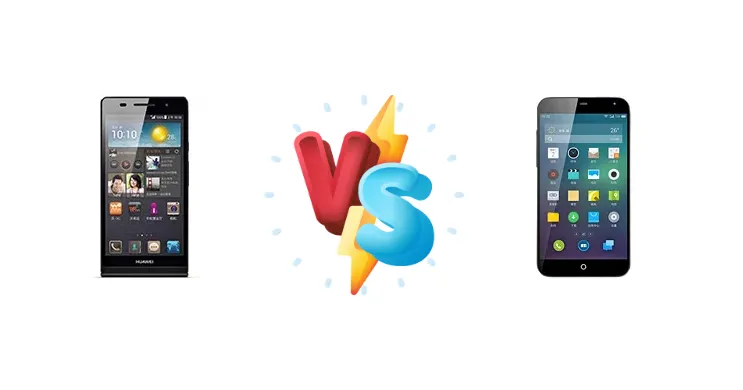
The Huawei Ascend P6 S and Meizu MX3 were both contenders in the mid-range smartphone market, offering compelling features at competitive prices. But which one truly delivered a better experience? This in-depth comparison will break down their strengths and weaknesses to help you decide.
🏆 Quick Verdict
The Meizu MX3 edges out the P6 S thanks to its superior Octa-core processor and impressive battery life. While the P6 S boasts a slimmer profile, the MX3's performance and endurance make it the more well-rounded choice for most users.
| Network |
|---|
| 2G bands | GSM 850 / 900 / 1800 / 1900 - SIM 1 & SIM 2 | GSM 850 / 900 / 1800 / 1900 |
| 3G bands | HSDPA 850 / 900 / 1700 / 1900 / 2100 | HSDPA 850 / 2100 |
| Speed | HSPA 21.1/5.76 Mbps | HSPA |
| Technology | GSM / HSPA | GSM / HSPA |
| Launch |
|---|
| Announced | 2014, January. Released 2014, January | 2013, September. Released 2013, October |
| Status | Discontinued | Discontinued |
| Body |
|---|
| Dimensions | 132.6 x 65.5 x 6.5 mm (5.22 x 2.58 x 0.26 in) | 139 x 71.9 x 9.1 mm (5.47 x 2.83 x 0.36 in) |
| SIM | Dual SIM, (Micro-SIM, dual stand-by) | Micro-SIM |
| Weight | 120 g (4.23 oz) | 143 g (5.04 oz) |
| Display |
|---|
| Protection | Corning Gorilla Glass | Corning Gorilla Glass |
| Resolution | 720 x 1280 pixels, 16:9 ratio (~312 ppi density) | 1080 x 1800 pixels, 5:3 ratio (~412 ppi density) |
| Size | 4.7 inches, 60.9 cm2 (~70.1% screen-to-body ratio) | 5.1 inches, 74.0 cm2 (~74.1% screen-to-body ratio) |
| Type | IPS+ LCD | IPS LCD |
| Platform |
|---|
| CPU | Quad-core 1.6 GHz | Octa-core (4x1.6 GHz Cortex-A15 & 4x1.2 GHz Cortex-A7) |
| Chipset | - | Exynos 5410 Octa (28 nm) |
| GPU | - | PowerVR SGX544MP3 |
| OS | Android 4.2.2 (Jelly Bean), upgradable to 4.4.2 (KitKat), EMUI 2 | Android 4.2 (Jelly Bean), Flyme 3 |
| Memory |
|---|
| Card slot | No | No |
| Internal | 16GB 2GB RAM | 16GB 2GB RAM, 32GB 2GB RAM, 64GB 2GB RAM, 128GB 2GB RAM |
| | - | eMMC 5.0 |
| Main Camera |
|---|
| Features | LED flash, HDR | LED flash |
| Single | 8 MP, AF | 8 MP, f/2.0, 1/3.2", 1.4µm, AF |
| Video | 1080p@30fps | 1080p@30fps |
| Selfie camera |
|---|
| Single | 5 MP | 2 MP |
| Video | 720p | 1080p@30fps |
| Sound |
|---|
| 3.5mm jack | Yes | Yes |
| 35mm jack | Yes | Yes |
| Loudspeaker | Yes | Yes |
| Comms |
|---|
| Bluetooth | 3.0, A2DP, EDR, LE | 4.0, A2DP |
| NFC | No | Yes |
| Positioning | GPS, GLONASS | GPS, GLONASS |
| Radio | FM radio | No |
| USB | microUSB 2.0, OTG | microUSB 2.0 (MHL TV-out), OTG |
| WLAN | Wi-Fi 802.11 b/g/n, Wi-Fi Direct, DLNA | Wi-Fi 802.11 a/b/g/n, dual-band, Wi-Fi Direct |
| Features |
|---|
| Sensors | Accelerometer, gyro, proximity, compass | Accelerometer, gyro, proximity, compass |
| Battery |
|---|
| Music play | - | Up to 40 h |
| Stand-by | Up to 216 h | Up to 429 h (2G) / Up to 393 h (3G) |
| Talk time | Up to 17 h (2G) / Up to 12 h (3G) | Up to 12 h (2G) / Up to 14 h (3G) |
| Type | Li-Po 2000 mAh, non-removable | Li-Po 2400 mAh, non-removable |
| Misc |
|---|
| Colors | Black, White | Black (front panel), several color options (back panel); white |
| Price | About 300 EUR | About 370 EUR |
| Tests |
|---|
| Audio quality | - |
Noise -93.9dB / Crosstalk -93.8dB |
| Battery life | - | Endurance rating 36h |
| Camera | - |
Photo / Video |
| Display | - |
Contrast ratio: 995:1 (nominal) / 1.754:1 (sunlight) |
| Loudspeaker | - |
Voice 67dB / Noise 66dB / Ring 77dB |
Huawei Ascend P6 S
- Extremely slim design
- Decent performance for everyday tasks
- Good build quality
- Less powerful processor
- Smaller screen
- Camera performance potentially lacking compared to competitors
Meizu MX3
- Powerful Octa-core processor
- Excellent battery life
- Larger, immersive display
- Good value for money
- Design less striking than P6 S
- Software experience (Flyme OS) may not appeal to everyone
Display Comparison
Both phones feature similar contrast ratios (995:1 nominal, 1.754:1 sunlight), suggesting comparable outdoor visibility. However, the Meizu MX3's larger screen size (5.5 inches vs P6 S's 4.7 inches) provides a more immersive viewing experience. Color accuracy and panel technology (likely IPS for both) would have been a key differentiator in real-world usage, but detailed reviews are needed for a definitive assessment.
Camera Comparison
Camera specifications are not fully detailed, but both phones featured Photo/Video capabilities. The Meizu MX3 likely had a slight edge in image processing due to its more powerful chipset. Low-light performance and video stabilization would have been key areas of comparison, but detailed reviews are needed.
Performance
The Meizu MX3's Exynos 5410 Octa chipset with its Octa-core processor (4x1.6 GHz Cortex-A15 & 4x1.2 GHz Cortex-A7) significantly outperforms the P6 S's Quad-core 1.6 GHz processor. This translates to smoother multitasking, faster app loading times, and better gaming performance on the MX3.
Battery Life
Both phones are reported to have an endurance rating of 36 hours, indicating excellent battery life. This suggests both devices could easily last a full day or more on a single charge, making battery anxiety a minimal concern.
Buying Guide
The Huawei Ascend P6 S is ideal for users prioritizing a slim and stylish design and are less concerned with raw processing power. The Meizu MX3 is a better fit for those who value performance, long battery life, and a vibrant display, even if it's slightly less sleek.
Frequently Asked Questions
❓ Which phone is thinner?
The Huawei Ascend P6 S is significantly thinner than the Meizu MX3, making it a more pocket-friendly option for those prioritizing a slim design.
❓ Is the Meizu MX3's Flyme OS user-friendly?
Flyme OS is Meizu's custom Android skin. While it offers unique features, its user interface and customization options may differ from stock Android and might not appeal to all users. It's recommended to research Flyme OS reviews before purchasing.