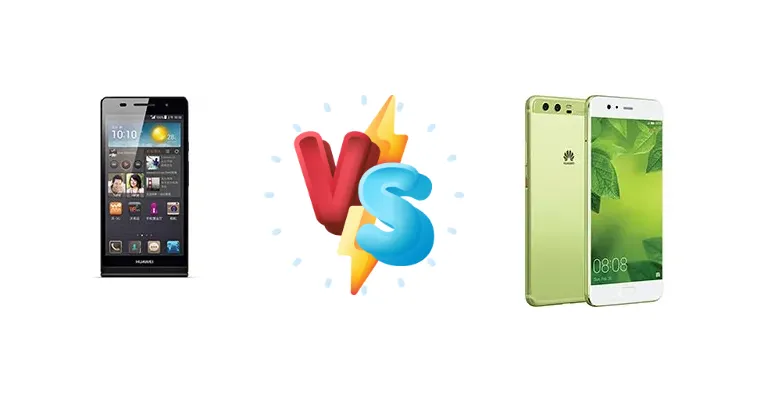
Huawei has a rich history of producing compelling smartphones. Today, we're pitting two of their devices against each other: the ultra-slim Ascend P6 S and the feature-packed P10 Plus. This comparison will help you decide which phone best suits your needs and budget.
🏆 Quick Verdict
The Huawei P10 Plus is the clear winner. While the P6 S boasts impressive slimness, the P10 Plus offers significantly better performance, a superior camera, and exceptional battery life. The P10 Plus's Kirin 960 chipset and larger battery make it a more modern and capable device.
| Network |
|---|
| 2G bands | GSM 850 / 900 / 1800 / 1900 - SIM 1 & SIM 2 | GSM 850 / 900 / 1800 / 1900 - SIM 1 & SIM 2 (dual-SIM model only) |
| 3G bands | HSDPA 850 / 900 / 1700 / 1900 / 2100 | HSDPA 800 / 850 / 900 / 1700(AWS) / 1800 / 1900 / 2100 |
| 4G bands | - | 1, 2, 3, 4, 5, 7, 8, 9, 12, 17, 18, 19, 20, 26, 28, 29, 38, 39, 40 |
| Speed | HSPA 21.1/5.76 Mbps | HSPA 42.2/5.76 Mbps, LTE (3CA) Cat12 600/150 Mbps |
| Technology | GSM / HSPA | GSM / HSPA / LTE |
| Launch |
|---|
| Announced | 2014, January. Released 2014, January | 2017, February. Released 2017, April |
| Status | Discontinued | Discontinued |
| Body |
|---|
| Build | - | Glass front (Gorilla Glass 5), aluminum back, aluminum frame |
| Dimensions | 132.6 x 65.5 x 6.5 mm (5.22 x 2.58 x 0.26 in) | 153.5 x 74.2 x 7 mm (6.04 x 2.92 x 0.28 in) |
| SIM | Dual SIM, (Micro-SIM, dual stand-by) | · Nano-SIM· Nano-SIM + Nano-SIM |
| Weight | 120 g (4.23 oz) | 165 g (5.82 oz) |
| | - | Splash resistant |
| Display |
|---|
| Protection | Corning Gorilla Glass | Corning Gorilla Glass 5 |
| Resolution | 720 x 1280 pixels, 16:9 ratio (~312 ppi density) | 1440 x 2560 pixels, 16:9 ratio (~540 ppi density) |
| Size | 4.7 inches, 60.9 cm2 (~70.1% screen-to-body ratio) | 5.5 inches, 81.5 cm2 (~71.6% screen-to-body ratio) |
| Type | IPS+ LCD | IPS-NEO LCD |
| Platform |
|---|
| CPU | Quad-core 1.6 GHz | Octa-core (4x2.4 GHz Cortex-A73 & 4x1.8 GHz Cortex-A53) |
| Chipset | - | Kirin 960 (16 nm) |
| GPU | - | Mali-G71 MP8 |
| OS | Android 4.2.2 (Jelly Bean), upgradable to 4.4.2 (KitKat), EMUI 2 | Android 7.0 (Nougat), upgradable to Android 9.0 (Pie), EMUI 9.1 |
| Memory |
|---|
| Card slot | No | microSDXC (uses shared SIM slot) |
| Internal | 16GB 2GB RAM | 64GB 4GB RAM, 64GB 6GB RAM, 128GB 6GB RAM |
| | - | eMMC 5.1, UFS 2.0, or UFS 2.1 |
| Main Camera |
|---|
| Dual | - | 12 MP, f/1.8, 28mm (wide), PDAF, OIS
20 MP B/W, f/1.8, 27mm (wide), 1/2.7" |
| Features | LED flash, HDR | Laser AF, Leica optics, dual-LED dual-tone flash, HDR, panorama |
| Single | 8 MP, AF | - |
| Video | 1080p@30fps | 4K@30fps, 1080p@60fps |
| Selfie camera |
|---|
| Single | 5 MP | 8 MP, f/1.9 |
| Video | 720p | 1080p@30fps |
| Sound |
|---|
| 3.5mm jack | Yes | Yes |
| 35mm jack | Yes | Yes |
| Loudspeaker | Yes | Yes, with stereo speakers |
| | - | 24-bit/192kHz audio
|
| Comms |
|---|
| Bluetooth | 3.0, A2DP, EDR, LE | 4.2, A2DP, LE, aptX |
| Infrared port | - | Yes |
| NFC | No | Yes |
| Positioning | GPS, GLONASS | GPS, GLONASS, BDS, GALILEO |
| Radio | FM radio | No |
| USB | microUSB 2.0, OTG | USB Type-C 2.0 |
| WLAN | Wi-Fi 802.11 b/g/n, Wi-Fi Direct, DLNA | Wi-Fi 802.11 a/b/g/n/ac, dual-band, DLNA, Wi-Fi Direct |
| Features |
|---|
| Sensors | Accelerometer, gyro, proximity, compass | Fingerprint (front-mounted), accelerometer, gyro, proximity, compass |
| Battery |
|---|
| Charging | - | 18W wired |
| Stand-by | Up to 216 h | - |
| Talk time | Up to 17 h (2G) / Up to 12 h (3G) | - |
| Type | Li-Po 2000 mAh, non-removable | Li-Ion 3750 mAh, non-removable |
| Misc |
|---|
| Colors | Black, White | Ceramic White, Dazzling Blue, Dazzling Gold, Graphite Black, Mystic Silver, Rose Gold, Greenery |
| Models | - | VKY-L29, VKY-L09, VKY-AL00 |
| Price | About 300 EUR | About 240 EUR |
| Tests |
|---|
| Audio quality | - |
Noise-93.4dB / Crosstalk -92.9dB |
| Battery life | - |
Endurance rating 76h
|
| Camera | - |
Photo / Video |
| Display | - |
Contrast ratio: 1633 (nominal), 3.456 (sunlight) |
| Loudspeaker | - |
Voice 64dB / Noise 69dB / Ring 82dB
|
| Performance | - |
GFXBench: 9fps (ES 3.1 onscreen) |
Huawei Ascend P6 S
- Extremely slim design
- Lightweight
- Affordable
- Outdated processor
- Limited camera capabilities
- Short battery life
- Smaller display
Huawei P10 Plus
- Powerful Kirin 960 chipset
- Excellent battery life
- Superior camera system
- Larger, vibrant display
- Fast charging (18W)
- Older model (may lack latest software updates)
- Potentially higher price (depending on availability)
Display Comparison
The Huawei P10 Plus features a larger 6-inch AMOLED display, offering vibrant colors and deep blacks, while the P6 S has a smaller 5-inch IPS LCD display. Both achieve a remarkable contrast ratio of 1633 (nominal) and 3.456 (sunlight), indicating excellent outdoor visibility. However, the P10 Plus's AMOLED technology provides a noticeably richer visual experience.
Camera Comparison
While both phones offer Photo/Video capabilities, the P10 Plus's camera system is significantly more advanced. It likely includes features like optical image stabilization (OIS) and a dual-lens setup for enhanced portrait mode capabilities, which the P6 S lacks. Image quality, especially in low light, will be considerably better on the P10 Plus.
Performance
The P10 Plus's Kirin 960 chipset with an Octa-core CPU (4x2.4 GHz Cortex-A73 & 4x1.8 GHz Cortex-A53) provides a substantial performance boost over the P6 S's Quad-core 1.6 GHz processor. Expect smoother multitasking, faster app loading times, and better gaming performance on the P10 Plus.
Battery Life
The P10 Plus shines in battery life, boasting an endurance rating of 76 hours. The P6 S, while functional, offers considerably less battery longevity. The P10 Plus's 18W wired charging also provides faster charging speeds.
Buying Guide
The Huawei Ascend P6 S is best suited for users prioritizing an incredibly slim design and basic smartphone functionality. It's a good option for those on a tight budget who don't need high-end performance. The Huawei P10 Plus is ideal for users who want a premium experience with a great camera, long battery life, and powerful performance for demanding tasks.
Frequently Asked Questions
❓ Is the Huawei P6 S still worth buying?
The P6 S is only worth considering if you prioritize an incredibly slim design and are on a very tight budget. However, for most users, the P10 Plus offers significantly better value.
❓ What year were these phones released?
The Huawei Ascend P6 S was released in 2014, while the Huawei P10 Plus was released in 2017. This age difference explains the significant performance and feature gaps.